Cosmos: A Spacetime Odyssey Documentary Review Through an Engineer’s Eyes

A comprehensive personal and academic review of all thirteen episodes of Cosmos: A Spacetime Odyssey, examining Giordano Bruno, Michael Faraday, Carl Sagan, scientific history, and engineering.
Following the History of Science and Human Curiosity
Some documentaries introduce their audience to new facts; others change the way the audience thinks about knowledge itself. For me, Cosmos: A Spacetime Odyssey, presented by Neil deGrasse Tyson, belongs to the second category. What remains with me is not only the imagery of galaxies, stars, planets, and physical laws. The experiences of Giordano Bruno, the scientific dedication of Michael Faraday, and the intellectual legacy of Carl Sagan have left a particularly strong impression.
My education in computer and mechatronics engineering, my postgraduate studies in digital forensics and cybersecurity, and my work in software engineering, artificial intelligence, and signal processing have repeatedly brought me into contact with the practical consequences of scientific principles. The control of an electric motor, the interpretation of digital signals, the extraction of information from images, and the reliable operation of software systems may appear to be unrelated engineering problems. Yet they all depend on observation, measurement, modeling, experimentation, and critical evaluation.
What makes Cosmos meaningful to me is its ability to reveal the intellectual foundations beneath those practices. Scientific laws that appear as compact equations in textbooks are often the results of centuries of disagreement, failed experiments, collective effort, and personal sacrifice.
The thirteen-part series, released in 2014 with important creative contributions from Ann Druyan and Steven Soter, continues the science communication legacy of Carl Sagan’s Cosmos: A Personal Voyage from 1980.
In this review, I examine all thirteen episodes by distinguishing the historical narrative presented by the documentary, the scientific evidence behind that narrative, and the connections that emerge from my engineering background. Appreciating the emotional power of a documentary does not require accepting every historical simplification without criticism.
1. Standing Up in the Milky Way
1.1. The Scale of the Universe
The opening episode carries the audience away from Earth, through the Solar System and our galaxy, toward the large-scale structure of the observable universe.
The Ship of the Imagination is not merely a visual device. It allows the audience to move between distances and times that human intuition cannot easily comprehend.
The Cosmic Calendar compresses approximately 13.8 billion years of cosmic history into a single calendar year. This does not change the underlying chronology; it changes the scale through which the chronology is represented.
In engineering, scale is equally important. The resolution of a measurement, the range in which a mathematical model remains valid, and the chosen time step all influence how a system is understood. The Cosmic Calendar demonstrates the explanatory value of a carefully selected representation.
1.2. Giordano Bruno and the Infinite Universe
Giordano Bruno is one of the historical figures who affects me most deeply in Cosmos.
Born in 1548, Bruno developed a philosophical cosmology that challenged the finite, centrally organized universe of the Aristotelian tradition. Building on the Copernican transformation, he advanced ideas about an infinite universe and innumerable worlds.
His thinking was not equivalent to modern experimental astronomy. His cosmology combined natural philosophy, metaphysics, theology, and arguments concerning the nature of reality.
This distinction matters because Bruno should not be portrayed as someone who had experimentally established all the conclusions of contemporary cosmology. It is equally misleading to describe his prosecution as a simple dispute about whether Earth orbited the Sun.
His trial involved a complex set of philosophical and theological disputes. After prolonged proceedings, he was executed in Rome on 17 February 1600. The Stanford Encyclopedia of Philosophy provides a detailed historical account of these events.
The documentary gives his story a powerful symbolic role in the history of intellectual freedom. For me, that significance remains even when the historical and scientific limitations of his arguments are acknowledged.
The truth or falsity of a proposition must be evaluated through evidence and reasoning. It cannot determine whether a person deserves persecution for expressing it.
What moves me about Bruno is therefore not a belief that every idea he defended was scientifically correct. It is the fundamental question of what happens when institutions seek to prohibit the very act of intellectual inquiry.
1.3. Carl Sagan and Neil deGrasse Tyson
Near the end of the first episode, Tyson describes an encounter with Carl Sagan during his youth.
That personal story illustrates another dimension of scientific progress: knowledge is transferred not only through publications and instruments but also through teaching, encouragement, and human relationships.
Sagan combined scientific curiosity with skepticism, intellectual humility, and an awareness of human responsibility. His approach to public science communication continues through Tyson and the 2014 series.
Preparing academic course notes and technical explanations has made this aspect particularly meaningful to me. Knowledge becomes more valuable when other people can understand, question, verify, and build upon it.
1.4. Cosmic Calendar and Model Scale
The cosmic calendar translates an almost inconceivably long history into a representation that can be compared and calculated. Mapping approximately 13.8 billion years onto one calendar year makes one day roughly 37.8 million years and one second approximately 438 years. These values are approximate scale conversions, contingent on the assumed cosmic age; they do not change physical time.
1 cosmic day ≈ 13.8 billion years / 365 ≈ 37.8 million years
1 cosmic second ≈ 13.8 billion years / (365 × 24 × 3600) ≈ 438 years
To me, this resembles normalization in engineering visualization. Millions of events may be compressed into one timeline, but short intervals become difficult to inspect. The calendar makes time intelligible without independently explaining the duration or sequence of physical processes. That transformation is one reason the opening episode is so affecting.
The narrative about Bruno requires an additional distinction: intellectual courage is not equivalent to having established a physical theory later confirmed by observation. Preserving this distinction does not diminish his tragedy. It makes the human and evidentiary dimensions of scientific history more precise.
2. Some of the Things That Molecules Do
2.1. The Molecular Foundations of Life
The second episode moves from the largest cosmic scales to the molecular processes of life.
DNA, heredity, mutation, natural selection, and common ancestry provide the foundations for understanding biological diversity.
The domestication of wolves and the development of dog breeds provide an accessible example of artificial selection. Human preferences influence which traits are propagated across generations.
Natural selection differs in its conditions and mechanisms, even though both processes involve heritable variation and differences in reproductive success.
The evolution of the eye is another important subject. Complex biological capabilities need not arise in their final form in a single step. Intermediate structures can provide functional advantages and become subject to further evolutionary change.
2.2. Biological Vision and Computer Vision
This episode has a particularly clear connection with my interests in image processing and computer vision.
A camera transforms incoming light into an electrical signal. Sampling and quantization produce digital image data, after which computational methods may estimate edges, texture, motion, depth, or object identity.
Biological vision involves photoreceptors, retinal circuits, the visual cortex, and complex neurological processing. It cannot be reduced to the architecture of a digital camera.
Similarly, an artificial intelligence model that successfully classifies an image does not necessarily perceive or understand the scene in the human sense.
My course material on Image Processing and Computer Vision Engineering addresses the sensor, representation, and learning stages of this engineering problem.
2.3. Evolution and Computational Optimization
Evolutionary algorithms offer another conceptual connection between biology and computation.
Genetic algorithms use representations, selection operators, variation, and fitness criteria to search for solutions. However, biological evolution does not optimize an explicit engineering objective function defined in advance.
Natural inspiration does not imply a literal duplication of biological processes. This boundary is essential when transferring ideas from biology into mathematical algorithms.
2.4. Physical and Computational Layers of Vision
The episode's treatment of biological vision emphasizes that neither biological nor technical vision accesses the external world without mediation. An optical system collects photons and produces measurements of intensity and spectral content. Retinal processing and a digital camera's sampling pipeline are not the same mechanisms, but both transform physical input into representations.
For computer vision, the distinction matters directly. An object label derived from pixels is influenced by illumination, optics, compression, sampling, and the training distribution. High classification accuracy does not establish representation invariance in every environment. Evolutionary adaptation and the explicit objective function of an optimization algorithm are also different kinds of explanation.
What affects me in this episode is the way an apparently ordinary faculty—seeing—joins physics, biology, and computation. Perception cannot be reduced to sensor sensitivity; the limitations of neural and computational interpretation must also be understood.
3. When Knowledge Conquered Fear
3.1. From Omens to Predictable Motion
The third episode follows the transformation of comets from feared celestial signs into objects whose motion can be studied scientifically.
Historically, unfamiliar astronomical phenomena were often interpreted through mythology, political anxiety, or religious expectations.
Systematic observation and mathematical description changed the intellectual status of these events. Rather than assigning supernatural meaning to an appearance in the sky, researchers could attempt to explain and predict it.
Edmond Halley and Isaac Newton occupy central roles in this narrative. Halley recognized relationships among observations of comets and encouraged Newton to publish his mathematical research.
3.2. Newton and Mathematical Modeling
Newtonian mechanics and universal gravitation provided a powerful framework for describing terrestrial and celestial motion using common physical principles.
The ability to predict observations is a defining feature of scientific models. A theory becomes more useful when it can generate consequences that are compared with independently obtained evidence.
This principle has a direct counterpart in mechatronics engineering. Equations of motion, forces, velocities, accelerations, and initial conditions form the foundations of robotics, dynamic simulation, and control systems.
Numerical results depend on more than the governing equations. Time-step selection, numerical stability, model uncertainty, and the quality of initial conditions all influence reliability.
A computational output with many decimal places is not automatically an accurate representation of the physical world.
3.3. Understanding Instead of Fear
I interpret the main achievement described in this episode not as the elimination of all uncertainty, but as the development of reliable methods for investigating it.
Scientific inquiry does not demand certainty before investigation. It provides a disciplined way to improve explanations through observation, mathematics, and critical testing.
3.4. Prediction, Observation, and Numerical Error
Halley's comet prediction demonstrates how observations of the past can yield testable statements about future motion. An orbit computed using Newtonian laws depends on both the initial conditions and the physical model. For me, the episode's account of knowledge overcoming fear rests on this transition: explanations can be inspected and tested rather than accepted as omens.
Engineering prediction requires three distinct checks. Governing equations must be suitable, numerical solutions must be sufficiently accurate, and results must be compared with independent measurements. A small integration step can reduce numerical error without correcting an invalid physical assumption. Conversely, correct equations cannot compensate for uncertainty in initial observations.
Newton's mathematical synthesis and Halley's observational discipline extend to contemporary control and simulation. The episode is memorable because it shows how predictive science turns an unknown event into an examinable problem.
4. A Sky Full of Ghosts
4.1. Observing the Past
The fourth episode explores the finite speed of light and its consequences for astronomical observation.
Looking toward a distant star means receiving information emitted at an earlier time. Increasing distance increases the delay between emission and observation.
The visible universe is therefore not a simultaneous snapshot of every object in space.
The discussion of William Herschel places this insight within the historical development of astronomy.
4.2. Relativity and Gravitational Phenomena
Einsteinian relativity extended the classical understanding of space, time, and gravity. Black holes represent one of the most dramatic subjects associated with gravitational physics.
Scientific visualizations help audiences understand concepts that cannot be experienced directly. They must nevertheless be distinguished from observations and from the mathematical models used to produce them.
A computer-generated image of a black hole is not automatically a direct astronomical photograph.
4.3. Time in Engineering Systems
In real-time software and distributed data systems, timestamps, synchronization, event ordering, and latency measurements are critical.
These engineering problems are not identical to relativistic physics. They nevertheless share a methodological requirement: time must be defined and measured carefully.
An event may have a physical occurrence time, a sensor acquisition time, an application reception time, and a database persistence time.
Confusing these timestamps can lead to incorrect interpretations even when every recorded value is technically valid.
This episode reminds me that observations must always be interpreted together with the conditions under which they were produced.
4.4. Light-Travel Delay and Observational Timestamps
Light-travel delay makes clear that a telescope does not show a distant source in an immediately simultaneous state. This reminds me of the distinction between event time and observation time in data systems. Emission, reception, and processing may each occur at different times. Distance makes the difference physically substantial in astronomy; transmission, buffering, and processing do something analogous in computing systems.
For a simple approximation neglecting cosmic expansion and other propagation effects:
Δt ≈ d / c
c ≈ 299 792 458 m/s
Cosmological redshift, expanding spacetime, and relativistic effects limit this elementary calculation. A light-year is a distance defined by the path light travels in one year, not a unit of time.
The link I draw from the episode to engineering is the need to treat observations as delayed, partial representations. A timestamp alone does not capture every physical circumstance of the underlying event.
5. Hiding in the Light
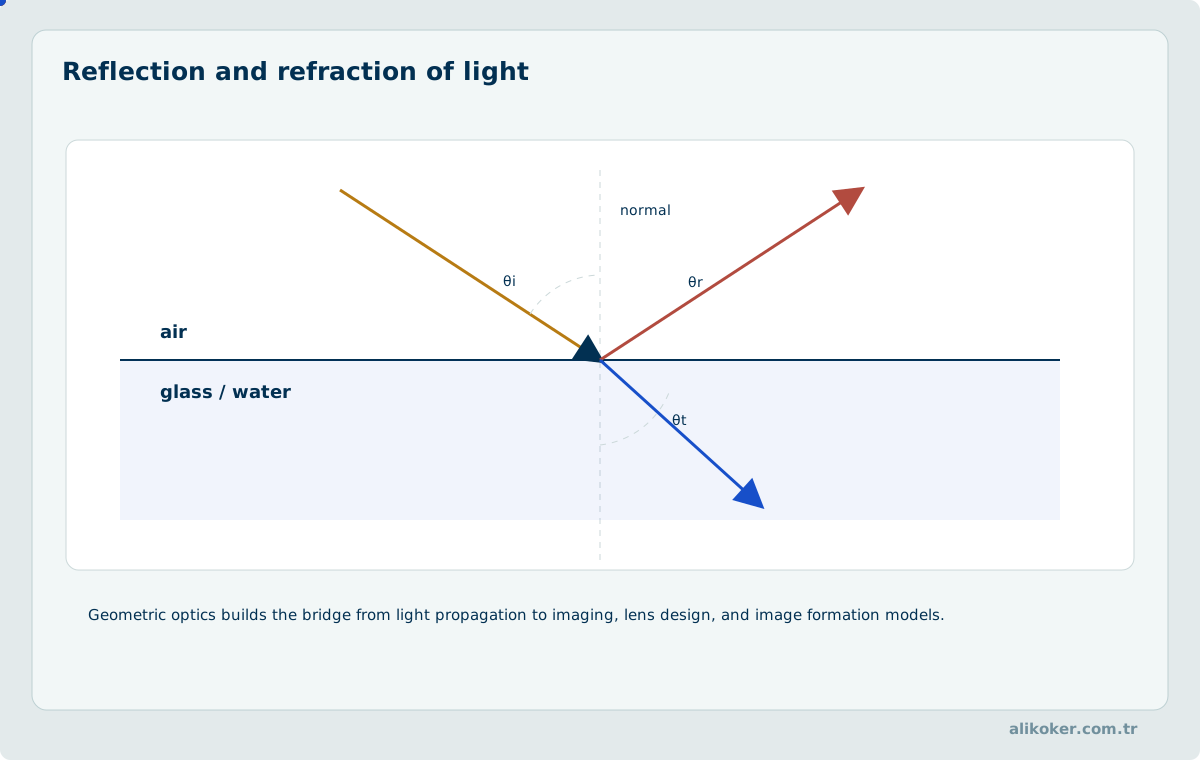
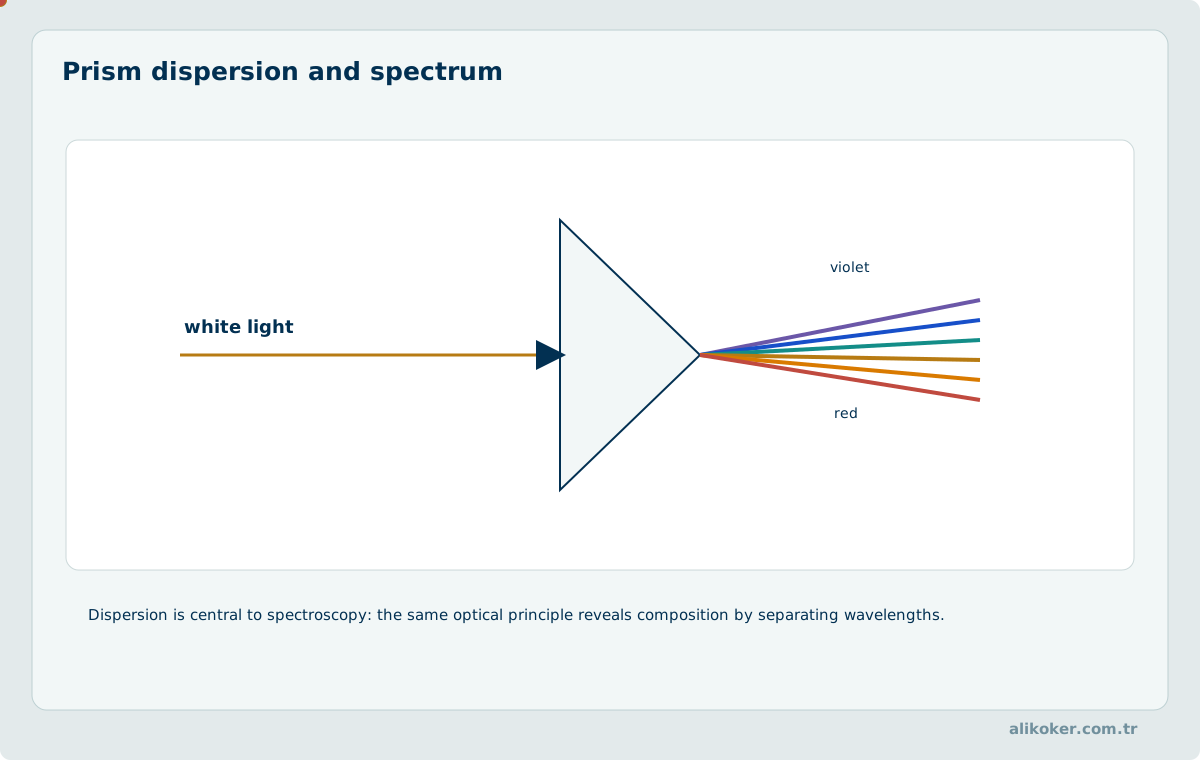
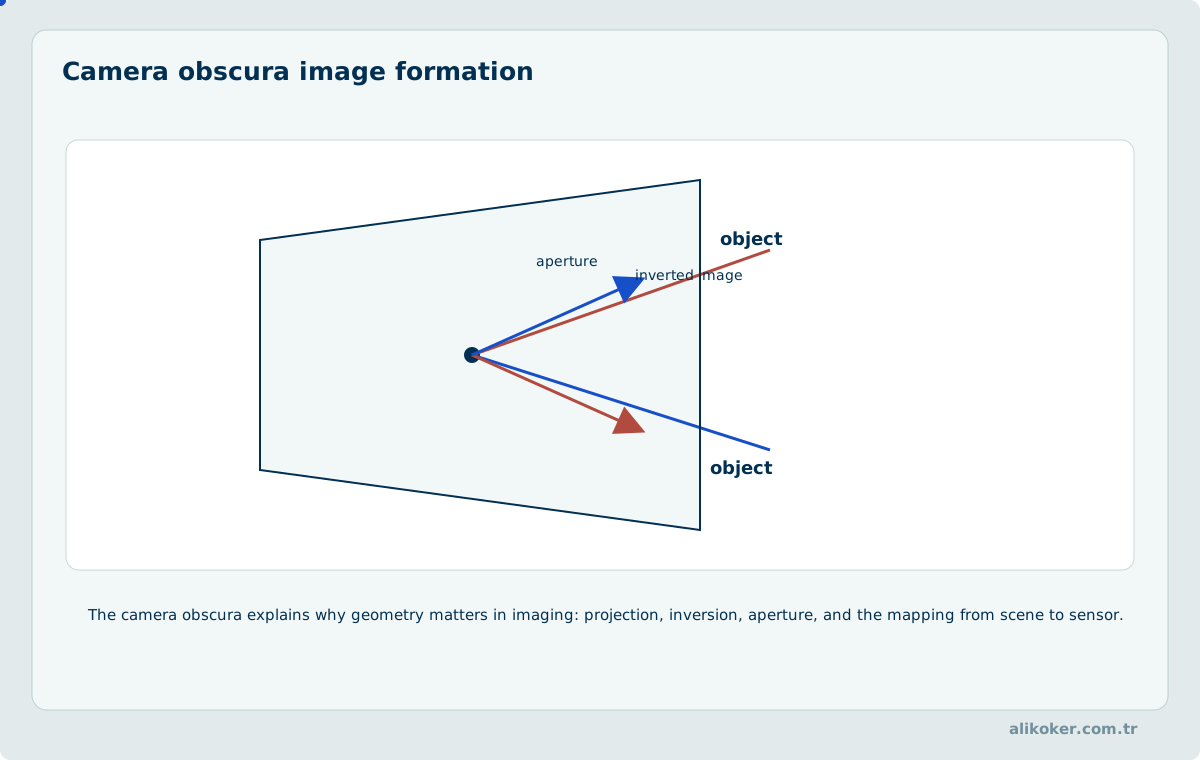
The optics emphasized in this episode are not only historically important; they remain the physical foundation of modern imaging systems.
5.1. Ibn al-Haytham and Experimental Optics
The fifth episode is particularly relevant to my technical interests.
Ibn al-Haytham made major contributions to optics through mathematical reasoning and experimental investigation of light, reflection, and vision.
It would be historically simplistic to claim that he single-handedly invented the modern scientific method. Nevertheless, his systematic use of experiments to investigate hypotheses is a significant contribution to the history of science.
UNESCO documents the mathematical and experimental dimensions of his optical research.
5.2. Herschel, Fraunhofer, and Spectroscopy
William Herschel’s work on infrared radiation revealed that the visible spectrum represents only part of electromagnetic radiation.
Joseph von Fraunhofer’s observations of spectral lines helped establish the importance of information carried by light.
The later development of atomic physics and quantum theory provided deeper explanations of the physical origin of spectral features.
The central idea is that a measured signal can contain information about a source that is not immediately visible in the raw observation.
5.3. Fourier Analysis and Signal Processing
This has a direct mathematical relationship with my work in digital signal processing.
A complex sound waveform may be represented in the frequency domain using Fourier analysis. The discrete Fourier transform and efficient FFT algorithms make spectral analysis practical for sampled data.
Short-time Fourier analysis reveals how the frequency distribution of a signal changes over time. Window size introduces a trade-off between temporal and frequency resolution.
Astronomical spectroscopy and speech signal processing do not involve the same physical mechanisms. Electromagnetic radiation and acoustic pressure waves are different phenomena.
The connection lies in signal representation, transformation, and feature extraction.
My Signal and Systems and Audio Processing and Forensic Audio Engineering course materials explore these mathematical and engineering principles in greater detail.
5.4. Measurement Before Interpretation
An image-processing system does not receive an ideal representation of physical reality.
Illumination, optics, sensor sensitivity, sampling, compression, and processing determine the information available in digital form.
Artificial intelligence models operate on the output of this measurement chain. They cannot reliably reconstruct every detail that was never captured by the sensor.
The lasting lesson I draw from this episode is that the quality and limits of an inference are inseparable from the quality and limits of its measurements.
5.5. Spectral Analysis and the Measurement Chain
Separating light into a spectrum permits inferences about physical properties not directly visible. The episode's presentation of Fraunhofer lines and optical experimentation leads me to a central issue in audio and image processing: a spectrum is not a self-interpreting explanation. The instrument response, sampling procedure, and noise all contribute to what is observed.
An optical spectrometer and a digital FFT are not the same process. One measures a wavelength-dependent distribution of optical energy after physical dispersion; the other transforms samples into discrete frequency components. Both require attention to resolution, dynamic range, and calibration. Identifying an element from a spectral feature depends on line position and formation conditions matching a physical model; one peak does not offer unlimited identification capability.
The episode's visual power rests on the separation between measurement and interpretation. The sampling, signal-to-noise, and feature-extraction concepts treated in Audio Processing and Forensic Audio Engineering and Image Processing and Computer Vision Engineering extend this distinction.
6. Deeper, Deeper, Deeper Still
6.1. The Microscopic Universe
The sixth episode moves through progressively smaller scales, introducing microscopic organisms, molecular processes, and particle physics.
Human perception provides access to only a restricted range of physical phenomena.
Scientific instruments extend that range, allowing effects that cannot be perceived directly to become measurable.
Each instrument, however, introduces limitations in sensitivity, resolution, calibration, and uncertainty.
6.2. Neural Systems and Artificial Neural Networks
The discussion of smell, memory, and neural activity offers an opportunity to compare biological and artificial information processing.
Biological neurons operate within complex electrochemical and physiological systems.
Artificial neural networks use parameterized mathematical operations, loss functions, and optimization procedures.
The historical inspiration is genuine, but the mechanisms are not interchangeable.
My course material on Artificial Neural Networks and Learning Models examines neuron abstractions, backpropagation, learning algorithms, and modern model architectures.
6.3. Indirect Measurement
Neutrino detection illustrates the importance of inferring properties of a phenomenon through its measurable effects.
Many engineering measurements have the same methodological structure. A sensor captures a physical consequence, and the analysis system estimates properties of the underlying source.
In audio, video, and forensic analysis, an inferred score or label should not be mistaken for an independently established physical fact.
The conclusion remains dependent on assumptions, measurement quality, and model validity.
6.4. Resolution and Uncertainty at Microscopic Scales
The microscopic world exposes the difference between directly depicting an object and representing it through instrument-mediated measurements. Different microscopes reveal material structure through different interactions. Diffraction and numerical aperture limit conventional optics, while electron microscopy depends on particle interactions and specimen preparation.
Resolution is not the same as certainty in an interpretation. Noise suppression, computational sharpening, and details reconstructed by a learned model must not be mistaken for additional physical measurements. The episode reminds me why scientific figures need acquisition and processing provenance.
As the series moves beyond ordinary scale, the important engineering question becomes not only what an instrument shows, but what is actually measured, how the representation is derived, and how uncertainty accompanies the result.
7. The Clean Room
7.1. Clair Patterson and the Age of Earth
The seventh episode is one of the strongest demonstrations of experimental reliability in the series.
Clair Patterson investigated the age of Earth using isotope measurements and radiometric dating methods.
His 1956 research reported a value of approximately 4.55 billion years, derived from meteorite and lead-isotope evidence.
The result became an important foundation of the modern scientific understanding of Earth history.
The research was complicated by lead contamination, which affected measurements and required improved experimental conditions.
7.2. Contamination and Digital Forensics
Patterson’s experience has a particularly strong connection with my postgraduate work in digital forensics.
The correctness of a forensic conclusion does not depend exclusively on the mathematical validity of an algorithm.
Acquisition, preservation, parsing, interpretation, and reporting must all be reliable.
In digital investigations, errors can arise from incomplete acquisition, incorrect timestamp conversion, corrupted parsing, changes to evidence, or unsupported interpretations.
Cryptographic hashes can support important integrity checks, but they do not by themselves establish that the original source was correctly identified or that an analyst interpretation is accurate.
My Digital Forensics Engineering course material addresses evidence provenance, chain of custody, validation, and defensible reporting.
7.3. Science and Public Responsibility
Patterson also investigated the effects of lead pollution and became an important figure in debates concerning environmental exposure.
His career demonstrates that scientific findings may carry consequences far beyond the laboratory.
Reliable measurements can inform public health decisions, regulatory discussions, and the evaluation of industrial practices.
What makes this story particularly compelling is the combination of experimental discipline and responsibility for the implications of scientific evidence.
7.4. Reliability as a Process
The main engineering lesson is that trustworthy results require trustworthy processes.
Forensic evidence, laboratory measurements, and critical production systems all benefit from traceability, independent validation, explicit assumptions, and clearly defined failure conditions.
A correct-looking result is not sufficient if the process by which it was obtained cannot be examined.
7.5. Clean Rooms, Blinded Experiments, and Forensic Provenance
Clair Patterson's struggle with lead contamination shows how sound physical reasoning can be undermined by a contaminated measurement. It evokes for me a strong methodological connection between laboratory discipline and provenance in digital forensics. Sample container, environment, operator, instrument, and processing order are not incidental details; they are part of the evidentiary context.
Preventing contamination and avoiding interpretive bias are distinct objectives. A clean laboratory reduces unwanted physical material; blinded interpretation attempts to limit expectation effects. Digital forensic practice deals with related—but not identical—requirements through documented acquisition tools, timestamps, hashes, transformation steps, and validation artifacts.
The episode's lasting lesson is that a scientific finding is not generated by an elegant idea alone. It emerges from a process whose details can be inspected. Even a failed measurement can become useful evidence when the source of failure is identified.
8. Sisters of the Sun
8.1. Annie Jump Cannon and Stellar Classification
The eighth episode explores the contributions of women scientists to astronomy and the development of stellar classification.
Annie Jump Cannon helped transform large collections of stellar observations into a systematic spectral classification framework.
Classification does more than organize data. When its features are scientifically meaningful, it can reveal patterns that support deeper investigation.
This is closely connected with machine learning and large-scale data analysis.
8.2. Cecilia Payne-Gaposchkin
Cecilia Payne’s 1925 doctoral research provided a major advance in the understanding of stellar composition.
Her analysis showed that hydrogen and helium were far more abundant in stars than earlier assumptions suggested.
The findings encountered resistance because they contradicted influential scientific expectations.
Harvard University’s Wolbach Library documents the intellectual and institutional circumstances surrounding her work.
8.3. From Features to Physical Explanations
A classification system and a physical explanation are different levels of knowledge.
Stellar spectra provide observational features. Understanding their relationship to temperature, ionization, and chemical composition requires physical models.
The same principle applies to machine learning. A model may classify observations accurately without providing a sufficient causal explanation of the underlying process.
Performance metrics, feature validity, error analysis, and scientific interpretation must therefore be evaluated separately.
This episode demonstrates how careful data analysis can challenge accepted assumptions and lead to new physical knowledge.
8.4. From Stellar Classification to Physical Models
The transition from Annie Jump Cannon's systematic stellar classification to Cecilia Payne's interpretation of stellar atmospheres illustrates an essential epistemic distinction. Organizing spectra into stable categories makes data comparable, but explaining the physical meaning of those categories requires another theoretical step. Modern machine learning faces a parallel problem when classification performance is mistaken for causal explanation.
A classifier can learn regularities in observed examples without discovering their physical origin. Interpreting spectral lines requires atomic physics and consideration of temperature, ionization, and composition. A category label is not equivalent to a directly measured physical variable.
What I value in the episode is the transition from collecting and ordering information to explaining the mechanisms behind it. That distinction remains central to the evaluation of software analytics and AI systems.
9. The Lost Worlds of Planet Earth
9.1. Geological Evidence and Deep Time
The ninth episode investigates Earth history through geology, oceans, continental movement, and traces of ancient life.
Geological processes often operate on time scales beyond direct human observation.
Reconstructing them requires the combination of different types of evidence, including rock composition, geological structures, fossils, and seafloor measurements.
9.2. Marie Tharp and Ocean Mapping
Marie Tharp’s work on mapping the ocean floor helped reveal major geological structures and contributed evidence relevant to plate tectonics.
The important methodological point is that a map is a representation constructed from measurements.
Coordinates, sampling density, interpolation, and visualization choices influence how the final representation appears.
A reconstructed surface should not be treated as if every point had been measured directly.
9.3. Sensor Fusion and Spatial Reconstruction
Mechatronics and computer vision systems face comparable problems.
Cameras, depth sensors, motion measurements, and positioning information can be combined to reconstruct an environment.
Missing observations, calibration errors, and uncertainty must be distinguished from measured facts.
The episode illustrates that visualization can contribute to scientific discovery while remaining dependent on the quality and limits of the original data.
9.4. Reconstructing the Seafloor from Sparse Observations
Marie Tharp's mapping of the seafloor is moving to me because a vast, otherwise invisible physical structure could be reconstructed from sparse, imperfect observations. Depth measurements follow particular survey tracks. Filling the large gaps between those tracks involves interpolation, sampling density, and assumptions.
Smooth contours on a map do not imply that the underlying surface has been measured with equivalent precision. Sparse observations can conceal abrupt features, and positioning or depth errors from different surveys can distort inferred patterns. Independent new measurements along additional tracks provide essential validation.
This also recalls timelines reconstructed from incomplete forensic records and surfaces inferred from sparse images. Reconstruction does not mean the unobserved region has been directly measured; it expresses a justified relationship between evidence and model.
10. The Electric Boy
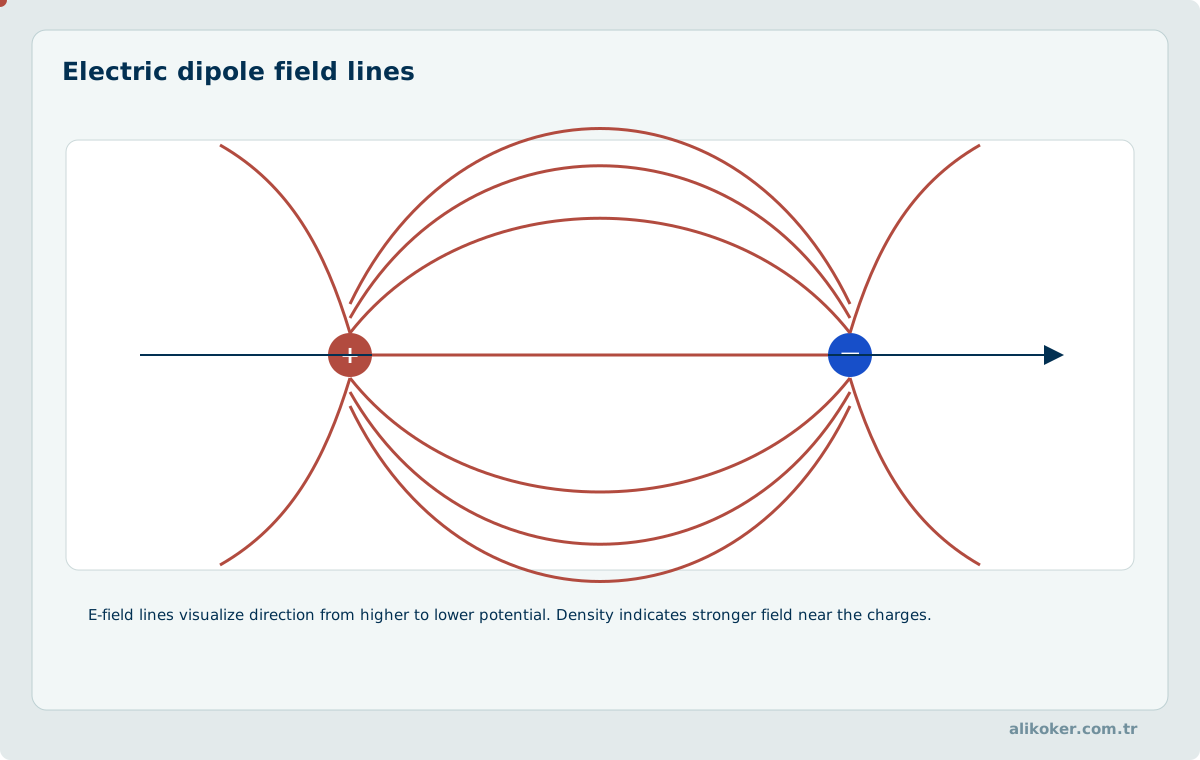
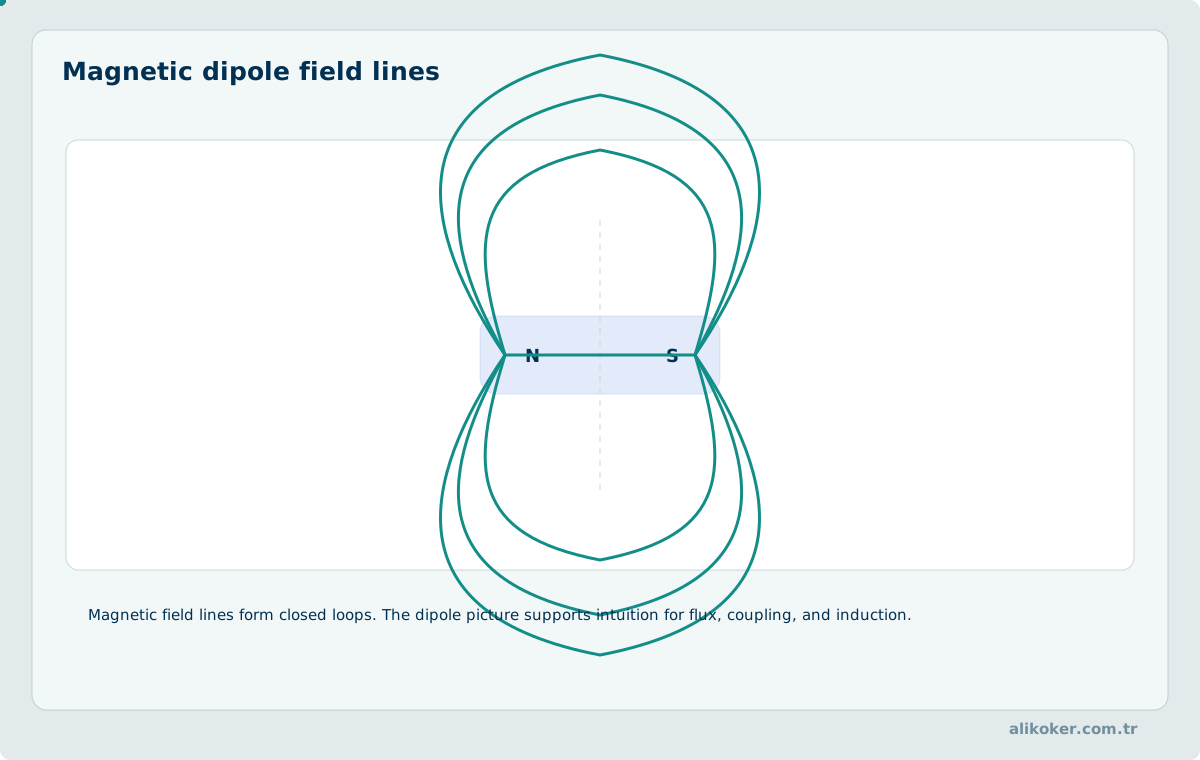
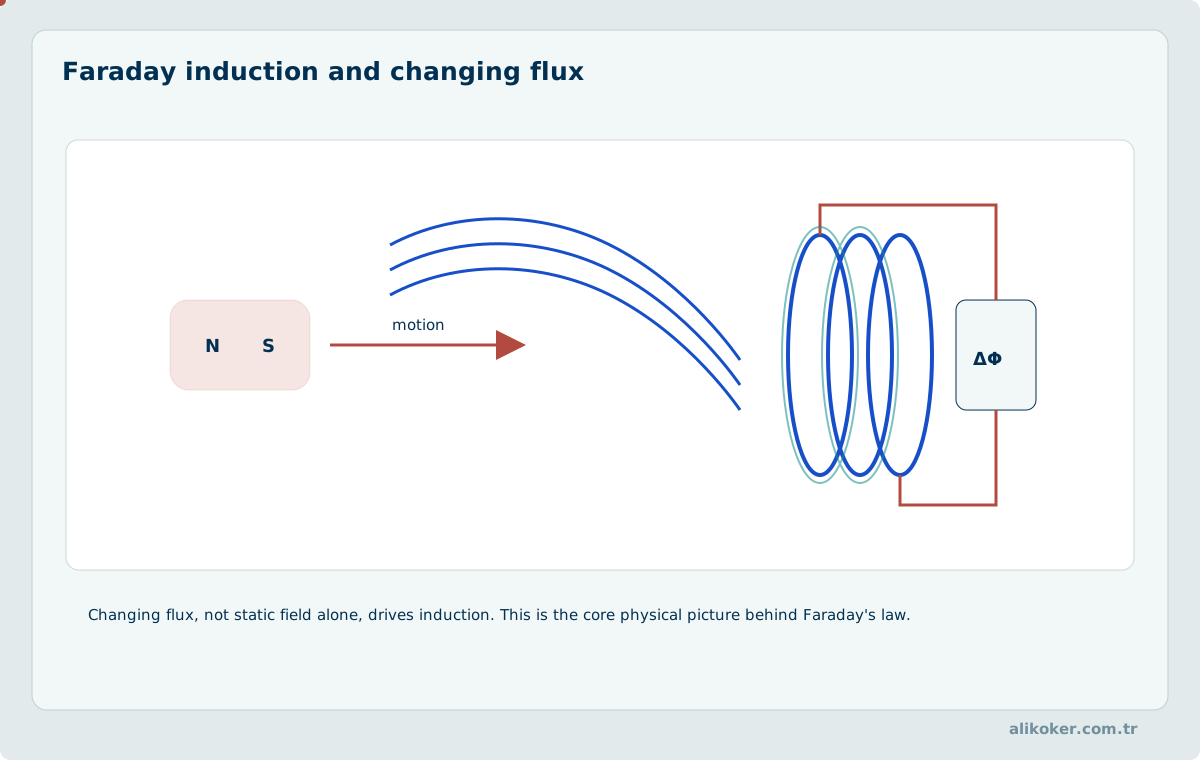
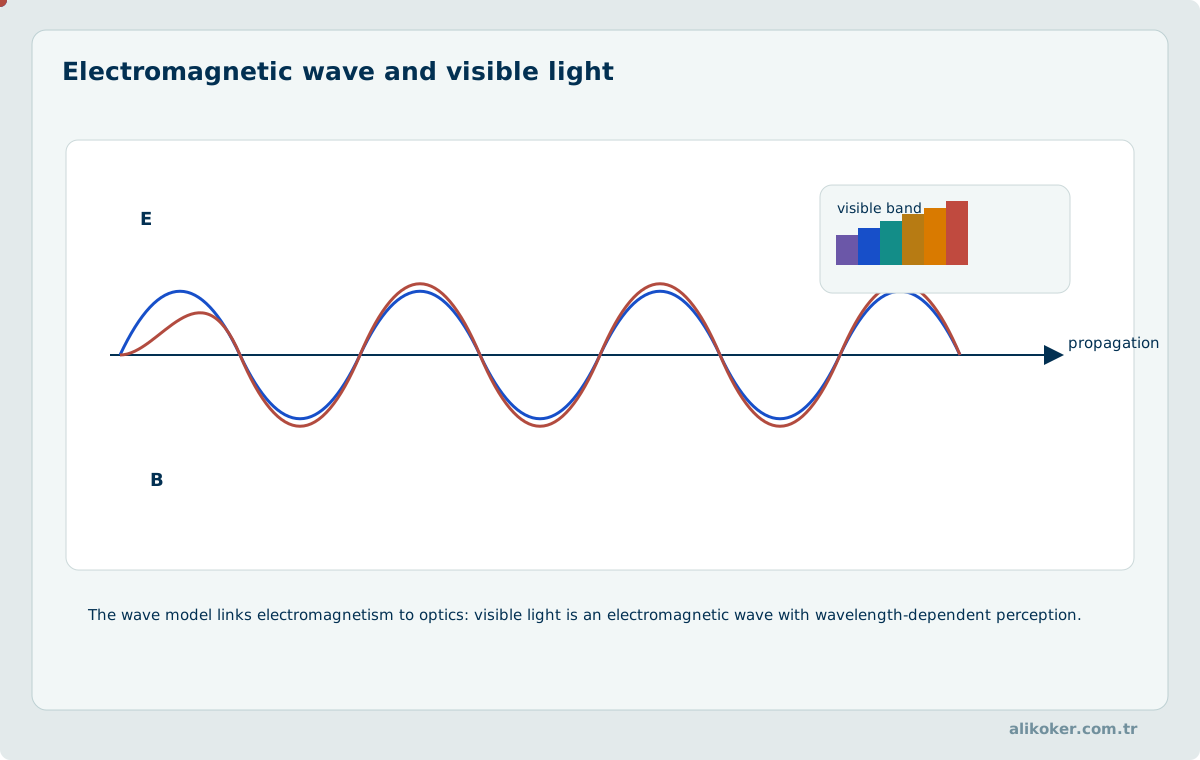
What makes Faraday so compelling is that invisible fields produce measurable and repeatable effects. The visualizations below support exactly that intuition.
10.1. Michael Faraday and Scientific Determination
The tenth episode is the most emotionally significant part of Cosmos for me.
Michael Faraday was born in 1791 and grew up under difficult economic circumstances. During his youth, he worked as a bookbinding apprentice and developed an interest in scientific literature.
His attendance at Humphry Davy’s lectures and subsequent employment at the Royal Institution became decisive stages in his scientific career.
What moves me most is not simply the list of his discoveries. It is the persistence, experimental discipline, and sustained curiosity through which he developed his understanding of physical phenomena.
10.2. The Relationship Between Electricity and Magnetism
Electricity and magnetism had long been investigated as separate phenomena.
In 1820, Hans Christian Ørsted demonstrated the magnetic effect of an electric current through the deflection of a compass needle.
Faraday built on this emerging understanding and explored the interaction of electric currents and magnetic effects.
His electromagnetic rotation experiments in 1821 demonstrated continuous mechanical motion produced through electromagnetic interaction.
These experiments hold a fundamental place in the history of electric motor technology.
For mechatronics engineering, the importance is immediate: the conversion between electrical and mechanical behavior is one of the foundational principles of electromechanical systems.
10.3. The Induction Experiment of 29 August 1831
On 29 August 1831, Faraday performed his celebrated induction-ring experiment.
The original apparatus, preserved by the Royal Institution, used insulated coils wound around an iron ring.
Changing the current in one winding produced a brief electrical effect in another winding.
This demonstrated an essential connection between changing magnetic conditions and induced electrical behavior.
Faraday’s subsequent work helped establish the experimental basis for electromagnetic induction.
A modern mathematical expression of the underlying relationship is:
ε = −dΦB/dtHere, the induced electromotive force is related to the time rate of change of magnetic flux.
The negative sign reflects the directional opposition expressed by Lenz’s law. For an ideal coil with multiple turns, the corresponding expression includes the number of turns.
This equation is a modern representation of the physical relationship, not a claim that Faraday originally wrote his discovery using precisely this notation.
10.4. From Faraday to Maxwell
James Clerk Maxwell developed a mathematical framework that gave Faraday’s field ideas a broader theoretical foundation.
His 1865 paper A Dynamical Theory of the Electromagnetic Field is a major milestone in the mathematical unification of electricity and magnetism.
The theory helped establish the electromagnetic nature of light and the basis for electromagnetic wave propagation.
The progression from Faraday to Maxwell illustrates something I find particularly meaningful in science.
Experimental observation identifies a physical relationship. Mathematical theory generalizes it. Engineering subsequently turns the resulting knowledge into functioning technologies.
10.5. Electric Machines and Modern Engineering
Electric motors, generators, transformers, and electromagnetic sensors rely on physical principles that emerged through the historical development of electromagnetism.
Modern electronic and computational systems are products of a much larger scientific and technological process. It would be inaccurate to present Faraday as the sole inventor of every later electrical technology.
Nevertheless, the influence of electromagnetic research on power systems, communications, electronics, and measurement technologies is profound.
The electrical quantities, inductors, and circuit behavior discussed in my Electronics I and II course material are contemporary engineering expressions of physical relationships investigated during this historical period.
10.6. The Meaning of Faraday’s Experiments in Engineering Education
Faraday’s story reminds me that concepts routinely presented through equations were once unanswered experimental questions.
Engineering education often begins with established mathematical models. Learning how these models emerged provides a deeper understanding of both their meaning and their limitations.
Knowing the governing equations of an electric motor is essential. Understanding the experiments that first revealed relationships between electrical energy and mechanical motion adds a historical and intellectual dimension to that knowledge.
10.7. Experimental Discipline and Lasting Knowledge
Faraday’s scientific legacy rests on careful observation, experimental persistence, and powerful physical intuition.
His story strengthens my belief that engineering should be concerned not only with making a system operate but also with understanding why it operates and under which conditions it may fail.
A working implementation is important. A reliable understanding of its underlying principles is more enduring.
10.8. Faraday Cage: From Electrostatic Experiment to Electromagnetic Shielding
Faraday's life is one of the parts of this documentary that affects me most deeply. The lasting engineering meaning of his experiments with electricity and magnetism extends beyond electromagnetic induction. The electrostatic phenomenon commonly associated with the Faraday cage demonstrates how conductive boundaries redistribute charge under an electric field. I treat it as a modern technical connection to Faraday's experimental legacy, not as a scene necessarily shown in the documentary itself.
Free charges on an ideal conductor redistribute until the electric field within the conductor reaches the electrostatic equilibrium condition. That result must not be stretched to imply zero field everywhere inside a cavity containing its own sources, an enclosure with apertures, or a structure exposed to time-varying fields. Electrostatic shielding and radio-frequency electromagnetic shielding are different boundary-value problems. Conductivity, induced surface currents, skin depth, contact continuity, and aperture dimensions matter at RF frequencies.
∮ E · dA = Q_enclosed / ε₀
δ ≈ √(2 / (2πf μ σ))
SE_E = 20 log₁₀(|E_ref| / |E_shielded|) dB
The first expression is Gauss's law, the second the good-conductor approximation for skin depth, and the third a field-based measure of shielding effectiveness under specified measurement conditions. None provides a universal protection guarantee. Celozzi, Araneo, and Lovat's Electromagnetic Shielding develops the modern field and measurement theories needed beyond Faraday's original experimental intuition.
This is where my education in mechatronics, electrical measurement, and motor control connects with later interests in software and digital forensics. The same underlying physics informs protection of sensitive sensors, assessment of electronic enclosures, and temporary radio isolation of mobile evidence. The theoretical basis belongs in Electronics I and II, circuit coupling in Circuit Theory, evidentiary implications in Digital Forensics Engineering, and layered protection in Cybersecurity Engineering.
10.9. Experimental Continuity from Induction to Field Theory
Faraday's 1831 ring apparatus made the relationship between changing magnetic flux and induced electrical response experimentally visible. In modern notation, the induced electromotive force around an appropriately oriented loop is written:
ℰ = −dΦ_B/dt
Φ_B = ∫ B · dA
The negative sign represents the directional relation expressed by Lenz's law; induction is not attributed simply to the presence of a static magnetic field. A stationary loop in a static field and a loop exposed to changing flux or motion represent different physical circumstances. Maxwell subsequently provided a mathematical synthesis of Faraday's field-based experimental insight, making electromagnetic wave theory possible.
For me, the beauty is how an observable experiment and a more abstract theory reinforce one another. A transformer, generator, or near-field sensor can be analyzed through fields and energy transfer rather than only the motion of a component. Signals and Systems concerns temporal models, while Circuit Theory covers lumped approximations.
10.10. Limits of the Faraday Cage in Digital Forensics and Cybersecurity
My interest in the Faraday cage extends beyond electronics laboratories. In mobile examinations, a shielded bag or enclosure may isolate a device from certain radio links, but it cannot simply be assumed to block every network or preserve the device's internal data unchanged. Attenuation of a radio signal does not demonstrate immutability of memory. The device can continue running, consume power, and create local records.
NIST's mobile-device forensics guidance distinguishes the risks of powering down, entering airplane mode, and using a shielded container. Improper closure and attached cables can undermine isolation. Sound forensic practice therefore does not equate field attenuation with the entirety of evidence integrity.
A related distinction applies to cybersecurity: reducing electromagnetic emissions does not replace encryption or network access control. These limitations do not diminish Faraday's legacy. Instead, they show why his experimental discipline remains necessary. A physical control becomes reliable engineering only when its limits and test conditions are understood.
10.11. Sources and Chronology in Faraday’s Research
A phenomenon later named for a scientist must be distinguished from the original chronology of specific experiments. The 1831 demonstrations of electromagnetic induction and subsequent work on electrostatic shielding were not the same experiment. Volume III of the supplied Experimental Researches in Electricity was published in 1855 and primarily compiles research from 1846–1852. It should not be cited as though it were the direct laboratory account of an electrostatic cage experiment from the 1830s.
What moves me about the documentary is not exhaustive chronology but its portrayal of an experimental way of thinking. Nevertheless, a careful review must avoid retroactively assigning the complete modern theory to Faraday. Quantities such as skin depth and measured shielding effectiveness incorporate later electromagnetic theory and engineering practice.
11. The Immortals
11.1. Biological and Cultural Continuity
The eleventh episode reflects on the persistence of life, inherited biological information, and the future of civilizations.
DNA enables the transmission of hereditary information. Human societies also transmit knowledge through language, writing, education, archives, and technological systems.
These are distinct processes. Their conceptual connection lies in the preservation and transmission of information across time.
11.2. Encoding, Storage, and Error Resistance
In computer engineering, storing information does not guarantee that it will remain understandable.
Data formats, encoding rules, error detection, correction methods, storage durability, and contextual metadata influence long-term usability.
A file whose bits remain intact may still become unreadable if its format or interpretation rules are lost.
This is particularly relevant to digital archives and forensic systems, where provenance and the meaning of stored information must be preserved along with the data itself.
11.3. The Fragility of Civilization
Technological sophistication does not necessarily guarantee long-term survival.
A civilization must not only generate knowledge but also maintain the capacity to preserve, communicate, and use it responsibly.
The episode transforms a scientific discussion into a wider reflection on the future of human societies.
11.4. Genetic Codes, Digital Codes, and Error Correction
Comparisons between biological inheritance and digital information storage are illuminating but must not turn DNA into a literal computer file or mutations into ordinary bit flips. Biological coding participates in gene expression, cellular repair, natural selection, and environmental interactions. Digital communications instead operate with specified symbol alphabets, coding rates, error models, and decoders.
The episode's consideration of continuity reminds me of long-term digital archives. Keeping bits on a storage medium does not guarantee that their meaning will remain intelligible in the future. Format documentation, provenance, encoding standards, and media migration must be maintained together. Sagan's concern for the survival of human knowledge thus meets a practical engineering responsibility.
12. The World Set Free
12.1. Venus and the Greenhouse Effect
The twelfth episode begins with the atmospheric conditions of Venus and proceeds toward Earth climate change.
The dense carbon dioxide atmosphere and extreme surface temperatures of Venus demonstrate the importance of atmospheric processes in planetary energy balance.
Venus and Earth have different atmospheric histories and physical conditions. Venus should therefore not be treated as a simple one-to-one prediction of Earth’s future.
12.2. Feedback and Complex Systems
Climate is a complex physical system involving radiation, atmospheric composition, oceans, ice, clouds, and the carbon cycle.
Feedback mechanisms influence the evolution of the system.
The concept of feedback is familiar from mechatronics and control engineering. However, a climate model should not be reduced to a simple closed-loop control circuit.
The interactions among its variables require models appropriate to their physical scales and mechanisms.
12.3. Observations, Models, and Uncertainty
Climate research combines observations, physical models, and projections under different assumptions.
The existence of uncertainty does not mean that all scientific conclusions are equally uncertain.
Measured trends, model projections, and scenario-dependent outcomes need to be distinguished carefully.
This principle also applies to software and systems engineering, where model validation, sensitivity analysis, and explicit operating assumptions are central to reliable decisions.
The episode emphasizes that scientific responsibility extends beyond mathematical correctness to the social consequences of applying scientific knowledge.
12.4. Feedback and System Boundaries in Climate Models
Venus provides an example of why the long-term behavior of a physical system cannot be explained through a single variable. Radiative balance, absorption, scattering, atmospheric composition, and temperature-dependent feedback interact. Reducing the differences between Earth and Venus to one parameter might simplify narration, but it would produce an incomplete physical model.
A simplified energy-balance model compares incoming and outgoing radiation. Climate models, however, are not static thermostats; they incorporate temporal, spatial, and chemical processes. Validation requires multiple observational records and uncertainty analysis rather than one temperature measurement.
My background in control and systems modeling makes the scale of the feedback question especially meaningful. Feedback is more than a regulator in a circuit: it may reinforce, suppress, or destabilize behavior over different timescales. The episode also gives scientific knowledge an ethical dimension, because measured changes can inform decisions that extend far beyond the model itself.
13. Unafraid of the Dark
13.1. The Limits of Current Knowledge
The final episode explores dark matter, dark energy, and unresolved questions concerning the universe.
These subjects show that scientific progress does not eliminate the frontier of the unknown.
Dark matter and dark energy are inferred through astronomical evidence and theoretical frameworks. They are not ordinary objects observed directly in everyday experience.
The evidence supporting a model and the questions still unanswered by that model must remain distinguishable.
13.2. Voyager and the Golden Record
Voyager 1 and Voyager 2 are remarkable achievements of scientific and engineering cooperation.
Launched in 1977, both spacecraft carry Golden Records containing images, natural sounds, music, and greetings from Earth.
NASA documents 115 images, greetings in 55 languages, and a collection of natural and cultural sounds. The images were encoded in analog form, while the recording system and its cover provide information relevant to playback and interpretation.
The Golden Record is particularly interesting from the perspectives of signal processing and information encoding.
13.3. Communicating Without a Shared Standard
Communicating with a hypothetical extraterrestrial receiver is a problem in which no common language, software platform, or technological convention can be assumed.
The physical carrier, encoding method, playback rate, and interpretation instructions become critical.
A recorded audio signal does not communicate its meaning through waveform data alone. Correct interpretation may depend on sampling, reproduction speed, physical equipment, and context.
The same is true for encoded images, which require information about their representation and geometry.
The Golden Record project raises these engineering problems while also expressing a philosophical commitment to communication beyond immediate human circumstances.
13.4. Carl Sagan and the Pale Blue Dot
On 14 February 1990, Voyager 1 captured the image later known as the Pale Blue Dot.
From a distance of approximately six billion kilometers, Earth appears as a tiny point against the vastness of space.
For me, the importance of this image lies not only in cosmic scale but also in the human responsibility that becomes visible through it.
Sagan’s reflections connect scientific understanding with intellectual humility and concern for the future of humanity.
Recognizing the small physical scale of our planet does not diminish the value of human life. It may instead reveal how much depends on the care with which we treat our shared world.
13.5. Continuing Scientific Curiosity
By the end of Cosmos, darkness has become more than an absence of visible light. It also represents what remains to be discovered.
Bruno’s intellectual courage, Faraday’s experimental persistence, Patterson’s measurement discipline, Payne’s scientific reasoning, and Sagan’s perspective converge on a central principle.
Science is not a declaration that everything is known. It is a disciplined and continually revisable approach to investigating what is not yet understood.
13.6. Physical Encoding of Information on the Voyager Golden Record
The Voyager Golden Record illustrates that preserving information on a physical medium does not ensure that a future receiver can decode it. Interpreting audio or imagery also requires understanding representation rules, timescales, and encoding conventions. Storing a signal and making it interpretable to an audience with no shared cultural or technical context are different design problems.
From a computer science perspective, data, coding, and meaning must be distinguished. Error-free recovery of a bitstream can establish syntactic integrity without guaranteeing that the intended picture, sound, or message will be understood. The same limitation concerns long-term digital preservation.
Considering this alongside Sagan's legacy does not diminish the hope embodied in the record. It makes the attempt to communicate human experience across enormous distances seem more demanding and more remarkable. That combination of curiosity and responsibility is why I return to Cosmos.
14. Evaluating Cosmos as Science Communication
14.1. Narrative Strengths
One of the greatest achievements of Cosmos is its combination of scientific concepts, visual representations, and human stories.
The Cosmic Calendar, the Ship of the Imagination, historical dramatizations, and shifts of scale allow viewers to consider phenomena that lie far outside ordinary experience.
The series also portrays scientists as individuals working within social and historical circumstances rather than merely attaching famous names to discoveries.
14.2. Historical Simplification
Popular science documentaries necessarily compress complex historical developments.
This creates risks. Collective discoveries can appear to be the achievement of one individual, and long intellectual transformations can be presented as isolated moments.
The story of Bruno, the development of experimental science, and the progression from Faraday to modern electrical technologies all benefit from additional historical context.
Recognizing these limitations does not weaken appreciation of the documentary. It provides a more rigorous way to continue the curiosity that the documentary inspires.
14.3. Visualization and Evidence
Scientific visualization can make complex data understandable, but it remains a representation.
Black-hole animations, molecular models, and reconstructions of ancient environments may be based on observations and theoretical models. They should not automatically be mistaken for direct recordings.
In computer vision, digital signal processing, and data visualization, the same principle applies: a compelling image does not establish the reliability of the evidence or methodology behind it.
14.4. Reenactment and Verification in the History of Science
Cosmos uses reenactments to communicate scientific lives with considerable emotional force, but documentary filmmaking necessarily selects and compresses events. A dramatized scene is not itself a substitute for a primary historical record. Bruno's trial, the chronology of Faraday's experiments, and the collaborative character of scientific advances all require this distinction.
Preserving the documentary's impact and grounding historical claims are compatible aims. Understanding what a reenactment simplifies may help viewers appreciate the work more deeply. Dramatic storytelling conveys motivation, while technical and historical sources establish when particular claims and equations are justified.
15. Cosmos Through the Eyes of an Engineer
What makes Cosmos personally significant is the way it reveals the human effort behind established scientific knowledge.
Computer engineering, mechatronics, digital forensics, cybersecurity, artificial intelligence, and signal processing may seem like separate disciplines. In practice, they frequently depend on related forms of scientific reasoning.
Observing a physical phenomenon, measuring data, building a mathematical representation, implementing a computational solution, and validating the outcome are stages that often belong to the same intellectual process.
Faraday’s experiments remind me of the physical foundations of engineering. Patterson’s work illustrates the importance of measurement integrity and defensible evidence. Stellar spectroscopy provides a historical perspective on signal analysis. The Voyager Golden Record raises questions about encoding, interpretation, and long-term preservation.
These connections do not mean that Cosmos is an engineering course. Its value lies in placing technical knowledge within a much broader history of scientific inquiry.
The series also addresses the resistance encountered by new ideas, the difficulties of research, public responsibility, and the questions that remain unanswered.
Bruno’s experiences lead me to reflect on intellectual freedom. Faraday’s career demonstrates the transformative potential of disciplined experimentation. Carl Sagan and Neil deGrasse Tyson illustrate the responsibility of communicating science beyond specialist communities.
15.1. From Faraday’s Experimental Method to Engineering Validation
The strongest connection I draw between Faraday's story and my own engineering work is not one invention or device name. It is the discipline of testing an idea, investigating contradictory results, and making observed behavior explainable. Electromagnetic induction may now fit into a textbook equation, but the equation's validity depends on the physical conditions under which it is used.
The Faraday cage offers a concrete example. Seeing a closed metal box does not establish how much of which field it attenuates, over what frequencies, with what experimental setup, and with what uncertainty. The same applies to software analysis. One correct result, one fast benchmark, or an impressive visualization cannot substitute for measurement, reproducibility, and boundary-condition testing.
For me, Cosmos remains more than a catalogue of scientific accomplishments. Bruno's personal cost, Faraday's experimental persistence, and Sagan's curiosity are distinct yet connected expressions of the responsibility to question and test what we believe. I do not want this review to end like a textbook chapter: what stays with me is the renewed desire to investigate and the enduring sense of responsibility that accompanies scientific knowledge.
Conclusion: Understanding, Questioning, and Discovering
For me, Cosmos: A Spacetime Odyssey is much more than a documentary about the structure of the universe.
Across thirteen episodes, it connects cosmology, biology, optics, electromagnetism, geology, climate science, information, and the history of human inquiry.
The stories that affect me most remain those of Giordano Bruno and Michael Faraday.
In Bruno’s life, I see the importance of intellectual freedom. In Faraday’s experiments, I see the power of persistence, curiosity, and disciplined observation.
Carl Sagan’s legacy and Neil deGrasse Tyson’s narration connect these stories to a larger question: How should humanity understand its position in the universe and the limits of its knowledge?
For me, the enduring value of scientific curiosity does not lie in having final answers to every question. It lies in preserving the freedom, discipline, and courage to continue asking better questions.
References
- American Physical Society. September 4, 1821 and August 29, 1831: Faraday and Electromagnetism. https://www.aps.org/apsnews/2001/08/faraday-electromagnetism
- Celozzi, Salvatore; Araneo, Rodolfo; Lovat, Giampiero. Electromagnetic Shielding. Wiley-IEEE Press, 2008. ISBN 978-0-470-05536-6.
- Druyan, Ann; Soter, Steven. Cosmos: A Spacetime Odyssey. 2014.
- Faraday, Michael. Experimental Researches in Electricity. 1839–1855.
- Faraday, Michael. Experimental Researches in Electricity. Vol. III. Bernard Quaritch, 1855.
- Harvard University, Wolbach Library. Cecilia Payne-Gaposchkin: Education and Doctoral Thesis. https://library.cfa.harvard.edu/cecilia-payne-gaposchkin/education-and-doctoral-thesis
- Maxwell, James Clerk. A Dynamical Theory of the Electromagnetic Field. Philosophical Transactions of the Royal Society of London, 1865. https://doi.org/10.1098/rstl.1865.0008
- NASA. Voyager Golden Record Contents. https://science.nasa.gov/mission/voyager/golden-record-contents/
- NASA/JPL-Caltech. Pale Blue Dot Revisited. https://www.jpl.nasa.gov/images/pia23645-pale-blue-dot-revisited/
- National Institute of Standards and Technology (NIST). Guidelines on Mobile Device Forensics. NIST SP 800-101 Rev. 1, 2014. https://doi.org/10.6028/NIST.SP.800-101r1
- Patterson, Clair C. Age of Meteorites and the Earth. Geochimica et Cosmochimica Acta, 10(4), 230–237, 1956. https://doi.org/10.1016/0016-7037(56)90036-9
- Royal Institution. Michael Faraday (1791–1867). https://www.rigb.org/explore-science/explore/person/michael-faraday-1791-1867
- Royal Institution. Michael Faraday’s Ring-Coil Apparatus. https://www.rigb.org/explore-science/explore/collection/michael-faradays-ring-coil-apparatus
- Sagan, Carl. Cosmos. Random House, 1980.
- Sagan, Carl. Pale Blue Dot: A Vision of the Human Future in Space. Random House, 1994.
- Stanford Encyclopedia of Philosophy. Giordano Bruno. https://plato.stanford.edu/entries/bruno/
- UNESCO. Ibn al-Haytham’s Scientific Method. https://www.unesco.org/en/articles/ibn-al-haythams-scientific-method