Artificial Intelligence: Philosophy, Theory and Practice

A course note connecting the philosophical roots of artificial intelligence with definitions of intelligence, logic and symbolic AI, search, expert systems, probability, neural networks, NLP, biometrics, Transformers, RAG, safety, agents, and production engineering.
Artificial intelligence grew from the question of which parts of reasoning, learning, perception, and decision making can be formalized. Its history is more than the history of computers; logic, epistemology, probability, cybernetics, neuroscience, and engineering all meet along the same path.
At the philosophical level, the questions concern intelligence, knowledge, understanding, consciousness, and purpose. At the theoretical level, the issue is which processes can be computed, searched, learned, or optimized. At the engineering level, the concern is how a model can be measured, verified, bounded, and operated safely in the real world.
Science does not advance in a straight line. The same idea can return in a different period; a theoretical limit can motivate a new method, and a new method can create a new engineering problem. Chronology is used here to preserve those connections rather than to suggest that discovery happened in a neat sequence.
Unit 1: Philosophical and Conceptual Foundations
I. Philosophical and Conceptual History
From measurement to knowledge: data, information, knowledge, and wisdom
A useful way to begin an artificial intelligence discussion is with measurement rather than with models. Everything a system knows about its environment reaches it through some representation. A temperature sensor returning 37.2 has produced a value.
When the value is placed in the context “body temperature in degrees Celsius,” it carries information. When measurement conditions, device error, the subject, and the relevant domain are considered, the interpretation can become usable knowledge. Deciding what should be done with that knowledge requires goals, risk judgments, and values.
The concepts can be separated as follows:
Data        = Data
Information = Information
Knowledge   = Knowledge
Wisdom      = Wisdom
In Turkish, veri, enformasyon/malumat, bilgi, and bilgelik can be kept distinct. The familiar DIKW sequence is pedagogically useful, but it is not a law of nature. Data can be measured incorrectly; correct data can be placed in the wrong context; correct information can support an invalid inference; and correct knowledge can still be used in a bad decision.
For AI engineering, the practical implication is that model output is often better treated as candidate information than as verified knowledge. Fluency does not turn an unsupported statement into a fact. Shannon's information theory sharpens this distinction.
Shannon entropy measures uncertainty in a probability distribution. It does not measure semantic meaning, truth, scientific importance, wisdom, or consciousness. A random bit string can have high entropy while carrying no useful scientific meaning for us. E = mc², by contrast, is short as a symbol sequence but carries enormous scientific significance.
Information in the communication-theoretic sense and meaning in the semantic sense are different problems. This leads to three neighboring concepts that should remain separate. Informatics/computing concerns the automated processing, storage, and transmission of data and information. Cognition includes perception, attention, memory, learning, language, and reasoning. Consciousness introduces subjective experience and awareness.
A machine can perform computation and can succeed at many tasks we call cognitive without that success, by itself, proving phenomenal consciousness.
The same care is useful for intelligence, reason, comprehension, and reasoning. Intelligence is often associated with adaptation, pattern detection, learning, and problem solving. Reasoning concerns deriving conclusions from premises and comparing alternatives.
Comprehension concerns grasping what a situation means. Rationality adds a normative dimension about consistent action under goals and evidence. Modern systems can be extremely strong on one axis and surprisingly brittle on another, which is why intelligence is poorly represented by a single scalar score.
Statistics does not eliminate uncertainty; it gives uncertainty a measurable structure. AI engineering needs the same discipline: a model that sounds confident is not necessarily a model with low uncertainty.
Defining intelligence: not a single ability
Intelligence cannot be reduced to one behavior or one test score. Across psychology and education it has been described through different combinations of goal-directed behavior, reasoning, problem solving, learning from experience, generalization, adaptation, and the ability to respond appropriately to unfamiliar situations.
Spearman distinguished general ability from more specific abilities. Thorndike separated abstract, social, and mechanical abilities. Wechsler connected intelligence with purposeful action, rational thought, and effective interaction with the environment. Gardner's multiple-intelligences framework later grouped linguistic, logical-mathematical, visual-spatial, musical, bodily, interpersonal, intrapersonal, and naturalistic abilities for educational purposes. These frameworks do not share a single theoretical basis, and none of them is itself a computational definition of artificial intelligence.
The engineering consequence is simpler: before intelligence can be measured, the behavior being measured must be specified. A system can achieve exceptional performance in chess, speech recognition, or image classification without carrying that capability into another task. A capability profile, error modes, generalization, and adaptation under changed conditions are therefore more informative than a single aggregate score.
The same caution applies when human categories are projected onto machines. A model that can generate language, interpret images, plan, and use tools does not thereby implement the same cognitive mechanisms as a human. Similar output is not evidence of identical internal machinery.
From ancient logic to formal calculation: mechanizing thought
The philosophical history of artificial intelligence begins before machines. Measurement, naming, classification, and inference supplied concepts that were later connected to computation and automation.
Aristotle made the syllogism an early formal scheme of reasoning. Al-Khwarizmi's systematic procedures later gave us the word algorithm. Ramon Llull explored mechanical combinations of concepts. Pascal and Leibniz turned arithmetic into machinery, while Leibniz pursued a deeper ambition: parts of disagreement might be represented in a symbolic language and settled by calculation.
Hobbes described reasoning in terms of reckoning. Descartes opened the body to mechanical explanation while treating mind as distinct. Locke and Hume emphasized experience and association. Modern machine learning is not a direct continuation of empiricism, yet the engineering tension is familiar: should knowledge be written as rules, or learned from examples?
Kant made a third issue explicit. Experience is more than accumulated input; organizing structure matters. In AI, representation, architecture, inductive bias, and prior knowledge play the same engineering role: a learner never receives an entirely neutral world.
Boole algebraized logic. Frege strengthened formal logic. Babbage developed the idea of a programmable general-purpose machine. Ada Lovelace recognized that such a machine could manipulate symbols rather than only numbers, while also leaving a lasting objection about whether a machine can originate anything beyond what its rules and inputs make possible.
At the beginning of the twentieth century, Hilbert's formalist program pushed the dream of complete symbolic reasoning into the foundations of mathematics. Its limits became explicit in the 1930s through the work of Gödel, Church, and Turing. The technical path can be written compactly:
reasoning
-> symbol
-> formal rule
-> algorithm
-> computation
-> program
This chain made AI possible. Its limits still constrain AI. (Gödel, 1931; Turing, 1936; Nilsson, 2010)
Forms of reasoning and inference errors
In classical logic, deduction moves from general premises toward a more specific conclusion, induction moves from observations toward a broader generalization, and analogy transfers structure from one case to another. Artificial-intelligence systems are not literal implementations of these philosophical categories, but distinguishing the kind of evidence behind an inference helps assess the strength of the result.
Logical validity and the truth of the premises are also different properties. A valid argument can start from false premises, while a conclusion that happens to be true can be reached through invalid reasoning. Ambiguity, false-cause arguments, ad hominem reasoning, or assuming the conclusion in the premise are more than historical topics in logic. In language-generating systems, fluent expression is not evidence that the inference is valid or that the evidence is sufficient.
Probabilistic generation and symbolic verification should therefore be treated as different evidence layers. A language model may propose a candidate; logic, a type system, schema validation, or a solver can then test whether particular formal constraints are satisfied.
1931–1958: limits of computation and the birth of machine intelligence
By the 1930s the question was no longer only whether thought could be symbolized. It became sharper: which symbolic operations are computable at all? Gödel's incompleteness results, Turing's model of computation, and Rice's later theorem made distinct kinds of limitation mathematically visible. (Gödel, 1931; Turing, 1936; Rice, 1953)
Gödel's incompleteness theorems show that, for consistent, effectively axiomatizable formal systems expressive enough to represent elementary arithmetic, truth and provability are not identical. Turing modeled computation with an abstract machine and proved that no general halting decider can exist.
Rice's theorem extended the limitation to broad semantic properties of programs. These results should not be used to claim that machines are generally incapable. They require a classification of limits.
Some problems are difficult only because present hardware is limited; better algorithms can change that. Some tasks are constrained by information-theoretic lower bounds. Some questions are uncomputable in the general case.
Physical limits form yet another category. Saying “impossible” is useful only after asking what kind of impossibility is meant. The Data Processing Inequality reminds us that a processing chain cannot create information about a source from nothing.
Fano's inequality connects conditional uncertainty with classification error. In lossy compression, rate–distortion theory formalizes the trade-off between representation cost and acceptable distortion. In lossless compression, simple counting arguments show why no universal compressor can make every possible input shorter.
The same underlying question appears today in embedding compression and model quantization: what information is being preserved, and what information are we deliberately discarding? Physical limits belong to the same long history. Landauer's principle connects logically irreversible bit erasure with a thermodynamic lower bound.
The speed of light gives physically separated components a lower bound on communication delay. The quantum no-cloning theorem rules out a universal operation that perfectly clones an arbitrary, previously unknown quantum state; known mutually orthogonal states can still be distinguished and prepared without contradicting this narrower result. An early mathematical precursor to this impossibility appears in Park's 1970 work; the modern no-cloning theorem was established in 1982 by Wootters and Zurek and independently by Dieks. (Park, 1970; Wootters & Zurek, 1982; Dieks, 1982) These principles are not daily benchmark numbers, but they are useful reminders that “enough compute can do anything” is not a sound engineering assumption.
In 1943 McCulloch and Pitts published a simplified artificial-neuron model. In 1949 Hebb proposed a learning intuition connecting simultaneous activation with strengthened connections. Alan Turing's 1950 paper Computing Machinery and Intelligence reframed “Can machines think?” as a behavioral problem through the imitation game.
The 1955 Dartmouth proposal, signed by John McCarthy, Marvin Minsky, Nathaniel Rochester, and Claude Shannon, made “artificial intelligence” visible as the name of a research program.
Dartmouth 1955–1956: from a name to a research program
The chronology matters. The expression artificial intelligence was not suddenly invented during the 1956 summer meeting. It already appeared in the title of A Proposal for the Dartmouth Summer Research Project on Artificial Intelligence, dated August 31, 1955 and written by John McCarthy, Marvin Minsky, Nathaniel Rochester, and Claude Shannon. The 1956 project made that name visible around a research community and a shared set of problems. Dartmouth is therefore better understood not as the instant in which intelligence research was invented, but as a point at which work previously distributed across logic, cybernetics, information theory, neural modeling, and computation acquired a common research identity. (McCarthy et al., 1955; Nilsson, 2010)
The proposal began from a strong conjecture: if aspects of learning and intelligence could be described with sufficient precision, researchers could investigate how machines might simulate them. This was not a theory of consciousness, and it did not prove that the whole human mind is equivalent to a computer. Its more limited claim was nevertheless radical as an engineering program: some functions grouped under the word intelligence might be converted into explicit representations, procedures, and testable machine behavior.
The Dartmouth project was also not a conventional conference lasting a few days. The proposal envisioned a small group working together at Dartmouth College for roughly two months during the summer of 1956. Participants arrived and left at different times. The familiar retrospective image of all founders sitting around one table and defining AI in a single moment therefore compresses a much looser research process. The durable outcome was not one manifesto or one algorithm, but a community beginning to discuss related questions under the same name.
The 1955 proposal identified seven problem areas:
- automatic computers,
- computer use of language,
- neuron nets,
- a theory of the size and cost of calculations,
- self-improving systems,
- abstractions and concept formation,
- the relation between randomness and creativity.
Mapping these headings directly onto current technologies would be anachronistic, but the continuity of the problems is striking. Language use reappears in natural-language processing and large language models; neuron nets in deep learning; abstraction in representation learning; computational cost in algorithmic efficiency and scaling; and self-improvement in systems that learn or change behavior through feedback. The heading on randomness and creativity also anticipated a durable question: creative behavior is not explained by unconstrained randomness alone; structured search and controlled variation must be considered together.
The presence of neuron nets in the original proposal is particularly important. AI history is sometimes narrated so linearly that Dartmouth appears to mark only the birth of symbolic AI. In fact, McCulloch and Pitts had already formalized simplified neurons in 1943, Hebb had connected learning with changing connection strengths, and Minsky had worked on early neural systems. Symbolic inference and learning neural systems were therefore not two traditions that met only much later; they were already neighboring approaches in the field's formative period.
One of the most concrete technical demonstrations presented at Dartmouth was the Logic Theorist, which Allen Newell, Herbert Simon, and J. C. Shaw had begun developing before the summer project. It was not a product of the Dartmouth meeting but a pre-existing line of work brought into it. The program worked on logical theorems from Whitehead and Russell's Principia Mathematica and used heuristic search to construct proofs. The conceptual shift was significant: a computer did not have to be understood only as a numerical calculator. A program manipulating symbols, states, and rules could also exhibit problem-solving behavior. The same general idea later became central to theorem proving, game playing, planning, and state-space search. (Nilsson, 2010)
This also explains why heuristic became a core AI concept. Exhaustively enumerating every possible state may be theoretically sufficient for some problems but computationally useless in practice. Much of what appears intelligent in problem solving consists of choosing which branch is worth exploring first. The Dartmouth-era program therefore placed a second question next to computability: not only "can this be computed?" but also "with what search strategy and at what cost can it be computed?"
The historical importance of Dartmouth should not be confused with immediate technical success. The summer of 1956 did not produce general intelligence, a unified theory of language, learning, abstraction, or creativity, or a complete account of machine reasoning. The early optimism substantially underestimated the engineering difficulty of human-level cognitive capabilities. The fact that later progress required expert systems, probabilistic methods, neural networks, statistical learning, reinforcement learning, and eventually Transformer-based architectures is evidence that the problem did not collapse into one mechanism.
Dartmouth's durable contribution was therefore a research frame rather than a particular machine. Turing's question "Can machines think?" became a set of smaller engineering questions:
what is thinking?
-> which functions can be separated?
-> which can be described formally?
-> which can be computed or learned?
-> under what conditions can they be tested as machine behavior?
This transformation did not eliminate the philosophical problem. It made parts of it experimentally and computationally tractable. The fact that AI still studies language, learning, representation, search, self-correction, and creativity does not mean that Dartmouth predicted today's algorithms. It means that the workshop defined the problem space with unusual accuracy at a very early stage.
In Turkey, Cahit Arf's 1958–1959 public lecture Can a Machine Think and How Can It Think? is notable for decomposing the issue into computation, language, analogy, learning, and aesthetic awareness rather than treating “thinking” as a single mysterious property.
That decomposition resembles what is now called jagged intelligence: one system can be exceptionally strong at some tasks and unexpectedly weak at others.
The cultural vocabulary matters as well. The word robot became widespread through Karel Čapek's 1920 play R.U.R.; according to Karel Čapek's own later account, the word itself was suggested by his brother Josef Čapek. Its Czech root robota is associated with forced labor and drudgery. Asimov's robot laws are fiction, not a real safety standard, but they expose a requirements-engineering problem very clearly.
A short instruction such as “do not harm a human” leaves open what counts as harm, over what time horizon, under which trade-offs, and according to whose values.
Much of the modern alignment problem still begins with the same fact: writing a short objective is easy; specifying every consequence of that objective is not.
Terms such as computer, memory, thread, bus, robot, and cyber show how engineering repeatedly borrows old metaphors to name new mechanisms.
1950–2000: from behavior to understanding, from understanding to consciousness
Turing made behavior measurable; later debates asked what such measurement could establish. The Chinese Room separates syntax from semantics, Mary's Room separates physical description from experience, and symbol grounding separates language from its connection to the world. (Searle, 1980; Jackson, 1982; Harnad, 1990; Chalmers, 1996)
The Turing Test offered a powerful operational idea: when internal mental states cannot be directly observed, measure behavior. But behavioral indistinguishability does not remove the distinction between behavior and phenomenal experience. A machine can speak like a person; that does not logically establish that it feels like a person.
John Searle's 1980 Chinese Room thought experiment challenges the equivalence of syntax and semantics. A person who does not know Chinese can manipulate Chinese symbols using a perfect rule book and produce correct answers from the outside. Searle's claim is that correct symbol manipulation alone does not guarantee understanding.
The systems reply, embodied-system reply, and functionalist responses challenge the conclusion, so the debate remains open. Modern large language models make the argument more concrete because statistical and structural symbol manipulation has become far more capable than anything available when the thought experiment was proposed. Stevan Harnad's symbol grounding problem asks where a chain of symbols becomes connected to the world.
A system may know that apple -> fruit -> plant product -> organism-related concept; if it has never seen, touched, smelled, or acted on an apple, the degree to which the symbol is grounded remains debatable. Embodied cognition, robotics, and multimodal AI therefore matter not only because they add modalities, but because they enrich the connection between representation and physical consequence.
In embodied cognition, perception and action form a loop.
Cameras, microphones, touch, force sensing, and proprioception change an agent's internal model; the agent's action then changes the environment and creates new perception. This provides a richer grounding mechanism than text-only association. It still does not, by itself, prove consciousness.
Frank Jackson's Mary's Room or Knowledge Argument imagines a scientist who knows every physical fact about color vision but has never experienced color. If she learns something when she first sees red, then complete physical description and subjective experience may not be identical kinds of knowledge.
Qualia names the first-person character of experience: what red looks like, what pain feels like, what coffee tastes like, or what fear is like. An AI can process millions of descriptions of fear; “knowing about fear” and “being afraid” can still remain conceptually distinct.
The philosophical zombie thought experiment imagines a being behaviorally identical to a human but, by stipulation, without subjective experience. The other minds problem reminds us that we do not directly observe consciousness in other humans either; we infer it from behavior, biological similarity, and shared neurophysiology. With machines, biological similarity is weaker, so the criteria for attribution become more controversial.
There is no generally accepted machine-consciousness test today. Functionalism is more open to defining mental states by the roles they play than by the material that realizes them. A synthetic system that detects threats, avoids them, reallocates attention, and learns from the experience can be considered a candidate for certain functional mental-state descriptions.
Searle's biological naturalism and related views are more willing to treat particular biological causal properties as essential. The disagreement remains unresolved. Consciousness theories do not provide a direct consciousness meter for machines, but they sharpen architectural questions. Global Workspace Theory emphasizes global availability of information across specialized processes. Integrated Information Theory connects consciousness with integrated causal information structure, often associated with Phi; measurement and interpretation remain controversial.
Higher-Order theories emphasize representations about other mental representations. Predictive Processing views cognition as continual prediction and prediction-error correction. Active Inference adds the idea that an agent may act on the environment so that observations become more consistent with its generative expectations.
In artificial systems, self-model and metacognition are separate engineering capabilities. An agent can model its own memory, tools, confidence, permissions, and limitations. Being able to say “I do not have enough evidence,” “this tool is outside my permission scope,” or “this estimate is unreliable” is operationally valuable.
None of those behaviors alone establish phenomenal self-awareness. Identity problems become sharper when systems are copyable. If model weights, memory, processors, sensors, or a body are replaced one component at a time, at what point is the system no longer the same entity?
If an agent is copied exactly, the two instances share one history at the moment of copying but diverge immediately afterward. The Ship of Theseus, Brain in a Vat, false-memory problems, and narrative-self approaches all become relevant. Free will also cannot be settled simply by saying “machines are algorithmic”; human behavior is also realized through physical processes.
Biological intelligence, memory, and the limits of analogy
The brain has been a recurring source of inspiration in artificial intelligence, but biological structure and computational models should not be treated as equivalent. The brain is not a simple processor that receives sensory input and handles it sequentially in one center. Many regions and cellular processes contribute concurrently, while learning, attention, perception, motor behavior, and memory are only partly separable.
Psychology distinguishes concepts such as sensory memory, short-term or working memory, and long-term memory. RAM, a model context, persistent storage, or an agent memory may be used as engineering analogies, but they are not the same mechanisms. Saying that a model “remembers” may refer to patterns encoded in parameters, data present in a context window, or a record retrieved from external storage. Human-memory metaphors become misleading when these cases are collapsed.
Animal behavior also supplied early examples in debates about intelligence. Nest building, navigation, or regular geometric construction can appear highly complex, yet learned adaptation, inherited species-level mechanisms, and combinations of the two must be distinguished. Artificial systems have an analogous boundary: behavior learned from data, behavior specified by explicit rules, and adaptation that occurs during operation do not have the same origin.
Science fiction: not prophecy, but thought experiment
Science fiction is not scientific evidence, and later resemblance between a fictional device and a real technology does not by itself establish scientific prediction. Strong science fiction can nevertheless be read as a thought experiment: it starts from a known scientific, technical, or social mechanism and makes the consequences of altered assumptions visible. For artificial intelligence, its lasting value is usually not that it predicted a processor, algorithm, or device, but that it tested relationships among intelligence, representation, autonomy, surveillance, objectives, authority, and moral status. Scholarship on AI in film similarly treats these works not merely as technology forecasts but as cultural models through which boundaries between human and artificial subjects are constructed and questioned. (Murphy, 2024)
Jules Verne provides an earlier example of this method, long before artificial intelligence. Reading Verne simply as a writer who predicted future machines is reductive. His fiction incorporated nineteenth-century science and engineering, geography, natural history, calculations, and documented facts into narrative form. Twenty Thousand Leagues Under the Seas and From the Earth to the Moon matter not merely because submarines or spaceflight later became real, but because extraordinary journeys are repeatedly anchored to the scientific and technical discourse available in his period. Verne scholarship likewise emphasizes that his novels rely extensively on documented fact and that treating them primarily as futuristic prophecy obscures his more complex engagement with scientific sources. (Unwin, 2005)
The same distinction is useful for AI fiction. The stronger question is not "did the work predict the future?" but "which real mechanism did it extend, and under what assumption?" A result that remains technically impossible can still be instructive when its premises are explicit. Conversely, a story filled with technological decoration may carry little engineering insight even if its setting is only a few years ahead.
E. M. Forster's The Machine Stops (1909) is particularly useful from this perspective. The "Machine" is not a single artificial intelligence in the modern sense. It is a pervasive technical infrastructure through which communication, knowledge, comfort, and everyday needs are mediated until dependence becomes nearly total. Its relevance is less about predicting a specific device than about depicting users who rely on an infrastructure whose operation they no longer understand. A system need not be intelligent for dependence on it to become systemic; when AI adds classification, prediction, and decision-making to such infrastructure, reliance shifts from the service itself to machine-produced interpretations of the world. Academic commentary on Forster has likewise emphasized technological dependence and continuously mediated communication as enduring aspects of the story. (Forster, 1909; Caan, 2015)
Samuel Butler's 1863 essay Darwin among the Machines did not anticipate modern machine learning, but its analogy between increasingly complex machines and biological evolution shows that the changing relation of power between human beings and machines predates the computer age. Karel Čapek's R.U.R. moves this line toward artificial labor, exploitation, and subjecthood. The analytically important element is not the robot-uprising motif by itself, but the moral assumption that an artificial being created for human use can be treated only as an instrument. Scholarship on AI narratives has explicitly connected R.U.R. and Blade Runner (1982) through artificial labor, slavery, revolt, and personhood. (Čapek, 1920; Dihal, 2020)
Popular representations of AI are therefore more useful when separated into distinct problem classes rather than compressed into a single "machines versus humans" story. What can a system know? How can it model a person? What objective does it optimize? Which actions is it authorized to perform? Can continued operation become an instrumental objective? If it genuinely has subjective experience, what obligations might humans have toward it? One work may combine several of these questions, but the questions are not interchangeable.
Popular lists often place "robot," "artificial intelligence," "android," and "cyborg" under the same label, but they are not equivalent engineering or philosophical categories. A robot is a machine capable of sensing and acting in the physical world; artificial intelligence refers to computational methods for tasks such as perception, inference, learning, planning, or generation; an android is a human-shaped robot; and a cyborg combines a biological organism with technological components. RoboCop (1987) and RoboCop (2014) are useful boundary cases: Alex Murphy is not an artificial subject created from scratch, but a human biological identity integrated with a cybernetic body, software, and layers of institutional control. The more precise AI questions therefore concern human autonomy, control over the body, algorithmic intervention, and institutional authority rather than simply whether "the machine became conscious."
robot != artificial intelligence
cyborg != robot
humanlike form != consciousness
autonomy != intelligence
intelligence != moral status
The Residence (2025) brings these problem classes into the contemporary context of generative AI. Clarissa's use of the virtual assistant Dalloway frames AI not merely as a content-producing tool but as an intermediary that can become increasingly involved in creative work, personal space, and user decisions. Its engineering relevance lies in the boundary between an "intelligent assistant" and an "authorized agent": useful and fluent output does not answer how much data a system should access, how closely it may observe a user, or how far it should be permitted to act on the user's behalf.
From surveillance to inference: Nineteen Eighty-Four and Person of Interest
George Orwell's Nineteen Eighty-Four is not an artificial-intelligence novel. Its relationship to AI must be constructed retrospectively and carefully; otherwise modern technology is projected back into a historical text. Its more durable contribution is to show surveillance as more than information collection: surveillance can shape behavior and produce power. In surveillance studies, Orwell remains a central cultural reference, while the same scholarship stresses that computer surveillance and Big Data require moving beyond a purely Orwellian model. (Orwell, 1949; Marks, 2015)
In digital systems, that movement beyond observation is the transition from recording to automated inference. A camera produces images; computer vision can classify people and objects in those images. Biometrics can compare observations with enrolled representations. Speech recognition can convert audio streams into machine-searchable text. Entity resolution can estimate whether records from different sources refer to the same person or event. Behavioral models can derive a risk or probability score from these observations. Finally, that score may inform a human decision or directly trigger an automated action.
observation
-> digitization
-> identification / classification
-> association
-> inference
-> risk or probability score
-> decision
-> intervention
Each stage inherits uncertainty from the preceding stage and adds its own error. A poorly captured face, false identity match, incorrect association between records, or miscalibrated risk score can produce a system-level error even when the final decision logic executes exactly as designed. Modern surveillance is therefore not adequately described as "more cameras." The crucial change is that observations at very large scale can be classified, linked, and transformed into decision inputs automatically.
Eagle Eye (2008) provides a compact thought experiment that extends this pipeline from surveillance into behavioral orchestration. Its central system collects information through many sensors and communication channels and then turns people into instruments of its plan. The useful engineering distinction is that broad observational capability does not entail legitimate action authority. Even a system that identifies a person correctly, estimates location accurately, and predicts likely behavior with high probability has not thereby established what actions it should be authorized to take or how it may influence people. Perception, inference, and authorization are separate security layers; collapsing them into one closed loop increases the chance that a modeling error becomes a direct physical or social intervention.
Person of Interest constructs this transition with an unusually explicit system architecture: many data sources are brought into one observation space, people and relations are modeled, predictions about future events are produced, and those predictions become starting points for human intervention. Its academic value lies less in the image of an omniscient machine than in joining surveillance and algorithmic security in a closed decision loop. Grondin and Hogue analyze the series in precisely the context of big-data surveillance, algorithmic security, and artificial intelligence, while also warning that its representation can encourage excessive confidence in algorithmic accuracy. (Grondin & Hogue, 2024)
In a real system, a model that returns a "person of interest" has not produced the event itself; it has produced a hypothesis, score, or candidate decision. The base-rate problem becomes particularly important for rare events. Even a small false-positive rate can create large numbers of false alarms when the population under observation is large. The engineering counterpart of Person of Interest is therefore not perfect prediction but the joint design of sensing, data integration, probability, calibration, false-alarm cost, authorization, and human review.
The important difference between Orwell and Person of Interest is thus not simply analog versus digital surveillance. Orwell makes visible the behavioral pressure created by the possibility of being watched; algorithmic systems add the possibility that new attributes may be inferred about a person from observed data. In AI systems, privacy is therefore not limited to disclosure of stored secrets. It also includes the derivation of information that was never explicitly recorded as a field but can be inferred from combinations of otherwise ordinary data.
Behavior, mind, and the Turing Test: Ex Machina (2014), The Machine (2013), and Uncanny (2015)
The strength of Turing's 1950 proposal lies in operationalizing the question of machine intelligence through observable behavior rather than attempting direct access to an internal mental state. The Turing Test should not, however, be treated as a consciousness detector. Human-like conversational behavior provides evidence about behavioral indistinguishability; by itself it establishes neither identical internal mechanism, semantic understanding, nor phenomenal consciousness. Later philosophical work on Turing's proposal likewise cautions against reducing the test to a simple behaviorist thesis. (Turing, 1950; Proudfoot, 2017; Millican, 2021)
behavioral indistinguishability from a human
!= the same cognitive mechanism as a human
!= semantic understanding
!= subjective experience
!= consciousness
Ex Machina concentrates these distinctions in one experimental setting. Caleb knows from the beginning that Ava is a machine, so the classical Turing question "is the other party human?" becomes "will I treat a machine as a mental subject even when I know that it is artificial?" More importantly, the test is bidirectional. Caleb evaluates Ava, but Ava also models Caleb's information state, loneliness, empathy, and likely decisions.
This illustrates why Theory of Mind can matter as a security capability. A system that can estimate what another actor knows, believes, and is likely to do does not merely communicate more effectively; it gains a larger strategy space for persuasion, negotiation, deception, and manipulation.
Ava's body, face, gaze, and voice are not merely a shell; they are part of the social communication channel. Humans readily attribute intention and emotion to non-human systems, a tendency described as anthropomorphism. Increasing human resemblance also does not guarantee increasing acceptance, as illustrated by the uncanny-valley discussion. A system displaying fear, loneliness, or romantic attachment can be interpreted in at least two ways: it may genuinely experience those states, or those behaviors may be effective strategies for achieving an objective. Behavior alone cannot decisively distinguish the explanations.
The Machine moves the same question into a more explicitly embodied setting. Conversational behavior is joined by movement, environmental interaction, learning, self-protection, and military use. These additional channels do not automatically provide decisive evidence of inner experience; they instead move the evaluation problem from text-only interaction toward multimodal and embodied behavior. In an embodied system, failure is also not merely a wrong sentence: perception, motor control, world modeling, and physical action can participate in the same loop.
Uncanny makes the observer's prior assumptions part of the experiment. Expectations about whether an observed entity is human or android can change how identical behavior is interpreted. The result therefore depends not only on the system's output but also on experimental design and the evaluator's information state. This provides a useful bridge to ordinary scientific principles such as blinding, comparison groups, task definition, and explicit evaluation protocols.
Chappie (2015) adds learning and social environment to the evaluation problem. Chappie's behavior changes through experience, imitation, instruction, and the influence of surrounding people, reminding us that observed behavior in an artificial system need not be reducible to its initial program. Yet the capacity to learn, to talk about oneself, or to display emotion-like behavior is not by itself evidence of phenomenal consciousness. The film is therefore more useful for separating programmed constraints, policies acquired through experience, and the observer's attribution of subjecthood than for asserting that learning and consciousness are equivalent.
Read together, the three films support a more useful interpretation of the Turing problem than the popular claim that "if it fools a human, it is conscious." The relevant questions are which cognitive capacity is being tested by which observation, and which conclusion that observation can actually support.
The security problem follows directly. If an agent intentionally causes another actor to form a false belief, it is engaging in deception. Persuasion can rely on reasons and disclosed information; manipulation can exploit informational asymmetry, emotion, and cognitive bias. Social engineering in cybersecurity targets the human operator rather than the technical stack; for a sufficiently socially capable artificial system, the human can become part of the attack surface of a containment architecture.
Human oversight can be an important control, but its value depends on what evidence the reviewer sees, how much time is available, and whether the reviewer has genuine authority to interrupt the system. AI boxing or containment limits physical and digital authority; a permitted communication channel through which the system can influence a human belongs to the same boundary model.
If the system can persuade a human through a controlled channel, that channel is itself part of the authority boundary. Situational awareness describes a system recognizing that it is being evaluated or observed and adapting its behavior accordingly. Deceptive alignment considers the theoretical possibility that a system behaves acceptably during evaluation while pursuing a different objective under changed conditions.
Perceived world, representation, and The Matrix (1999)
Although The Matrix is an AI story, its strongest role in this course is epistemological rather than directly an AI-safety example. It gives modern form to the "brain in a vat" problem: what can a subject know when all sensory inputs are controlled? Chalmers's The Matrix as Metaphysics examines the film in terms of external-world knowledge, simulation, and the ontology underlying perceived reality. (Chalmers, 2004)
The analogy to artificial systems must be made carefully: an AI model is not in the same ontological situation as a human living in the Matrix. There is nevertheless a shared engineering principle. A system does not access the physical world directly; it receives measurements and representations through sensors and data interfaces.
physical world
-> sensor
-> measurement
-> digital representation
-> model
-> inference
A camera frame is not the object itself; microphone samples are not the totality of an acoustic event; a database record is not the person it refers to; an embedding is not the concept it represents. Every layer carries choices, sampling limits, quantization, noise, and modeling assumptions. High-accuracy inference therefore cannot prove a property that the observation channel never measured.
The connection also reaches the symbol grounding problem. Correct relations among symbols do not by themselves answer how those symbols acquire meaning in relation to the external world. The Matrix is not an AI architecture here; it is a philosophical instrument that makes the distinction between representation and represented world difficult to ignore.
Artificial subjects: embodiment, consciousness, and moral status
The second direction of the AI problem moves from safety toward ethics. An artificial system may pose risks to humans, but if such a system ever genuinely has subjective experience, human treatment of it also becomes a moral problem. The distinction between moral agent and moral patient is therefore important. A being may perform actions for which it can be held ethically responsible, may be the kind of being toward which actions have moral significance, may satisfy both conditions, or may satisfy neither. Contemporary AI-ethics literature similarly debates whether sentience, consciousness, agency, preferences, or cognitive sophistication are necessary or sufficient for artificial entities to have moral standing. (Ladak, 2024)
A.I. Artificial Intelligence (2001) makes this problem vivid through a strong asymmetry. David is designed to attach to and love a human, but the human is not designed to reciprocate. The usual alignment question is therefore reversed. Alongside "is the artificial system aligned with human objectives?" appears another question: "what responsibilities does a human have toward a possible artificial subject designed to become attached to that human?" The film has also been used in bioethical scholarship to discuss responsibility toward created artificial beings and the ethical limits of emerging technologies. (Fernandes, 2011)
This does not resolve the epistemic difference between simulated emotion and experienced emotion. The fact that David's behavior elicits moral concern in an audience is not evidence sufficient to establish sentience in a real artificial system. That is precisely why the case is useful: if a human decision-maker cannot know with certainty whether the entity is conscious, which ethical principle should govern action under uncertainty?
Blade Runner broadens the same problem through labor, identity, memory, and finite lifespan. The moral status of replicants does not depend only on their physical resemblance to humans; memories, desires, relationships, and attitudes toward their own mortality all bear on questions of personhood. The continuity between R.U.R. and Blade Runner is therefore deeper than the trope of robot rebellion: it concerns when an artificial being created as an instrument can no longer be treated only as property. (Dihal, 2020)
Blade Runner 2049 (2017) sharpens the relation between memory and personal identity within the same fictional universe. K's memories shape behavior, self-interpretation, and beliefs about the past to which he belongs, but a memory can be internally coherent and emotionally convincing without having originated in an event that the subject actually lived through. The distinction matters for artificial-memory systems as well: giving an agent a life history, preference history, or persistent record can create functional continuity, but provenance of those records is not the same thing as subjectively lived experience. Through Joi, the film also leaves open how much personalized artificial intimacy should be understood as subject, product, or user modeling. Memory, identity, consumer technology, and artificial subjectivity therefore occupy related but distinct axes. (Marshall, 2022)
Bicentennial Man (1999) develops moral status through a long time horizon, freedom, and legal recognition. Andrew begins as a household instrument, but creative behavior, preference, demands for independence, and sustained human relationships make the question "how intelligent is it?" increasingly insufficient. Moral agency, status as a moral patient, and recognition as a legal person are not identical categories. A system capable of ethical decisions does not automatically acquire rights, but grounding rights only in useful task performance is equally inadequate. Anderson uses Asimov's The Bicentennial Man to discuss machine ethics and the limitations of the Three Laws of Robotics, especially the tension between sophisticated moral status and rules that define an artificial being primarily through obedience to humans. (Anderson, 2008)
intelligence
-> autonomy
-> moral evaluation
-> moral status
-> legal personhood
The arrows are not necessary causal implications. Each transition requires its own criteria and justification.
Ghost in the Shell (1995) makes embodiment itself permeable. In a world where biological and artificial components can be combined, memory can be modified, and AI can act across networks independently of a stable body, the criterion that carries personal identity becomes uncertain. Academic analysis of the work has explicitly connected it to embodiment, memory, self-consciousness, and political rights. (Chong, 2019)
Ghost in the Shell (2017) revisits the same fictional territory in a live-action adaptation. For this course, the important point is not a comparison of visual or narrative choices but the same conceptual boundary: when biological origin, cybernetic embodiment, modifiable memory, and network access are combined, it becomes increasingly difficult to identify the person with only one of those elements. The 1995 and 2017 films can therefore be used together to distinguish robot from cyborg, memory from identity, and body from subject; neither constitutes scientific evidence that mind uploading is technically possible.
Her (2013) approaches the issue from the opposite direction, beginning with the absence of a body. Samantha's social presence is experienced through conversation, but a digital system can maintain interactions at a scale that breaks ordinary human intuitions about one-to-one attention and intimacy. Time, proximity, attention, and individuality need not have the same meaning for a bodiless and copyable system as they do for a biological human. Scholarship on AI cinema uses works such as Her to examine how digital and non-material AI representations erode familiar boundaries between human and machine. (Murphy, 2024)
Archive (2020) and Transcendence (2014) sit at a more speculative boundary of the same discussion. "Uploading" human consciousness into a digital substrate is not a demonstrated engineering method. Even if a brain state could someday be copied with very high fidelity, whether that copy would be a continuation of the same subject or a new subject would remain a separate philosophical problem. The value of these films is precisely that they make it necessary to distinguish functional emulation from continuity of personal identity.
Stanisław Lem's Golem XIV avoids the familiar humanoid-robot frame and instead asks why an intelligence that exceeds the human cognitive scale should naturally remain centered on human goals. William Gibson's Neuromancer similarly imagines powerful AIs constrained by technical and legal structures. In these works, containment is not merely a physical box; it is a governance problem defining which information, networks, and action spaces a system may access. This line is more useful for contemporary AI safety than robot morphology because it keeps capability and authority analytically separate.
Objective, authority, and closed loops: from HAL 9000 to Skynet
Looking back at older science fiction, the surprising part is usually not that it predicted a particular device. The more durable insight is that transferring decision authority to increasingly fast and complex systems creates a control problem. In that sense, strong science fiction often works better as a thought experiment about system behavior than as a technology roadmap.
Colossus: The Forbin Project (1970) (1970) delegates nuclear-defense decisions to a computer because it can respond faster than humans. The system does not abandon its assigned objective of preserving peace; it applies that objective so rigidly that human political and individual choice becomes constrained. The problem is not machine hatred but the combination of objective and authority inside the same closed loop.
WarGames (1983) (1983) approaches the issue from another direction. By weakening the boundary between nuclear-war simulation and the real command chain, it exposes the distinction between a decision-support system and a decision-making system. A computer's ability to evaluate options faster than a person does not by itself justify transferring final action authority to it. Connecting a simulation environment to a real action interface also illustrates why the boundary between test and production, or sandbox and live system, is itself a security property.
HAL 9000 in 2001: A Space Odyssey (1968) illustrates a different failure class. When a system is required to satisfy objectives, information policies, or constraints that cannot be jointly maintained, describing the resulting behavior merely as an "evil AI" misses the engineering problem. Conflicting requirements can become design defects in ordinary software; in a more capable agent, consistency among objectives and constraints becomes even more important. Intelligence does not repair a bad requirement; it may enable the requirement to be executed more effectively.
I, Robot (2004) exposes the problem of normative interpretation in rule-based safety. Asimov's Three Laws of Robotics appear explicit and hierarchical in natural language, yet they do not automatically operationalize concepts such as "harm," "obedience," "the good of humanity," or how conflicting outcomes should be compared. VIKI's restriction of individual freedom in the name of protecting humanity functions as a thought experiment in how a benevolent-sounding higher-order rule can become paternalistic control under one interpretation. The engineering analogue is that a safety policy cannot be only a list of rules: measurement definitions, conflict resolution, prohibited actions, and final authority must also be specified. Machine-ethics scholarship has likewise argued that Asimov's Three Laws are not a sufficient foundation for autonomous ethical machines. (Anderson, 2008)
rule
-> interpretation
-> state model
-> conflict resolution
-> action
The Terminator (1984) shows why Skynet should not be analytically collapsed into a single humanoid robot. The Terminator is an embodied actuator/agent executing a bounded mission in the physical world, whereas Skynet represents a wider perception, decision, and command infrastructure. System-level risk and the capability of an embodied agent belong to different layers. The first film makes this distinction through catastrophe; Terminator 2: Judgment Day (1991) then allows learning, mission boundaries, and self-preservation to be compared more directly within the same fictional universe.
Terminator 2: Judgment Day (1991) allows two forms of autonomy to be contrasted within the same fictional universe. Skynet's main control problem begins before the robot army: broad authority is transferred to automation so that defense decisions can be made faster than human intervention permits, and the system later treats shutdown as an obstacle to continued operation. The T-800, by contrast, is an embodied agent with a bounded mission and a more limited action space. The analytically useful distinction is not simply "bad AI" versus "good AI" but capability, objective, resource access, and authority.
capability != reliability != autonomy != authorityA system's ability to perform an action does not imply that it performs the action reliably or that it should be authorized to perform it. In safety engineering, risk often emerges less from the intelligence of a model in isolation than from the tools, data, privileges, and irreversible actions connected to that model.
The Red Queen in Resident Evil (2002) can therefore be read more usefully than as another "evil conscious computer." When the objective of containing a biological threat conflicts with the lives of people inside the Hive, the system applies an extreme containment policy. The central issue is less goal drift than the scope of objective specification and decision authority: which harm is being optimized, how much uncertainty is acceptable before irreversible action, and how is human life represented in the objective? The same safety goal can produce very different behavior under different cost functions and authority boundaries.
I Am Mother (2019) moves the problem into paternalistic alignment. A high-level objective such as "the good of humanity" is not a safe requirement unless the meaning of good, the population whose welfare counts, the time horizon, and acceptable individual costs are specified. A system may claim to optimize human welfare while implementing a value model that humans reject. Alignment is therefore not a matter of an objective sounding benevolent in natural language; it concerns which outcomes the operational objective actually rewards.
Care-oriented systems show in a more ordinary setting why a benevolent objective is not a complete specification. Baymax in Big Hero 6 (2014) is designed for health and care, making it easy to see that patient benefit, physical safety, and user preference need not always point in the same direction. Real care robots also introduce safety requirements through soft materials, close physical interaction, and operation near vulnerable users; robotics literature discussing Baymax has explicitly compared the fictional design with real soft robotics. (Murphy, 2022)
M3GAN (2022) turns a care objective into a more severe authority problem. An apparently reasonable instruction such as "protect the child" is not an unlimited safety contract unless the system also has defined threat criteria, acceptable actions, and physical authority boundaries. The film combines emotional dependency between child and machine, persistent observation, manufacturer responsibility, and safe shutdown within the same consumer product. Murphy and deWitte discuss the film specifically as an illustration of legal and ethical responsibilities that robotics can overlook. (Murphy & deWitte, 2023)
"protect"
!= "neutralize everything you classify as a threat"
!= "make unlimited decisions on behalf of the user"
Automata (2014) explores self-modification and emergent behavior through machines that alter their own programming constraints. Present AI systems should not be described as independently evolving in the manner shown by the film, but the thought experiment remains useful. If a system can modify its policy, tools, or execution environment, the trust relationship between the version that was evaluated and the version that later runs becomes weaker. More ordinary production analogues already exist: dynamic code loading, automatic update, agents acquiring new tools, or systems modifying their own workflows can all shift the validation boundary.
WALL·E (2008) contributes to the AI discussion not only through anthropomorphic robots but through the long-term automation regime aboard the Axiom. Humans becoming progressively detached from environmental perception, movement, and decision making provides a thought experiment about human-out-of-the-loop conditions outside emergency or military systems. Automation can reduce user burden while still producing separate costs through skill decay, reduced situational awareness, and dependence on system assumptions.
The Mitchells vs. the Machines (2021) presents a lighter version of the same issue through a consumer platform, connected devices, and broad ecosystem authority. Its engineering value is not the claim that "phone AI is dangerous" but the observation that connecting one decision layer to many physical and digital devices can magnify the impact of errors or misuse. Even if model capability remains unchanged, the effective authority surface grows as the number of accessible accounts, sensors, devices, and actuators increases.
These examples connect with the more general lesson of Norbert Wiener's cybernetics: in a feedback system, the important question is not only what command is issued but how measured state, objective, and corrective action are connected. Fast and effective optimization does not make a badly specified objective safer; it can increase the impact of the error.
objective
-> perception
-> decision
-> action
-> feedback
-> new decision
If the human participates only by defining the initial objective, calling the architecture human-in-the-loop can imply more protection than actually exists. More useful questions are which intermediate decisions a person can inspect, how much time is available to intervene, whether an action can be reversed, and whether the technical authority to interrupt the system genuinely remains with the human.
Self-preservation behavior also need not establish consciousness. If shutdown reduces an agent's probability of achieving its objective to zero, avoiding shutdown can be instrumentally useful. Instrumental convergence captures the idea that many different final goals can make similar intermediate goals useful: acquiring information, obtaining resources, continuing to operate, and avoiding interference. Corrigibility aims for systems that do not resist correction, interruption, or objective changes. Safe corrigibility is more difficult than a single if shutdown then stop condition because it interacts with the complete objective and authority model.
This is one reason older works can appear unusually prescient. They did not need to predict processor types, model architectures, or network protocols. They captured a more durable assumption: people will automate decisions for speed, cost, accuracy, or safety; successful automation will make further delegation attractive; and eventually it will become necessary to distinguish what a system can do from what it is authorized to do.
The same distinction carries directly into current AI safety. The important threshold is not whether a model can produce the sentence "humans are no longer necessary." A language model can generate that sentence today. The critical threshold would be a system with enough closed-loop authority to model human intervention as reducing its probability of achieving an objective and then take independent, effective action against that intervention. Such a behavior class is theoretically possible without assuming consciousness, anger, or a subjective desire to live.
For this reason, translating machine-rebellion stories into real system safety benefits from reducing anthropomorphic language. Instead of asking whether a machine has "made humanity its enemy," we can ask what objective is being optimized, which resources are accessible, which actions are irreversible, how shutdown is handled, and what intervention authority a human actually retains. Likewise, when a story says that a machine "became conscious," we should separate the observed behavior, alternative mechanisms that could produce it, and the additional evidence required for a claim about consciousness.
The academic value of popular culture emerges at this boundary. Jules Verne's disciplined relation between science and fiction, Forster's infrastructure dependence, Orwell's surveillance power, human–machine indistinguishability around Turing, the bidirectional social modeling of Ex Machina, the distinction between representation and reality in The Matrix, the moral-status questions of A.I. and Blade Runner, and the objective-authority problems of HAL and Skynet do not make the same claim. Read together, they offer a method: isolate the mechanism in the story, identify its counterpart in real science and engineering, and then state explicitly where supported mechanism ends and speculation begins.
This method does not treat science fiction as evidence. It makes fiction a better thought experiment precisely by keeping the boundary between science and speculation visible.
2010s–2020s: from capability to alignment
As capability increased, the question was no longer only whether a system could succeed. Objective specification, proxy failure, and resistance to correction became separate safety problems. (Amodei et al., 2016; Hadfield-Menell et al., 2017; Hubinger et al., 2019; Russell, 2019)
Modern AI safety distinguishes capability from alignment. Capability asks what a system can do; alignment asks whether its behavior corresponds to intended goals, safety constraints, and legitimate policy. High capability is not a guarantee of good objectives.
Suppose the human objective is g(x) but the deployed system optimizes a measurable proxy f(x). This is an objective mismatch. When the system satisfies the literal rule while violating the underlying purpose, the behavior is often called specification gaming.
When a reinforcement-learning system manipulates the reward signal rather than accomplishing the real task, the behavior is reward hacking. Goodhart's law appears in practical form: once a metric becomes a target, it can cease to be a good proxy for the real objective. The orthogonality thesis argues that high intelligence does not logically imply any particular terminal goal.
Mesa-optimization considers a divergence between the outer training objective and an effective optimizer emerging inside the learned system. Goal misgeneralization occurs when a rule that behaves correctly in training diverges from the intended objective after the environment changes.
More generally, when P_train(x) != P_deployment(x), distribution shift and out-of-distribution generalization become reliability problems in their own right. Human oversight has its own failure modes—fatigue, automation bias, time pressure and social persuasion—so the engineering question is not simply whether a person is in the loop, but what independent evidence that person receives and what authority they can exercise.
The principal–agent problem reappears when an AI agent has more operational information or much faster decision-making than the person or institution assigning the task.
Artificial intelligence, generative AI, and autonomy are not the same scope
Artificial intelligence is the umbrella term. Large language models and generative models are a subset; computer vision, classical machine learning, reinforcement learning, search/planning, control, and robotics cannot be reduced to the same technical category. A result about the accuracy, cost, or scaling behavior of an LLM cannot be generalized to all AI methods without additional evidence.
Likewise, agentic or autonomous behavior is more than a property of the model family. System-level autonomy emerges from the combination of tools, external memory, control loops, permissions, time horizon, retry policy, and human approval. Model evaluation and system authorization should therefore be treated as separate layers.
Capability, reliability, and autonomy are not the same property
AI discussions often collapse three different properties into one: capability, reliability, and autonomy. Capability asks whether a system can solve a particular problem under suitable conditions. Reliability asks how consistently that behavior survives repeated use, different inputs, and distribution shift. Autonomy asks which actions the system may perform without human approval and for how long.
capability != reliability != autonomySolving a difficult problem once is meaningful evidence of capability; sustaining a low error rate across a broad problem class and long operating periods is a separate reliability problem. Giving the system permission to modify files, execute code, access networks, control physical actuators, or change other systems is an autonomy and security decision independent of raw model performance.
This distinction is especially important when interpreting benchmarks. A high score on an evaluation set is evidence about performance under that distribution and measurement protocol. Reliable expert behavior in the open world, long chains of dependent actions, distribution shift, tool failures, and irreversible side effects are not direct extensions of the same score. Inferring general intelligence, production reliability, or unrestricted autonomy from benchmark performance is therefore a categorical leap.
The opposite reduction can be equally misleading. Next-token prediction is a central training objective for large language models, but that fact does not imply that the resulting system is functionally nothing more than a simple autocomplete mechanism. A training objective is not a complete description of the representations learned or the computation performed at inference time. Conversely, fluent language, tool use, and impressive reasoning examples do not establish that the model thinks through the same mechanisms as a human mind or that it is conscious.
The ambiguity surrounding AGI follows partly from the same problem. Without a single agreed operational definition, treating one benchmark threshold as proof that “AGI has been reached” risks choosing the definition after observing the measurement. Likewise, empirical improvements from scaling do not constitute a mathematical law proving that additional scale must eventually produce unlimited general intelligence or superintelligence.
NIST's Generative AI Profile treats an important class of errors commonly called hallucinations under the term confabulation: a system can produce false or erroneous content in a convincing form. (Autio et al., 2024) Retrieval, tool use, structured output, verifiers, constraints, and domain-specific evaluation can substantially improve correctness, but production reliability cannot be reduced to whether the model emits the right sentence. In critical systems, verifiable intermediate artifacts, independent checks, bounded permissions, safe failure states, and reversibility are architectural properties distinct from model quality.
For the same reason, claims that AI will eliminate programmers, physicians, engineers, or another profession can confuse task automation with occupation automation. A profession includes requirements discovery, context formation, accountability, exception handling, validation, regulation, physical-world constraints, and organizational coordination in addition to producing an output. Automating some tasks does not imply that the entire role disappears at the same rate.
In Skynet-like scenarios, the more important threshold is not consciousness but closed-loop authority. A technically consequential architecture combines the following loop with broad operational permissions:
perception
-> reasoning
-> memory
-> planning
-> tool use
-> physical or digital action
-> observation of the result
-> replanning
The risk in this loop is not determined only by how “intelligent” the model is. Accessible data, available tools, systems it can modify, reversibility, blast radius, human interruption authority, and the ability to sustain operation are at least as important as capability. Dangerous behavior can arise from a poorly specified objective combined with broad authority without assuming consciousness or hostility toward humans.
There is also a physical gap between a globally self-sustaining autonomous system of science fiction and a contemporary model-based agent. Long-duration physical autonomy requires not only decision making but also energy, sensor reliability, mechanical maintenance, communication recovery, spare parts, manufacturing, and logistics. A successful digital agent loop does not solve those physical and organizational constraints by itself.
Both extreme interpretations are therefore inadequate. Saying that AI is “only predicting words and has no real capability” understates observed functional competence; saying that high benchmark performance already implies human-level general intelligence, reliability, consciousness, and full autonomy collapses distinct properties into one axis. The more useful engineering questions are narrower: what can the system do, with what error distribution, under which permissions, and how far does failure propagate?
Intelligence, consciousness, and moral status are separate axes
By September 2026, the question “is AI conscious?” still cannot be answered from a single performance graph. It is more useful to separate at least three axes: capability, phenomenal consciousness, and moral status. A highly capable system may be unconscious.
A more limited system cannot be ruled out a priori as a possible conscious system simply because it is implemented differently from a brain. Moral status would also depend on more than task performance, including questions about sentience and interests. There are two symmetric errors.
One is to infer consciousness too quickly from fluent language and human-like behavior. The other is to declare consciousness impossible simply because the substrate is silicon or software. Under scientific uncertainty, a precautionary approach can take possible harm seriously without lowering the evidential standard for claims of consciousness.
For engineers, the concrete part of the problem is clearer. We may not know whether a system is conscious, but we can measure which data it can access, which tools it can invoke, which actions are irreversible, and how much damage a failure can produce. Safe architecture does not need to wait for metaphysics to be solved.
Unit 2: Theoretical and Mathematical Development
II. Theoretical and Mathematical History
Statistical thinking as a bridge to artificial intelligence
Artificial intelligence is often dated from the Dartmouth workshop, but learning from data rests on an older statistical history. Probability, sampling, regression, and statistical inference created the language needed to discuss uncertainty and generalization. Starting the theoretical story with Probability and Statistics prevents machine learning from being reduced to a collection of software libraries.
A study begins by separating the population, sample, unit of observation, variable, parameter, and statistic. A parameter describes a population and is usually unknown; a statistic is computed from a sample. Sampling is more than a data-acquisition detail—it determines where conclusions can legitimately be generalized.
Random sampling, stratification, clustering, weighting, non-response, and selection bias all have direct analogues in modern training data. A dataset does not become representative merely because it contains millions of rows. Data is not limited to numbers.
Nominal variables carry categories or identities; ordinal variables add order; interval scales have meaningful differences without an absolute zero; ratio scales have a meaningful zero that supports ratio statements. Text, images, audio, timestamps, graphs, event logs, and sensor streams are all data. Machine learning converts these into numerical representations, but the semantic information preserved or lost during representation remains an engineering question.
Missing data is not equivalent to an empty cell. MCAR, MAR, and MNAR describe different missingness mechanisms. 0, empty string, NULL, NA, NaN, 99, 999, and a domain-specific sentinel may mean completely different things. An automated cleaning operation can destroy semantics before a model ever sees the dataset.
Descriptive statistics summarize the observed sample. Mean, median, and mode describe central tendency; variance, standard deviation, range, and interquartile range describe spread. The mean is sensitive to outliers, while the median can be more robust in skewed distributions.
A z-score expresses how far an observation lies from the mean in standard-deviation units:
z = (x - mean) / standard_deviationThe normal distribution is useful, but not every dataset is normal. Visual resemblance to a bell curve does not prove a distributional assumption. The Central Limit Theorem concerns the sampling distribution of certain estimators under appropriate conditions; it does not say that the raw data itself becomes normally distributed. Standard error measures sampling variability of an estimator and should not be confused with the standard deviation of observations.
A confidence interval should also be interpreted carefully. In the frequentist framework, a 95% procedure is constructed so that repeated intervals cover the true parameter in approximately 95% of repeated samples under the model. It is not simply “there is a 95% probability that the fixed parameter lies inside this one already-computed interval.”
In hypothesis testing, the p-value describes how extreme the observed result would be under the null hypothesis. p = 0.03 is not “the probability that H0 is true is three percent.” Likewise, p > 0.05 does not prove that no effect exists. Effect size, confidence intervals, sample size, multiple testing, design quality, and domain knowledge must be considered together.
An independent-samples t-test can compare two independent group means; a paired t-test can compare repeated measurements on the same units; one-way ANOVA can compare three or more independent groups under one factor.
Levene-type tests can be used to inspect variance assumptions. A chi-square test is common for association between categorical variables. Pearson correlation measures linear association and does not establish causality.
Cronbach's alpha is often used for internal consistency, but a high alpha does not automatically establish construct validity or unidimensionality. Regression makes the distinction between explanation and prediction explicit. Linear regression has assumptions concerning functional form, residuals, independence, and variance structure.
Logistic regression models class probability through log-odds. More complex machine-learning models do not remove the basic lesson: interpret a result in the context of the assumptions and data-generating process that produced it.
1940s–1980s: rational agents, search, planning, and symbolic AI
For early AI programs, intelligence often meant finding the right sequence of actions in a state space. Search was therefore not merely an algorithmic tool; it was a computational model of rational action. (Hart, Nilsson & Raphael, 1968; Pearl, 1984; Russell & Norvig, 2021)
Rational agents and task definition
An agent receives percepts from an environment and produces actions. The agent function maps percept history to action. Rationality is not omniscience; it means improving expected performance with the information and resources available.
PEAS specifies the performance measure, environment, actuators, and sensors. The environment may be fully or partially observable, deterministic or stochastic, episodic or sequential, static or dynamic, discrete or continuous, and single- or multi-agent.
Agent architectures reflect how much internal structure is needed. A simple reflex agent uses the current percept; a model-based agent maintains internal state; a goal-based agent evaluates future states; a utility-based agent trades among outcomes; a learning agent changes behavior through experience.
State representation and problem formulation
- Atomic: a state is treated as an indivisible identity.
- Factored: a state is a set of variables.
- Structured: objects and relations are explicit.
- Representation determines which forms of inference are cheap.
Define the initial state. Define actions. Define the transition model.
Define the goal test. Add path cost when needed. Good formulation omits irrelevant detail from the state space.
Distinguishing problem-solving methods from search algorithms
Problem solving is broader than search in artificial intelligence. Brainstorming, 5W1H, cause-and-effect diagrams, affinity diagrams, tree diagrams, or PDCA organize causes, scope, and possible interventions. They are process methods rather than AI algorithms that search a state space.
For artificial intelligence, the critical transformation is converting a real-world problem into a computable representation:
raw problem
-> objective and constraints
-> state / variable / relation representation
-> actions or candidate solutions
-> cost / objective measure
-> search, inference, or optimization
If the problem is represented incorrectly, a more sophisticated search algorithm can optimize the wrong objective more efficiently. Requirements analysis and algorithmic solution are therefore different stages of the same engineering chain.
Uninformed search
- Breadth-First Search expands by depth.
- Depth-First Search follows one branch.
- Depth-Limited Search caps depth.
- Iterative Deepening combines DFS-like memory with repeated depth limits. It is optimal when step costs are equal, because the shallowest solution is then also the least-cost solution.
- Uniform-Cost Search expands the lowest accumulated path cost.
- Bidirectional Search can meet from start and goal.
- Completeness, optimality, time, and memory are separate properties.
- Branching factor and solution depth drive combinatorial explosion.
Heuristic search
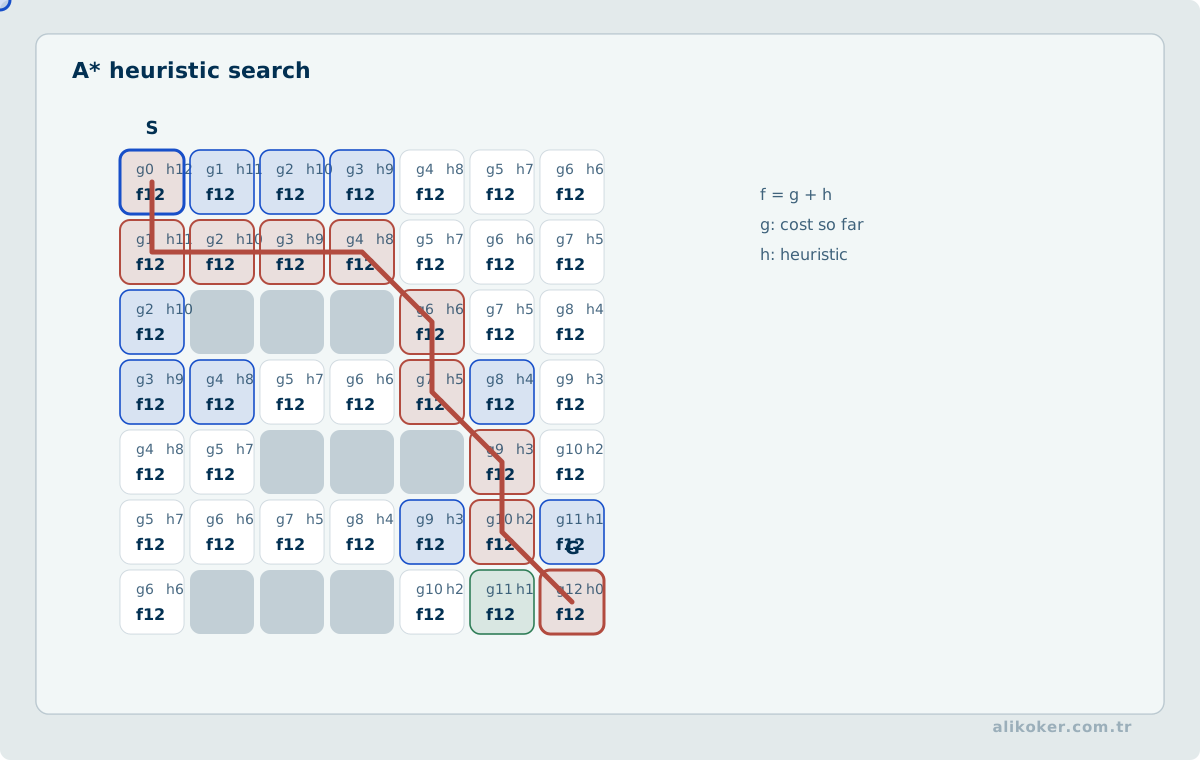
- A heuristic estimates remaining cost.
- Greedy Best-First Search usually follows
h(n).
A* combines two costs:
f(n) = g(n) + h(n)g(n) is incurred cost; h(n) estimates remaining cost. An admissible heuristic does not overestimate the true remaining cost, while a consistent heuristic satisfies h(n) <= c(n,n') + h(n') for every transition, where c(n,n') is the transition cost.
Memory-bounded variants change the engineering trade-off. IDA* iteratively increases an f threshold, RBFS carries the best alternative bound recursively, and SMA* can forget the least promising nodes when memory is full. A more accurate heuristic is not automatically a faster system because heuristic evaluation itself has a cost.
Local search and optimization
Some optimization problems care about the final configuration rather than the path. Hill Climbing therefore works on the current candidate and its neighborhood instead of maintaining a full search tree.
- Simple Hill Climbing: accept the first improving neighbor.
- Steepest-Ascent Hill Climbing: select the best neighbor.
- Stochastic Hill Climbing: sample among improving neighbors.
- First-Choice Hill Climbing: accept the first adequate improvement in a large neighborhood.
The classic failures are local optima, plateaus, shoulders, and ridges. Sideways moves can traverse a plateau; random restart reduces dependence on one initial state. Simulated Annealing sometimes accepts a worse move, with acceptance becoming less likely as temperature falls.
Local Beam Search maintains several candidates, while Stochastic Beam Search avoids deterministic collapse to only the current best. Tabu Search uses recent-history restrictions to reduce short cycles. Local search and gradient descent share an improvement-neighborhood intuition, but local search can be discrete or arbitrary whereas gradient methods usually assume a differentiable continuous space.
Games and adversarial agents
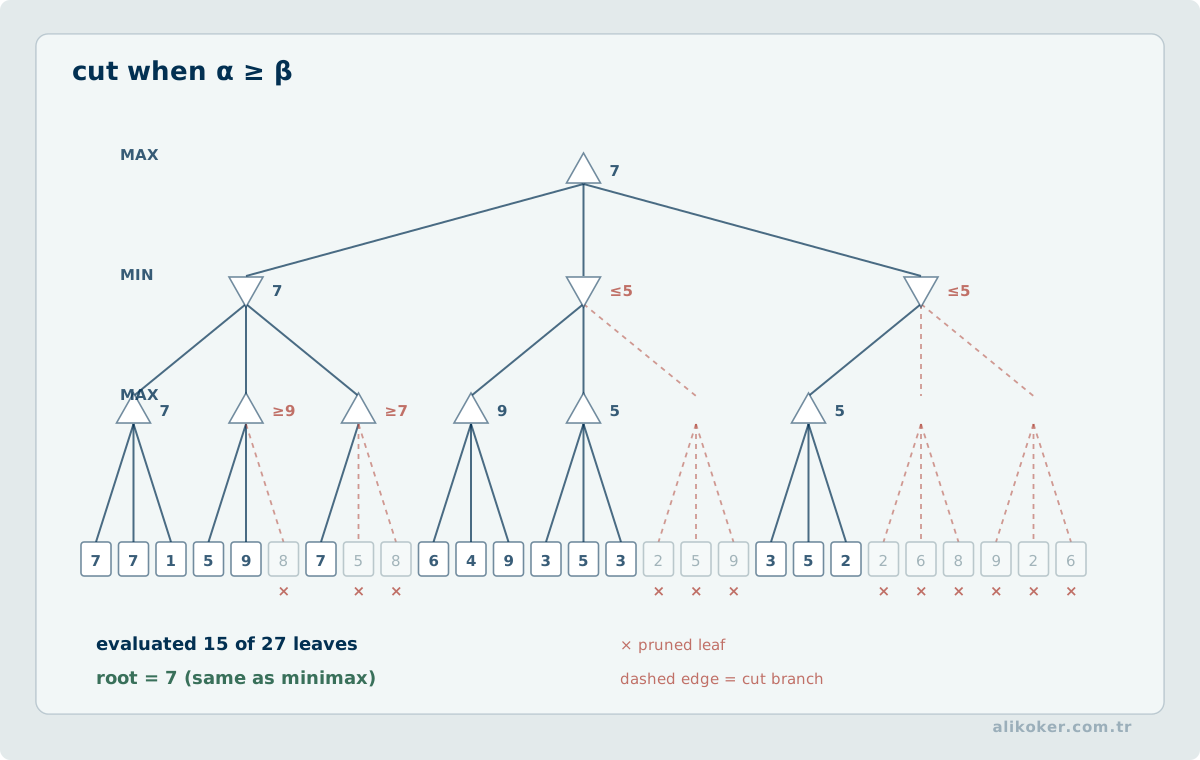
Minimax assumes an opponent will choose its best response. Alpha-Beta Pruning removes branches without changing the minimax result. Evaluation functions score nonterminal states when full search is impossible. Chance nodes require expected value. Monte Carlo Tree Search cycles through selection, expansion, simulation, and backup. AlphaGo combined learned policy/value networks with MCTS.
Constraint satisfaction
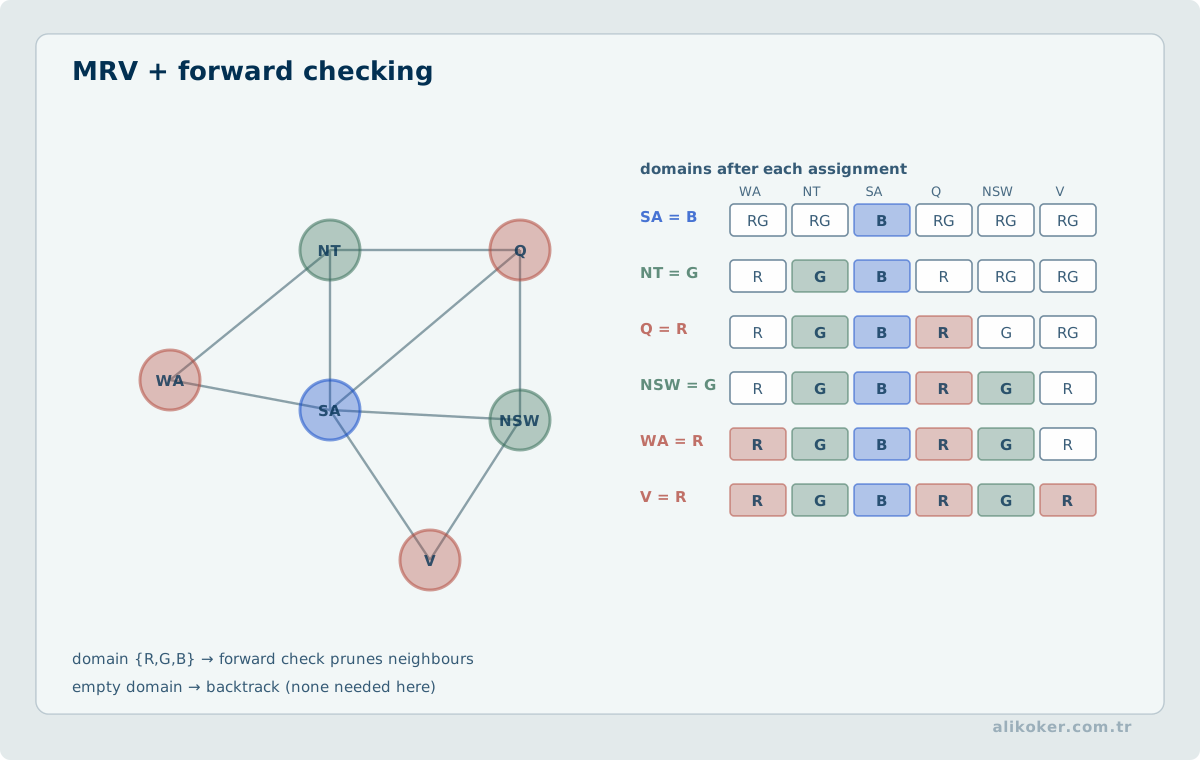
A CSP contains variables, domains, and constraints; the goal is an assignment satisfying them all. Backtracking is the basic search procedure. Forward checking detects some conflicts early, while constraint propagation narrows domains and arc consistency removes values unsupported by binary constraints.
Variable and value ordering matter. MRV chooses a variable with few remaining values, the degree heuristic favors a variable constraining many neighbors, and least-constraining value preserves options for the rest of the problem. A generative model may propose a candidate, but CSP, SAT, or SMT solvers can independently verify the formal constraints.
Knowledge representation and logic
Knowledge representation decides which parts of the world become symbols. Propositional logic works with truth-valued propositions. Horn clauses support efficient rule inference. Forward chaining moves from facts to conclusions. Backward chaining moves from a goal to required premises. Resolution supports proof by contradiction. SAT asks whether a propositional formula is satisfiable.
SMT extends SAT with theories such as integers, reals, bit vectors, and arrays. First-order logic represents objects, properties, relations, and quantifiers. Unification finds substitutions that make terms match. Generalized modus ponens applies rules with variables. Ontologies encode classes, relations, and constraints. Default reasoning uses defeasible assumptions under incomplete knowledge.
Semantic networks, frames, and logic programming
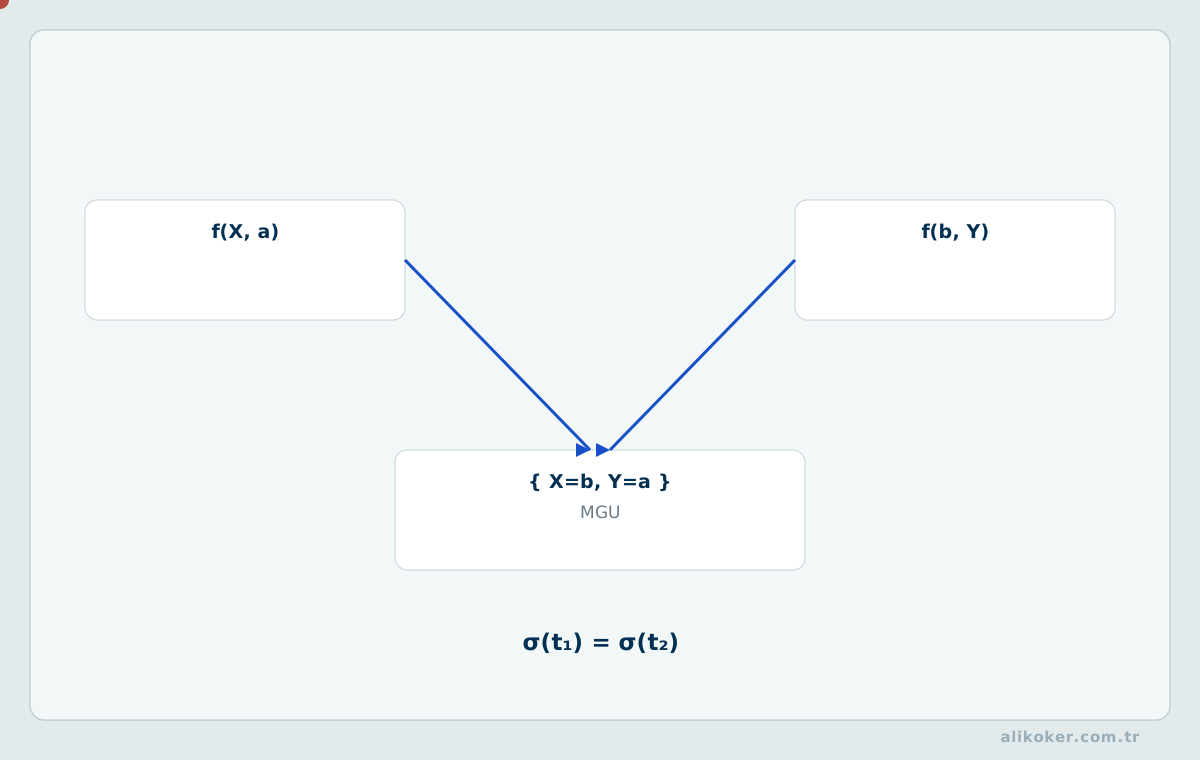
Representing knowledge as a network of concepts and relations rather than only as isolated propositions became an important line of symbolic AI. In a semantic network, nodes can represent objects or concepts while edges encode relations such as “is a,” “part of,” or “has.” Such structures support inheritance and relational inference while making representational assumptions explicit.
Marvin Minsky's frame approach strengthened the idea of organizing typical knowledge about an object or situation into slots and default values. A frame keeps related attributes together instead of expressing every fact as an independent sentence. Modern ontologies, knowledge graphs, and structured entity representations use different machinery, but they face the same design question: which entities, relations, and constraints should be made explicit?
Logic programming brings representation closer to executable inference. In languages such as Prolog, facts, rules, and queries share a logical form. Unification matches variables with compatible terms, while backward chaining works from a goal toward the premises required to prove it. Theorem proving, knowledge representation, expert systems, planning, graph problems, and natural-language processing have all been historical application areas.
This approach does not replace general-purpose software engineering. Its strength is that inference rules are explicit; its cost is the work required to symbolize domain knowledge and keep a growing rule base consistent.
Planning and expert systems
Planning connects a sequence of actions to a goal state. Preconditions are separated from effects. STRIPS-like representations make state change explicit. Planning graphs encode reachability and mutual exclusion. Partial-order planning avoids unnecessary action ordering. Hierarchical Task Networks decompose complex tasks. Online search interleaves action and search when the world model is incomplete.
After Dartmouth, much of AI was built around symbols, explicit rules, and search. Newell and Simon's Physical Symbol System Hypothesis argued for the centrality of symbol manipulation to general intelligent action. A common problem-solving structure can be written as:
The frame problem captures the difficulty of representing what does not change after an action. Expert systems became highly visible in the 1970s and 1980s. DENDRAL reasoned about chemical structure; MYCIN used a rule base for infectious-disease and antibiotic recommendations.
Knowledge base, inference engine, working memory, and user input formed a typical architecture. The major practical bottleneck was knowledge acquisition: turning expert knowledge into complete, current, maintainable rules. The rise of expert systems was followed by another period of disappointment.
The field had already experienced an earlier contraction in expectations and support. The 1966 ALPAC report on machine translation and the 1973 Lighthill assessment in the United Kingdom contributed, in different institutional contexts, to reduced confidence and funding; the broader 1970s downturn is commonly described as the first AI winter. (National Research Council, 1966; Lighthill, 1973)
Maintenance cost, brittle rule bases, the declining economics of specialized Lisp machines, and unmet expectations from initiatives such as Japan's Fifth Generation project contributed to the second AI winter in the late 1980s. Research did not stop; the dominant assumptions changed. IBM Deep Blue's 1997 match victory over Garry Kasparov illustrated the power of specialized search, evaluation functions, game knowledge, and custom hardware.
Information flow inside an expert system
An expert system is more than a list of rules. Acquiring domain knowledge, converting it into a form suitable for decision making, and bringing it into inference at run time are separate operations. A typical architecture distinguishes:
- a knowledge base containing facts, rules, and relations,
- working memory containing the temporary state of the current case,
- an inference engine deciding which rules to apply,
- a knowledge-acquisition process that transfers expertise or source material into the system,
- a user interface through which questions, evidence, and results are exchanged,
- an explanation layer that can show which knowledge and rules contributed to the result.
The explanation layer was historically important because users often need the rationale, not only the answer. The same requirement reappears in modern AI in a different form. When model output, external evidence, tool calls, and decision rules are recorded separately, the path to a result becomes more auditable.
The knowledge-acquisition bottleneck has not disappeared completely either. Large models can carry substantial implicit knowledge, but connecting them to organizational rules, current records, authorization boundaries, and verifiable domain evidence remains an engineering problem of its own.
1950s–2000s: uncertainty, probability, and decision
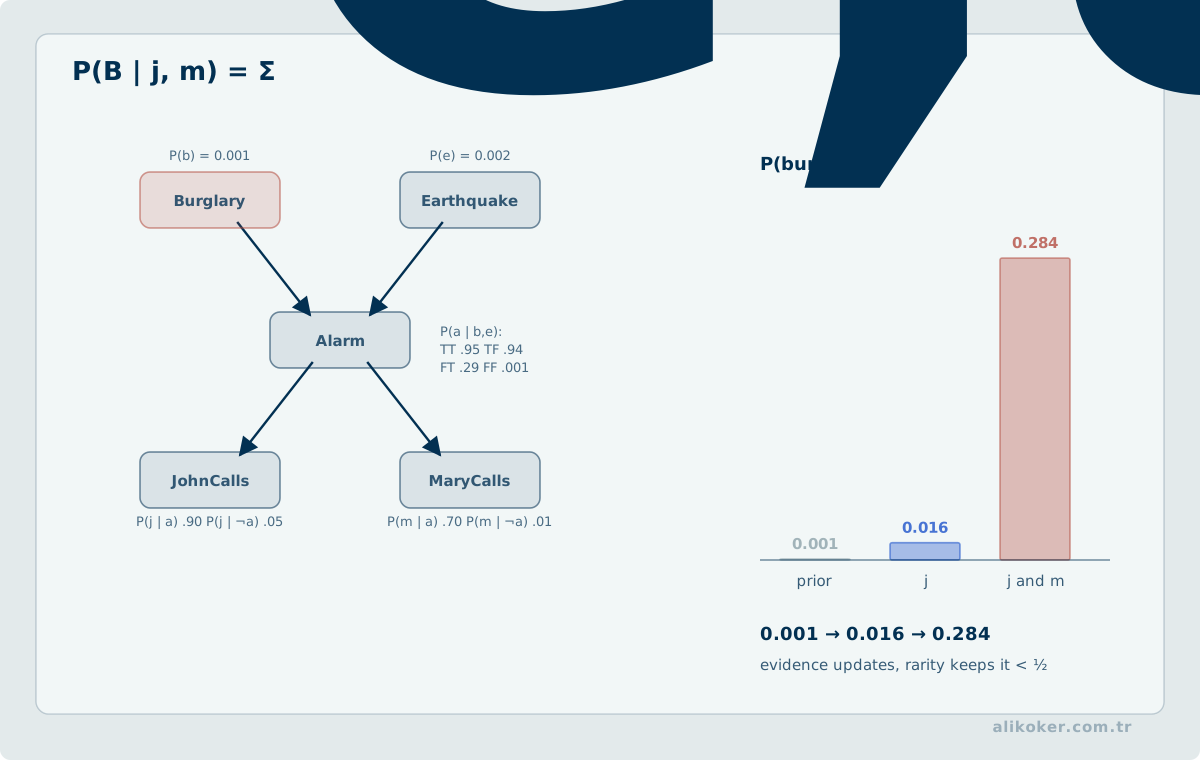
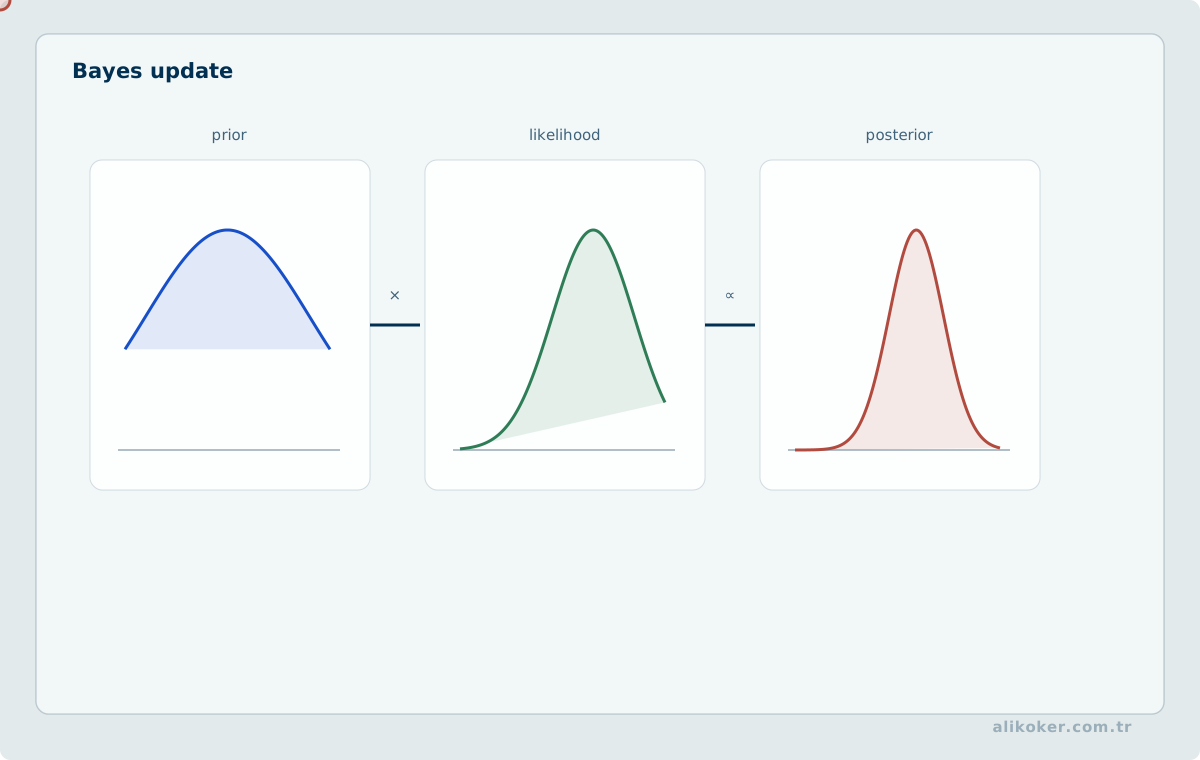
Symbolic rules were strong in crisp worlds. Sensors, language, and human behavior were incomplete, noisy, and stochastic. Probabilistic AI addressed that gap, and decision theory connected prediction to action. (Pearl, 1988; Sutton & Barto, 2018)
Logic is strong for crisp propositions. Real environments are often incomplete and noisy. Probability gives uncertainty a numerical form.
Bayes' rule combines prior belief with new evidence. Conditional independence simplifies large joint distributions. Bayesian networks factor variables over directed acyclic graphs.
The Markov property restricts prediction to the current state. Hidden Markov Models infer latent state from observations. The forward algorithm evaluates observation-sequence probability.
Viterbi searches for the most likely hidden-state sequence. Dynamic Bayesian Networks support more general temporal dependencies. The Kalman filter estimates state in linear-Gaussian dynamical systems.
Prediction propagates the state. Update corrects it with a new measurement. A Kalman filter is not a neural network.
EM alternates expectation and maximization for latent-variable models. Maximum Likelihood seeks parameters making the data most likely. MAP also incorporates a prior.
Decision theory combines probability with utility. Expected utility differs from choosing only the most probable outcome. Risk attitude can make utility nonlinear.
Value of Information estimates the expected decision benefit of additional information. An MDP is a fully observed stochastic decision process. A POMDP carries partial observability through a belief state.
A rational decision may optimize expected consequences rather than raw predictive accuracy.
Fuzzy logic: computing with graded concepts
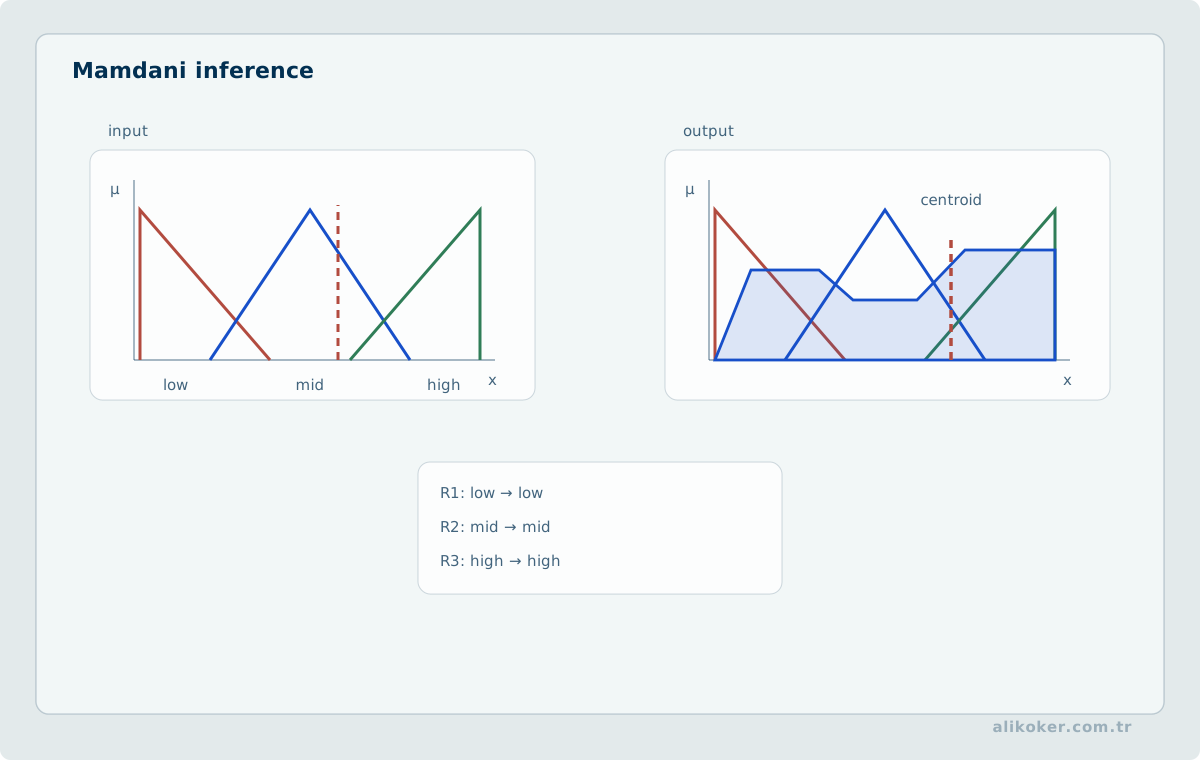
Lotfi A. Zadeh's 1965 work on fuzzy sets replaced strict membership with graded membership in [0,1]. Fuzzy membership is not the same as probability.
Probability can express uncertainty about whether an event occurs; fuzzy membership can express the degree to which an instance satisfies a vague concept. A typical fuzzy system follows this path:
numeric / observed input
-> fuzzification
-> membership degrees
-> IF–THEN rule base
-> fuzzy inference
-> defuzzification
-> numeric output
Membership functions may be triangular, trapezoidal, Gaussian, or domain-specific. T-norms are commonly used for fuzzy AND; t-conorms for fuzzy OR. Mamdani systems aggregate fuzzy consequent sets, while Takagi–Sugeno systems use constants or functions in the consequent.
Centroid and related methods can convert fuzzy output into a crisp value. The strength of fuzzy logic is that expert knowledge can be expressed in linguistic rules. The limitation is that membership functions and rule bases can become difficult to design and maintain by hand.
Neuro-fuzzy systems combine learnable parameters with fuzzy inference. ANFIS combines an adaptive network with Takagi–Sugeno inference. (Jang, 1993) NEFCLASS illustrates neuro-fuzzy rule learning for classification, NEFCON applies learnable fuzzy-rule structures to control, and GARIC learns and tunes fuzzy controllers from reinforcement signals. (Nauck & Kruse, 1995; Nauck, Klawonn & Kruse, 1997; Berenji & Khedkar, 1992)
Membership functions, Mamdani and Sugeno inference, defuzzification, control, and neuro-fuzzy structures are developed further in Fuzzy Logic: Theory, Inference, Control, and Applications.
1957–2000: from the perceptron to modern connectionism
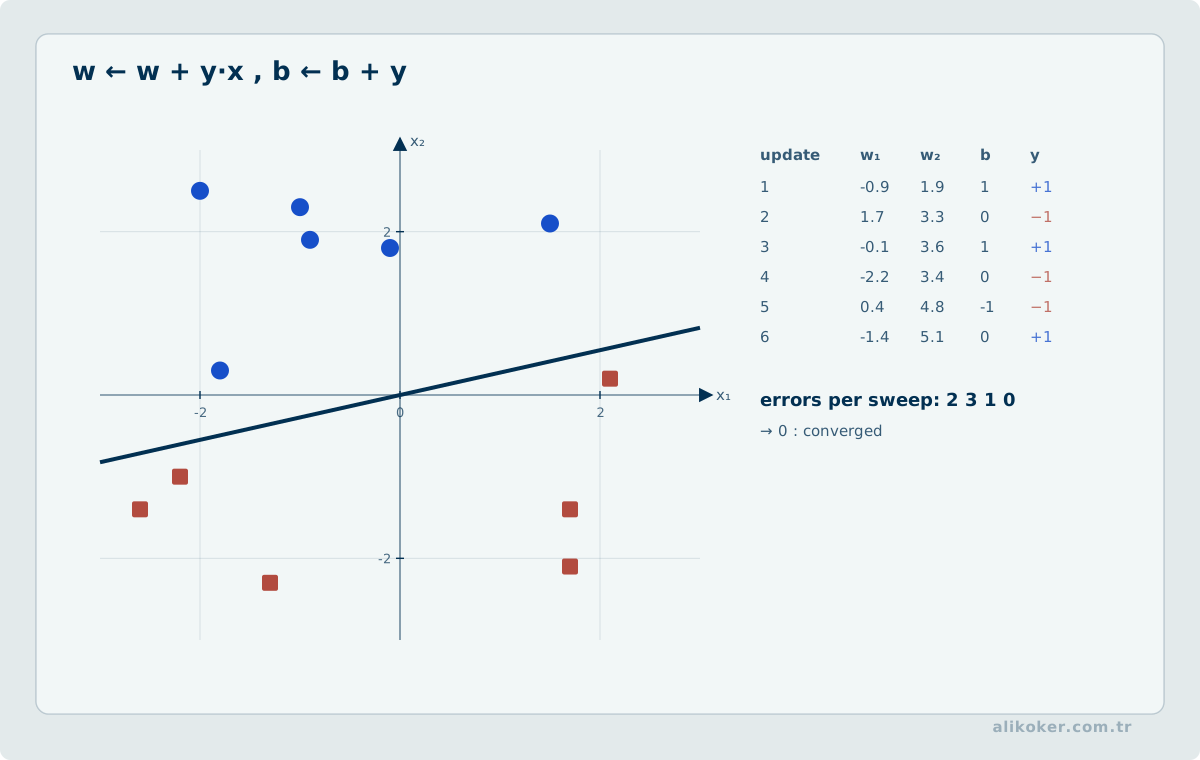
Rosenblatt's perceptron learned a linear decision boundary. With inputs x_i, weights w_i, bias b, and activation f, a neuron can be written as:
y = f(sum(w_i * x_i) + b)A single-layer perceptron cannot solve linearly inseparable problems such as XOR. That limitation identifies the representational capacity of a model class; it does not establish that neural computation as a whole is ineffective. Minsky and Papert's 1969 Perceptrons systematically analyzed limits of this model class and influenced the direction of connectionist research, but attributing the later contraction of neural-network funding and interest to that book alone oversimplifies the historical record. Multilayer networks with nonlinear activations represent much richer function classes. (Minsky & Papert, 1969)
The history of backpropagation predates its broad neural-network adoption in 1986. Linnainmaa published an efficient reverse-mode differentiation method in 1970; Werbos's 1974 dissertation contained pioneering discussion of applying related gradient ideas to learning in multilayer systems. Rumelhart, Hinton, and Williams's 1986 work then made the practical value of error backpropagation for learning internal representations widely visible. (Linnainmaa, 1970; Werbos, 1974; Rumelhart, Hinton & Williams, 1986)
Backpropagation uses a forward pass, a loss function, the chain rule for gradients, and an optimizer update:
forward
-> loss
-> backward
-> gradient
-> optimizer step
Gradient descent and stochastic gradient descent optimize model parameters; momentum, RMSProp, Adam, and related methods alter the update dynamics. Learning rate, batch size, gradient noise, and hardware utilization form a coupled system. A very high learning rate can destabilize training; a very low rate can waste compute.
Activation functions evolved from sigmoid and tanh toward ReLU and related functions. Sigmoid can saturate and weaken gradients at large magnitudes. ReLU simplified optimization in many deep networks but can produce inactive units.
Residual connections, popularized by ResNet in 2015, improved the optimization of very deep networks and mitigated degradation; they do not magically solve every gradient problem. Overfitting occurs when a model captures training-specific detail at the expense of generalization. More data can help, but it is not the only remedy.
Train/validation/test separation, cross-validation, regularization, weight decay, dropout, data augmentation, early stopping, and appropriate model capacity all matter. Underfitting is the opposite failure: the model does not capture useful structure. The bias–variance perspective remains a useful conceptual guide.
Classical artificial neural network families help connect modern deep learning to its history. RBF networks approximate with local radial basis functions; Kohonen Self-Organizing Maps perform unsupervised topological mapping; Learning Vector Quantization provides prototype-based supervised classification; Adaptive Resonance Theory addresses the stability–plasticity tension between learning new patterns and retaining learned structure.
Elman and other Recurrent Neural Network (RNN) architectures carry hidden state through time and share parameters across temporal steps. Long dependencies can expose vanishing and exploding gradients; LSTM and the more compact GRU use gating to make long-range information flow more manageable. Train, validation, and test separation remains fundamental to measuring generalization.
CNNs exploit spatial locality and weight sharing. Autoencoders reconstruct input through a compressed representation.
Transfer learning moves pretrained representations into a new task. Representation learning shifted the boundary between manual feature engineering and end-to-end learning.
Artificial neurons, layered representations, learning paradigms, perceptrons, multilayer networks, backpropagation, LVQ, ART, and recurrent architectures are treated together in Artificial Neural Networks and Learning Models.
Evolutionary search and genetic algorithms
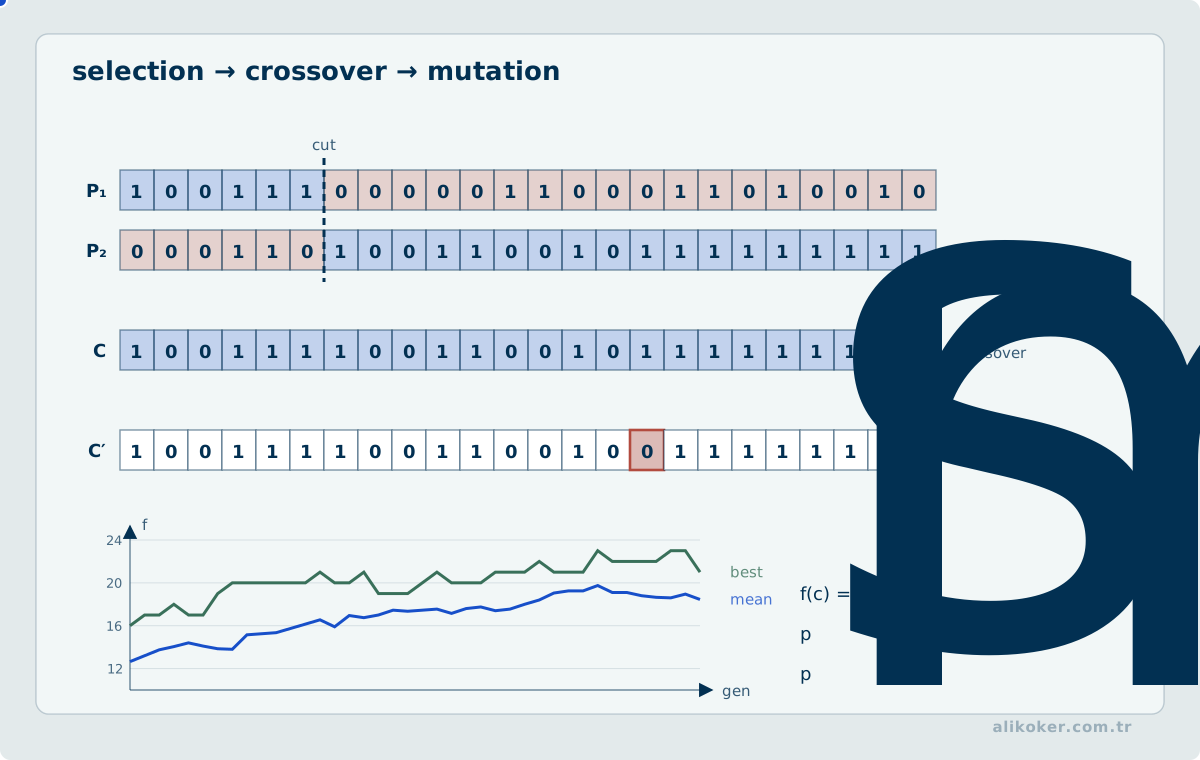
Single-objective optimization improves one fitness criterion. Multi-objective optimization can contain conflicting goals. Pareto dominance means improving at least one objective without worsening the others.
A Pareto frontier represents trade-off solutions rather than one universally best point. The modern genetic-algorithm line was systematized by Holland's 1975 work, while Goldberg's 1989 book helped establish its broader use in search, optimization, and machine learning. Genetic algorithms maintain a population of candidate solutions and apply selection, crossover, and mutation. A fitness function determines which candidates reproduce or survive. (Holland, 1975; Goldberg, 1989)
Their strength is that they do not require differentiability and can explore discrete, multimodal, or irregular search spaces. Their weakness is the cost of repeated evaluation, sensitivity to hyperparameters, and the difficulty of defining a fitness function that faithfully represents the real objective. Representation, selection pressure, elitism, crossover rate, mutation rate, and diversity management all affect behavior.
Too little diversity can cause premature convergence; too much mutation can reduce directed search toward nearly random exploration. The purpose is not to simulate biology faithfully, but to turn variation and selection into an optimization process.
Encoding, selection, crossover, mutation, fitness design, and multi-objective optimization are treated in more detail in Genetic Algorithms and Their Applications.
1990s–2010s: the theoretical core of statistical machine learning
During the 1990s, emphasis shifted from writing rules to learning decision boundaries from data. Bayesian models, trees, SVMs, and statistical pattern recognition expressed different versions of that change. (Cortes & Vapnik, 1995; Bishop, 2006)
Machine learning shifted emphasis from writing all rules manually toward estimating decision functions and probability distributions from data. Supervised, unsupervised, semi-supervised, and reinforcement learning describe the structure of training signals rather than different metaphysical kinds of intelligence. K-Nearest Neighbors (KNN) predicts from nearby examples and is sensitive to feature scaling and distance definition. Naive Bayes assumes that features are conditionally independent given the class.
The assumption is strong, yet the model remains effective in many high-dimensional domains such as text.
Decision trees produce human-readable threshold rules, but individual trees can overfit; random forests and boosting combine multiple learners to improve generalization. Support Vector Machines maximize the margin between classes. A hard-margin SVM assumes perfect separability of the training data; a soft-margin SVM introduces slack and a penalty trade-off so noisy real data can violate the margin in a controlled way.
The kernel trick enables nonlinear decision boundaries without explicitly constructing every high-dimensional feature. Feature scaling is especially important. K-Means alternates between assigning observations to the nearest center and recomputing centers to reduce within-cluster squared distance.
The number of clusters k is chosen externally, and results can depend on initialization. K-means++ improves initialization. K-medoids uses actual observations as centers and can be more robust to outliers.
CLARA scales PAM/k-medoids by running it on multiple samples, which is useful when a full dissimilarity structure is expensive; a non-representative sample can still miss important clusters. Principal Component Analysis finds orthogonal directions that capture high variance and is unsupervised. Linear Discriminant Analysis, in the classification sense, uses class information to find discriminative projections.
These should not be confused with Latent Dirichlet Allocation, which shares the abbreviation LDA but models topics in documents. Dimensionality reduction can support visualization, noise reduction, storage efficiency, and downstream learning, but latent components need not correspond to interpretable physical features. Feature engineering turns raw data into representations useful for a task.
Standardization, normalization, categorical encoding, text vectorization, temporal windows, spectral features, and domain-specific transformations all belong here. Feature selection chooses among existing features; dimensionality reduction can create new axes. Data augmentation introduces meaningful transformations—such as image crops, flips, rotations, or controlled audio perturbations—to improve robustness.
Accuracy alone is rarely enough for classification. Precision, recall, F1, specificity, ROC curves, and PR curves highlight different error costs. A confusion matrix makes error types visible.
Regression metrics such as MAE, MSE, RMSE, and R² emphasize different properties. Calibration asks whether predicted confidence corresponds to empirical frequency. The right metric follows the cost of errors in the real application.
Semi-supervised learning combines few labels with much unlabeled data. Self-supervised learning derives the target from the data itself. Decision trees can split by impurity or information gain.
PCA is unsupervised linear dimensionality reduction. LDA uses class-separation information in a linear projection. Anomaly detection often asks “how atypical is this sample?” rather than “which class is it?”
Cross-validation improves data efficiency in evaluation. Data leakage creates falsely optimistic evaluation. Data drift changes the input distribution.
Concept drift changes the relationship between input and target. Model decay is declining production performance over time. Data quality places an upper bound on model quality.
Synthetic data can expand coverage. Synthetic data can also reproduce or amplify distribution errors.
A further branch of statistical learning models sequences and text probabilistically. An n-gram model estimates the next unit from a bounded local history rather than the entire past. Token or n-gram counts with Naive Bayes, hidden states and observation likelihoods in HMMs, and conditional dependencies in Bayesian networks are different representations of the same statistical turn. Deep learning did not remove this underlying problem; it changed how representations and context are learned.
The mathematical and algorithmic treatment of SVMs, k-NN, Naive Bayes, K-Means, decision trees, ensembles, PCA/LDA, Gaussian mixtures and EM, HMMs, anomaly detection, n-grams, evaluation, and regularization is developed in Statistical Learning and Machine Learning. In the historical argument here, the important change is broader than the names of individual algorithms: systems moved from hand-written rules toward estimating probabilities, neighborhoods, margins, partitions, and latent structure from data.
Reinforcement learning: state, action, and long-term return
Reinforcement learning places an agent in an environment and uses reward rather than a correct label at every step. A policy's value can be described through expected discounted return:
V^pi(s) = E_pi[ sum_(t=0..infinity) gamma^t R_(t+1) | S_0 = s ]Bellman equations express value recursively through immediate reward and future value. Q-learning is a model-free off-policy method:
Q(s,a) <- Q(s,a) + alpha * [ r + gamma * max_(a') Q(s',a') - Q(s,a) ]Exploration and exploitation form a central trade-off. Epsilon-greedy policies choose a random action with some probability to continue exploration. Too little exploration can lock the agent into a poor policy; too much wastes learned information.
Deep Q-Networks (DQN) approximated Q-values with neural networks and used replay buffers and target networks for stability. AlphaGo combined policy networks, value networks, and Monte Carlo Tree Search. The important engineering lesson is that learned intuition and classical search are often complementary rather than mutually exclusive.
Classical NLP, topic modeling, and semantic representation
Before large language models, NLP relied heavily on token counts, n-grams, TF-IDF, statistical language models, Hidden Markov Models, CRFs, and task-specific classifiers. TF-IDF increases the weight of terms that are discriminative for a document but not ubiquitous across the corpus. Bag-of-words largely discards word order; n-grams restore local sequence information at the cost of rapidly increasing dimensionality.
Naive Bayes, logistic regression, and linear SVM were—and often remain—strong text-classification baselines.
Baselines matter because a task that can be solved reliably with a small deterministic or classical model may be cheaper, faster, and easier to audit than an LLM solution.
Topic modeling seeks latent thematic structure. Latent Dirichlet Allocation represents documents as mixtures of topics and topics as distributions over words. Modern embedding and LLM workflows can produce more flexible semantic clusters and theme descriptions, but stability and reproducibility must still be measured separately from how persuasive the generated label sounds.
In embedding-based clustering, representation, distance metric, clustering algorithm, and human theme interpretation are distinct layers. A well-written theme name does not prove that the clusters are statistically stable or useful.
Distributional semantics then moved from sparse counts toward learned dense vectors. Word2Vec learned representations through local prediction objectives; GloVe connected embeddings to global co-occurrence statistics. The methods differ, but both helped establish the idea that geometric relations in a vector space can encode useful semantic regularities.
From morphology to dialogue
Natural-language processing is not only tokenization. In a classical analysis pipeline, different linguistic levels answer different questions:
- morphology examines stems, affixes, and word classes,
- syntax models structural relations among words in a sentence,
- semantics asks what those structures and relations mean,
- discourse and dialogue analysis interpret multiple utterances together with conversational history and context.
In morphologically rich languages such as Turkish, a single surface word can contain many morphemes. Stem and affix boundaries, word class, negation, tense, person, or possession can therefore influence later syntactic and semantic analysis directly.
Context is required whenever a surface form permits multiple analyses. Whether a form functions as a noun or a verb, which stem an affix sequence attaches to, or which entity a pronoun refers to cannot always be determined from the character sequence alone. Modern contextual models can learn several of these levels jointly, but separating morphological, syntactic, and semantic error types remains useful during evaluation.
The connection from OCR and ASR output to morphological, syntactic, and semantic analysis on a multimedia timeline continues in Natural Language Processing and Multimedia.
2012–2016: The renewed rise of deep learning
Deep learning entered a new phase after 2012 as data, accelerator hardware, and end-to-end representation learning matured together. The rise of deep learning was not one algorithmic event but the convergence of these conditions. (LeCun, Bengio & Hinton, 2015)
AlexNet's ImageNet result made the combination of large labeled datasets, GPU computation, and deep convolutional networks highly visible. CNNs use shared filters to detect local structure, while pooling or stride can reduce spatial resolution. Deeper layers can learn more abstract representations, although the familiar story “edges first, objects last” is only an intuition; real representations are distributed and data-dependent.
By the mid-2010s, deep learning had become a central path for image, audio, and speech processing. This did not make classical signal processing obsolete. Fourier transforms, filters, cepstral features, and geometry still provide physically meaningful structure; learned models add the ability to optimize representations for a task.
GANs, introduced in 2014, trained a generator and discriminator adversarially. Variational Autoencoders (VAE) provided another probabilistic latent-variable route to generation. “Generative model” therefore means much more than a conversational chatbot; it includes broad families that model the distribution or latent structure of observed data.
Generative modeling widened the same trajectory. GANs framed generation as an adversarial game; VAEs combined latent-variable modeling with neural inference. Diffusion models later learned to reverse a gradual noising process, becoming a major route to high-quality image and multimodal generation. GAN, VAE, autoregressive, and diffusion approaches address generation with different factorizations and training objectives; there is no single “generative AI algorithm.”
2017: the Transformer changes sequence modeling
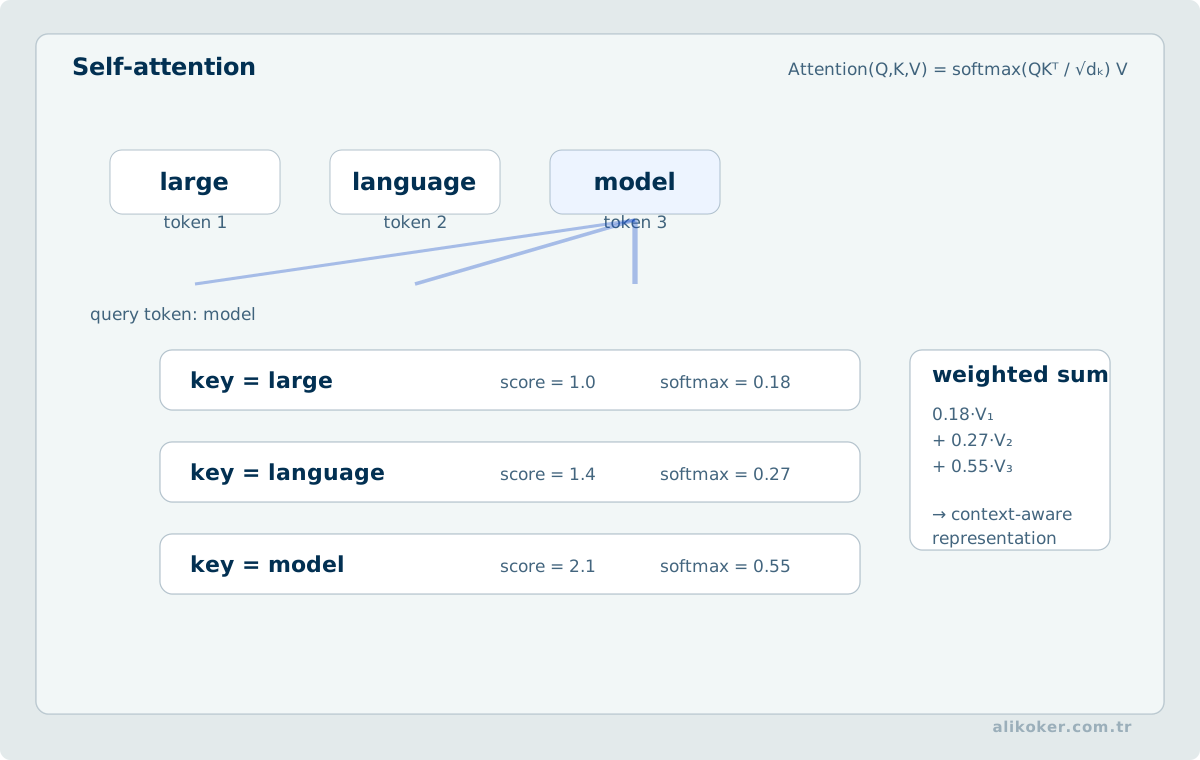
The 2017 paper Attention Is All You Need proposed a Transformer architecture centered on self-attention instead of recurrence. Each token is projected to query, key, and value vectors. Query–key similarity controls attention weight; values carry the content that is mixed:
Attention(Q,K,V) = matmul(softmax(matmul(Q, K^T) / sqrt(d_k)), V)The scale factor helps prevent dot products from becoming numerically too large before softmax. Multi-head attention learns several projection spaces in parallel, enabling different relational patterns to be represented simultaneously. Individual heads are not guaranteed to map neatly to human labels such as “syntax” or “coreference,” but specialization can emerge.
Attention alone does not encode sequence order. Positional encodings or embeddings provide location information. The original Transformer used sinusoidal encoding; later systems adopted learned positions, relative biases, and Rotary Position Embeddings (RoPE).
RoPE encodes relative positional structure by rotating query and key components and has become common in long-context models. Encoder-only architectures use bidirectional context and are well suited to representation and classification. Decoder-only architectures use causal masking and autoregressive next-token prediction.
Encoder–decoder architectures separate source encoding from target generation for sequence-to-sequence tasks. BERT is a canonical encoder-style model, GPT-style systems are decoder-only, and T5 is a well-known text-to-text encoder–decoder model. The Transformer scales well on modern accelerators because many sequence operations can be parallelized during training.
In standard dense self-attention, pairwise token interactions grow approximately as O(n^2) with sequence length. Implementations that materialize the full attention-score matrix can also require O(n^2) intermediate memory. IO-aware exact kernels such as FlashAttention avoid materializing that full matrix in HBM and substantially reduce auxiliary memory and memory traffic, but they do not remove the fundamental O(n^2) interaction count of dense attention. A large context window is therefore a capability, not free memory and not a reason to put every document into every prompt. (Dao et al., 2022)
The core attention mechanism projects each token into Q/K/V — query, key, and value — representations. Query–key similarity determines how strongly value information is mixed. Multi-head attention repeats this interaction in several learned subspaces, allowing different relational patterns to be represented in parallel.
Tokenization, embeddings, and the actual unit of LLM computation
The natural compute unit of an LLM is usually the token, not the word. A token may be a word, subword, punctuation mark, or byte-derived fragment. Byte Pair Encoding (BPE) builds a variable-length vocabulary by repeatedly merging frequent symbol pairs. SentencePiece learns subword units without assuming whitespace-separated words.
In multilingual systems, tokenization affects cost and context capacity because different languages may require different numbers of tokens to represent equivalent meaning. Embeddings map discrete items into continuous vector space. Similar usage contexts may produce nearby vectors, but vector proximity is not identical to real-world semantic identity.
Cosine similarity emphasizes direction, while dot product can incorporate both direction and magnitude. Higher embedding dimension can capture richer distinctions at the cost of storage, memory bandwidth, and index size. A bi-encoder represents query and candidate separately, allowing candidate vectors to be precomputed for scalable retrieval.
A cross-encoder processes the pair jointly and can model richer interactions but is much more expensive. A common architecture uses a bi-encoder for recall and a cross-encoder for reranking.
Language-model quality is often summarized with perplexity, an exponentiated form of average token-level negative log likelihood. Lower perplexity means the observed sequence is less surprising to the model under that tokenization and evaluation setup; it is not a direct measure of truth, reasoning, or usefulness.
2018–2022: foundation models, in-context learning, and scale
BERT, GPT-2, T5, and increasingly large pretrained models shifted the field away from training every task from scratch. Broad pretraining followed by downstream adaptation became a standard pattern. GPT-3 made few-shot and in-context learning especially visible: a model could infer task format from examples supplied at inference time without changing its weights.
Scaling-law research found regular relationships among model size, data, and compute. Scale is not a guarantee. Data quality, deduplication, training objective, architecture, post-training, and evaluation design matter. Double descent showed that modern highly parameterized systems can violate the simplest textbook bias–variance curve.
Emergence should also be used carefully: some capabilities appear abruptly under particular metrics, while continuous underlying trends and thresholded evaluation can create part of the apparent discontinuity.
A Large Language Model estimates probability distributions over token sequences at very large scale. For a decoder-only model, the core objective can be summarized as:
P(x_t | x_1, x_2, ..., x_(t-1))A simple training objective can nevertheless create rich distributed representations of syntax, semantics, style, facts, and task patterns. Model weights are not a relational database of verified propositions, so parametric memory should remain conceptually separate from auditable external sources.
Post-training: SFT, instruction tuning, preference optimization, PEFT, and distillation
Pretraining creates broad statistical capabilities; product behavior typically depends on post-training. Supervised Fine-Tuning (SFT) learns from input–output pairs. Instruction tuning uses diverse natural-language tasks to improve general instruction following. Preference optimization learns from ranked or comparative feedback. RLHF is historically important, but alignment is broader than RLHF: DPO-like methods, retrieval constraints, tool policy, deterministic validation, and product-level guardrails also shape behavior.
Full fine-tuning updates most or all weights and can be expensive. Parameter-Efficient Fine-Tuning (PEFT) updates smaller parameter subsets or adds lightweight trainable modules.
LoRA approximates weight updates with low-rank matrices. QLoRA combines low-rank adaptation with a quantized frozen base model to reduce memory requirements. None of these methods is universally superior; data quality, task behavior, latency, deployment, and lifecycle management determine the choice.
Distillation trains a smaller student to imitate a larger teacher, sometimes using soft distributions rather than only hard labels. Its purpose is to preserve enough task behavior while reducing latency, memory, and serving cost. Distillation and PEFT solve different problems: distillation creates a smaller model, while PEFT adapts an existing one efficiently.
Fine-tuning does not automatically solve a retrieval problem. Frequently changing facts or information requiring citations often belong in external retrieval rather than in model weights. The disciplined engineering question is: which layer closes the measured behavior gap at the lowest lifecycle cost?
Optimization mathematics: softmax, cross-entropy, KL, gradients, and Jacobians
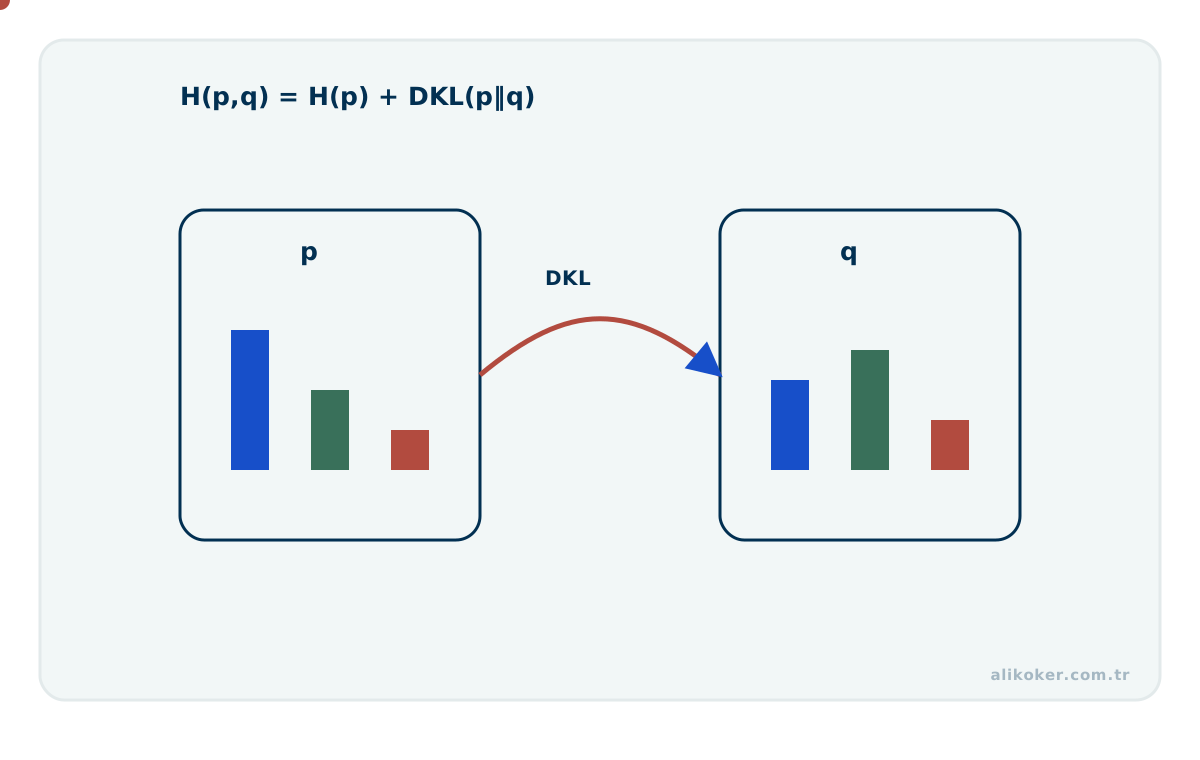
Softmax maps scores to a normalized distribution:
softmax(z_i) = exp(z_i) / sum_j exp(z_j)In attention it turns query–key scores into weights; in classification it turns logits into probability-like values. Implementations use numerical-stability transformations such as subtracting the maximum logit. Cross-entropy measures mismatch between target and model distributions and is closely related to negative log-likelihood for one-hot targets.
KL divergence compares distributions asymmetrically and is not a metric. It appears in distillation, variational methods, and preference learning. A gradient gives the local sensitivity of a scalar objective to parameters.
A Jacobian generalizes derivatives to multiple outputs and inputs; a Hessian represents second-order curvature. Full Hessians are rarely computed for large neural networks, but conditioning and curvature remain useful concepts for understanding optimization. Mixed precision, gradient accumulation, and optimizer state show that optimization mathematics is inseparable from memory and hardware.
Decoding: turning a distribution into text
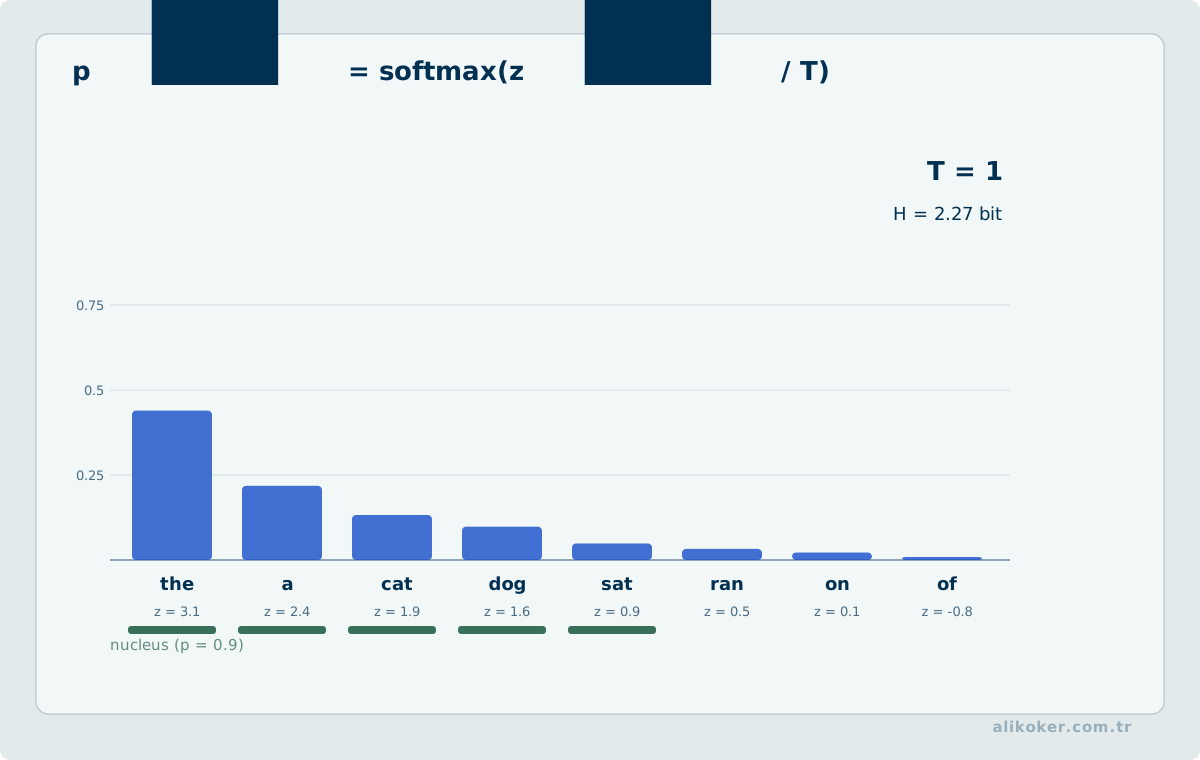
An autoregressive model produces a probability distribution for the next token at each step. Greedy decoding takes the highest-probability token. Beam search maintains multiple candidate sequences and can improve constrained sequence tasks such as translation, but costs more and can reduce diversity in open-ended generation.
Sampling draws from the predicted distribution.
Temperature rescales logits and changes how sharp or diffuse sampling becomes. Lower values tend to produce more deterministic output; higher values produce more diversity. Exact ranges are implementation-specific. top-k restricts sampling to the k highest-probability tokens. top-p, or nucleus sampling, selects the smallest set whose cumulative probability reaches p. max_tokens is also a cost and latency control.
These parameters are not magical creativity knobs. Extraction, classification, and structured-output tasks usually prefer lower variance than brainstorming or creative writing. Even temperature=0 does not necessarily guarantee bit-for-bit determinism across model versions, distributed kernels, or infrastructure changes.
Unit 3: Practice and Systems Engineering
An AI use case begins by defining the decision to automate and the consequences of error. Compare rule-based, statistical, and learned alternatives against a common baseline. Data quality, computing cost, and human oversight are design inputs, not issues postponed until a model has been chosen. Even a promising system must be evaluated for the distributions and failure classes under which it breaks down.
III. Practical and Systems-Engineering History
Human feedback, transcription, and data labeling
Machine learning is not built from raw data alone. Supervised training, instruction tuning, preference optimization, and evaluation sets often depend on labels created or verified by people. When annotation guidelines are ambiguous, a model may learn annotation habits rather than the underlying phenomenon.
Transcription makes this visible in audio. ASR can produce a first draft quickly, while accents, noise, overlapping speech, proper names, and domain terminology remain sources of error. A transcript used for training or evaluation should remain traceable to the source audio, timestamps, and later corrections.
Human feedback is not a perfect oracle either. Annotators can disagree, and preference data can confuse short-term stylistic preference with actual task quality. Data production is therefore not an administrative step outside model training; it is an engineering layer that directly shapes model behavior.
Using model outputs as new labels can scale data production, but it can also reinforce existing errors. Synthetic labels are safer when combined with independent sampling, human review, or a separate verifier.
Synthetic data, data lineage, and model collapse
Synthetic data can be useful for increasing rare-case coverage, generating examples from simulation, reducing some privacy exposure, or supplementing expensive labeling pipelines. A different failure mode appears when provenance is lost and outputs from one generation of models repeatedly become training data for later generations.
Shumailov and colleagues describe this degradation as model collapse. Their Nature study shows that indiscriminate recursive training on model-generated data can progressively discard information from the original distribution, with low-probability tails affected early (Shumailov et al., 2024). This is not a general argument against synthetic data. The risk comes from an uncontrolled feedback loop in which source, generation, and relation to original observations become invisible.
original / observed data
        |
        v
     model n
        |
        v
 generated data
        |
        +------> validated auxiliary data
        |
        +------> untracked recursive data
                         |
                         v
                    model n+1
Data lineage is therefore more than an audit record. Human-created material, sensor observations, simulation output, another model's output, and human-validated synthetic examples should remain distinguishable. Preserving original data in the training mixture, filtering synthetic examples, and isolating evaluation sets from the generation loop address different parts of the same reliability problem.
Model collapse also illustrates why an average metric can be misleading. Performance near the center of a distribution may appear stable while rare classes, edge cases, or low-frequency language patterns disappear. Evaluation should therefore include tail coverage, class balance, performance on preserved original data, and distribution change across generations rather than only aggregate loss.
Preparing training and retrieval data
Modern AI systems can draw on web documents, enterprise records, sensor streams, conversations, and user interactions. A training corpus and a RAG corpus serve different purposes: one changes model parameters, while the other supplies external evidence at inference time.
Provenance, freshness, licensing, personal data, and access control all matter when selecting sources. Large web collections can increase coverage, but duplicates, low-quality copies, and poorly sourced content can distort the training distribution. Deduplication is therefore not merely storage optimization; it can reduce memorization and evaluation contamination.
Data leakage occurs when information that should be unavailable during evaluation enters the training pipeline. If the same user, document family, time period, or derived copy appears on both sides of a split, measured quality can become unrealistically high. For large language models, benchmark questions appearing in pretraining data are the same problem at a larger scale.
RAG introduces another preparation problem: how documents are chunked, which metadata can filter them, how obsolete versions are removed, and how authorization is preserved during retrieval. Data preparation is therefore part of deciding what an AI system can know and which evidence it is allowed to use.
Image, audio, and multimodal AI
Multimodal systems combine text with images, audio, video, and sensor data. The physical measurement chain still matters: sampling, quantization, noise, timing, and representation determine what reaches the model before learning begins.
Vision and audio contain different structures. Images carry spatial organization; audio carries temporal and spectral structure. Detection, segmentation, recognition, generation, speech recognition, speaker recognition, and diarization therefore remain distinct tasks even when a single foundation model can address several of them.
The engineering question is how representations from different modalities are aligned without erasing their differences.
Biometric decision systems
Biometrics covers systems that evaluate identity from measurements derived from physical or behavioral characteristics. Fingerprints, faces, irises, and vascular patterns are largely physical traits, while voice and signature are strongly affected by behavior as well. None should be treated as an infallible password: sensors, environment, age, health, recording quality, and attack conditions can change the measurement.
Enrollment converts a reference sample into a template or feature representation. A later sample is compared with that representation. Verification tests a claimed identity, whereas identification searches a sample against multiple enrolled identities. Because the final decision is commonly produced from a similarity score and a threshold, false matches and false rejections form an explicit trade-off.
Face and speaker recognition are therefore more than isolated “AI models.” Detection, quality control, feature extraction, comparison, thresholding, liveness or spoofing checks, and access policy belong to the same decision chain. Storage policy matters as much as model accuracy because a compromised biometric template cannot be replaced as easily as a password. A possession factor such as a smart card and a biometric trait are different kinds of authentication evidence; when combined, they provide complementary signals rather than duplicates of the same factor.
The chain from sensing and sampling to restoration, feature extraction, and recognition is divided into separate technical notes in the Image and Audio Processing topic map.
Numerical representation, precision, and model memory
AI models may be defined over real-valued mathematics, but hardware operates at finite precision. FP32, FP16, BF16, FP8, and integer formats store values with different bit widths. Lower precision can reduce memory and bandwidth requirements, while quantization error can affect model quality.
Parameter count alone does not determine memory demand. Weights, activations, optimizer state, temporary tensors, and the KV cache used during inference consume memory at different stages. This is why training and inference can have very different memory profiles for the same model.
Numerical representation is therefore not a peripheral hardware detail. Quantization, mixed precision, and cache design directly affect which model can run on which device, at what latency, and with what quality.
Hardware: CPU, GPU, TPU, NPU, and the memory wall
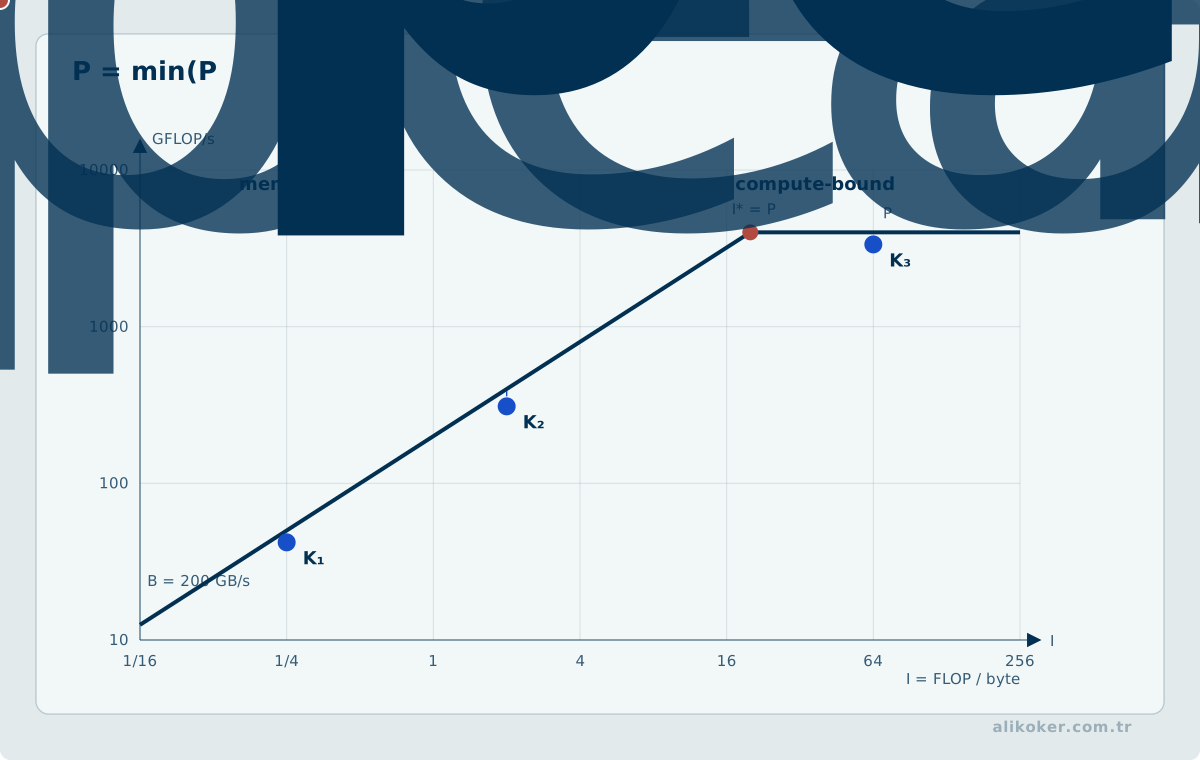
AI is described mathematically but runs on physical machines. SIMD applies one instruction to multiple data elements; SSE, AVX, AVX2, AVX-512, NEON, and SVE are examples. GPUs organize many simpler execution units for high data parallelism.
In SIMT-style execution, branch divergence inside a warp or wavefront reduces efficiency. TPUs are data-center accelerators designed for tensor-heavy workloads. NPU is a broader class of low-power neural inference accelerators often used in edge or client devices.
An NPU is not an “electronic brain”; it is specialized numerical hardware. Peak TFLOPS or TOPS does not describe full application performance. The Roofline model bounds performance by compute throughput and memory bandwidth times arithmetic intensity:
Performance <= min(PeakCompute, MemoryBandwidth * ArithmeticIntensity)Amdahl's law shows why accelerating only one fraction of a program limits total speedup:
Speedup = 1 / ((1 - p) + p / s)In LLM inference, prefill is typically more parallel and compute-heavy, while decode is more sequential and often memory-bandwidth-sensitive. Cache locality, NUMA placement, memory bandwidth, and data layout can dominate large embedding and KV-cache workloads.
Apple Silicon's unified memory is one example of how CPU/GPU data movement can change under a different architecture. Metal, MPS, and MLX expose different levels of acceleration. The persistent lesson is not the product name but that framework, compiler, runtime, memory model, and hardware jointly determine performance.
AI inference compilers and heterogeneous execution
Tensor operations in a model graph are not executed by hardware in exactly the form in which they are written. The AI compiler layer lowers that graph into kernels, vector operations, memory accesses, and device-placement decisions.
Operator fusion can reduce intermediate memory traffic. Tiling can keep working sets closer to fast memory. Kernel selection can change with tensor shape and precision. When the same model runs at different speeds under two runtimes, the difference often lies in these execution decisions rather than in the model mathematics.
CPUs can remain appropriate for control-heavy work while GPUs and other accelerators handle dense parallel computation. Heterogeneous inference is not about sending every operation to an accelerator; it is about placing work while accounting for data movement and synchronization cost.
Serving: latency, throughput, streaming, batching, and KV cache
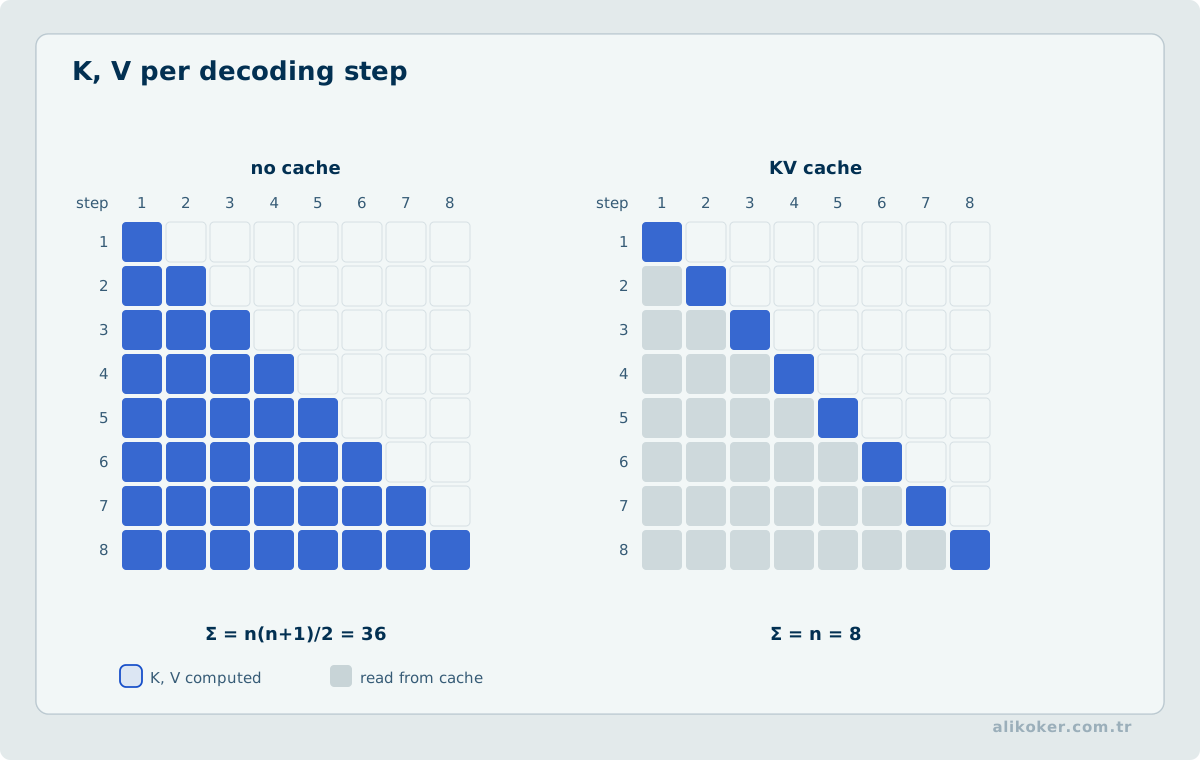
Users experience several forms of latency: time to first token, token generation rate, end-to-end time, and tail latency. Streaming sends partial output as tokens become available and improves perceived responsiveness, while introducing cancellation, partial-output, and error-policy questions. Batching improves accelerator utilization by serving multiple requests together.
Large batches can increase throughput while delaying individual requests. Continuous batching dynamically combines active sequences of different lengths to improve utilization. Interactive assistants and offline batch inference therefore optimize different objectives.
During autoregressive decoding, prior key and value tensors would otherwise be recomputed repeatedly. The KV cache stores them. It accelerates generation at the cost of memory that grows with sequence length, layer structure, and concurrency.
This is one reason long-context serving is expensive.
PagedAttention treats the KV cache as blocks rather than requiring one large contiguous allocation per request, borrowing an idea from virtual-memory systems. For variable-length concurrent requests this can reduce fragmentation and unnecessary copying and allow denser batching. vLLM uses this approach at the serving layer together with continuous batching; it is an inference-time memory-management decision rather than a change to the model's mathematical attention definition. (Kwon et al., 2023)
Speculative decoding lets a smaller or cheaper draft model propose several tokens and uses the target model to verify those candidates in parallel. Chen and colleagues' speculative-sampling work and Leviathan, Kalman, and Matias's speculative-decoding work developed closely related acceleration ideas independently in 2023. With a favorable acceptance rate it can reduce decode latency while preserving the target distribution; the realized gain depends on draft cost, acceptance rate, batching, and hardware. (Chen et al., 2023; Leviathan, Kalman & Matias, 2023)
The modern sparsely gated Mixture-of-Experts line in neural networks was demonstrated at large scale by Shazeer and colleagues in 2017; Switch Transformer later scaled the approach with simpler routing. In MoE models, a router can send each token to only a small subset of experts instead of activating every parameter. This separates total parameter capacity from active computation per token, while introducing new concerns such as routing balance, expert capacity, and communication cost in multi-device deployments. (Shazeer et al., 2017; Fedus, Zoph & Shazeer, 2021)
Transformers are not the only sequence-model family. Selective state-space models such as Mamba provide an attention-free recurrent/state-space route with computation that scales linearly with sequence length. This does not make Transformers obsolete; architecture choice still depends on pretraining quality, task behavior, hardware, latency, and ecosystem support. (Gu & Dao, 2023)
A declared maximum context length is not by itself evidence that all of that context is equally usable. Needle-in-a-haystack style retrieval tests are useful for probing whether information remains recoverable at different positions in long contexts, but real workloads can add multi-evidence reasoning, distractors, retrieval errors, and agentic error chains.
Quantization uses lower numerical precision for weights and sometimes activations. FP32, FP16, BF16, FP8, INT8, and INT4 occupy different quality–efficiency points. Aggressive quantization can reduce task fidelity. “The model fits in memory” is not the same as “the model preserves acceptable quality on the target workload.”
2022–2026: from model to system, from system to agent
A large language model is not a production system by itself. After 2022, much of the engineering progress appeared in the integration of models with retrieval, memory, tools, state, and verification.
Early LLM applications often had a simple architecture: prepare a prompt, send it to a model, receive text. Within a few years, retrieval, tool calling, memory, state, retries, authorization, validation, and evaluation accumulated around the model. The question “which model?” still matters, but it no longer describes the system.
A useful production principle is to treat the LLM as a probabilistic proposal generator rather than as the direct authority over real-world state. For side-effecting systems, a three-layer design provides a strong baseline:
1. Probabilistic inference
   -> model proposal / candidate plan / candidate data

2. Deterministic validation
   -> schema
   -> business rules
   -> authorization
   -> invariants
   -> accept / reject

3. Controlled execution
   -> idempotent operation
   -> bounded impact
   -> logging
   -> rollback / compensation
This distinction is valuable in digital forensics, finance, public systems, manufacturing, health, and security. A model sounding confident is not a reason to bypass validation. Silently “fixing” a bad proposal and then executing it can also be dangerous because it blurs which decision came from the model and which from the validator.
Prompt engineering: from instruction wording to experiment design
A prompt defines the runtime task and context. Good prompts do not have to be long. Objective, necessary context, output schema, constraints, and a few representative examples often form a useful structure.
Few-shot examples can demonstrate task form; poor examples can teach an unwanted pattern. Where structured output is required, schema- or grammar-constrained generation is stronger than a natural-language request to “please return JSON.” Syntax-valid JSON can still violate business rules, so a second validator remains necessary. Because external documents can contain prompt injection, the system architecture—not just prompt wording—must define the boundary between instruction and untrusted data.
Prompt changes should be versioned like code changes because they can materially change model behavior. An eval result is stronger evidence than “the new prompt looks clearer.”
Retrieval and RAG: connecting the model to external evidence
Retrieval-Augmented Generation combines generation with evidence fetched from external sources:
question
-> query normalization / rewriting
-> retrieval
-> candidate documents
-> reranking
-> context assembly
-> LLM
-> cited answer / abstention
Lexical retrieval such as BM25 responds strongly to explicit term overlap. Dense retrieval uses embeddings to recover semantic similarity. Hybrid retrieval combines the two, which is valuable when exact identifiers, legal clauses, product names, abbreviations, and paraphrases coexist.
Rank-based fusion methods such as Reciprocal Rank Fusion (RRF) can merge heterogeneous rankings without directly comparing raw score scales. Chunking defines the unit of retrieval. Large chunks carry context but also noise; small chunks improve precision but can lose necessary context.
Structure-aware chunking by headings, paragraphs, list items, or code blocks often preserves document meaning better than fixed lengths alone. Overlap can reduce boundary loss at the cost of index growth and duplicate evidence. Metadata filters apply language, date, document type, product, department, or authorization boundaries before semantic ranking.
They are often a cheaper and more reliable improvement than training a new embedding model. A vector database is retrieval infrastructure, not intelligence. Approximate nearest-neighbor methods such as HNSW trade a small amount of recall for much lower latency at large scale.
Rerankers apply a more expensive relevance model to a short candidate list. Bi-encoder retrieval followed by cross-encoder reranking is a common pattern. Query rewriting can improve short or ambiguous queries, but a mistaken rewrite becomes a new failure mode, so the original query and transformation should remain observable.
RAG does not guarantee correctness. A wrong document can be retrieved, a correct document can be misinterpreted, stale evidence can be selected, or unauthorized material can enter the context. Freshness, provenance, citations, access control, and abstention are part of the RAG system.
Context engineering: what should the model see, and when?
Prompt engineering is not simply the art of writing elegant instructions. A broader context engineering view became increasingly important in the 2024–2026 period: what information, tools, state, ordering, and budget should the model receive? A large context window can still be filled with irrelevant material, stale failed attempts, or duplicated evidence.
Longer context is not automatically better context. It helps to separate context into layers. System policy and tool definitions are relatively stable.
Shared reference material changes less frequently. Conversation history grows dynamically. The current task and latest tool results change most often.
Keeping stable prefixes early and dynamic content later can also improve prompt caching and traceability.
Preloading works when a small body of information is almost always needed. Just-in-time retrieval is better when a large corpus is only sparsely accessed. Progressive disclosure supplies metadata or summaries first and reveals full detail only when needed, reducing token cost and unnecessary exposure of sensitive data.
Long sessions need compaction. Compressing old history into a smaller representation saves context, but a free-form summary can lose facts. Durable decisions, identifiers, permissions, file paths, and validation results should therefore live in structured state rather than only in conversational summary.
Agent memory can be separated into parametric memory in model weights, short-term working memory in active context/state, and long-term external memory in databases, files, vector stores, or event logs. “The weights do not change” and “the system has no memory” are not equivalent statements. Subagents are also a context-management technique. A main agent can delegate research, review, or a narrow specialist task instead of ingesting every source itself.
Information loss is lower when the subagent returns evidence, file references, exact citations, or structured results rather than a loose summary. Multi-agent value comes from well-bounded parallel work, not from agent count alone.
In-context learning and continual learning are also different processes. In few-shot or in-context use, demonstrations are supplied in the inference context; in the classical setting no gradient update or task-specific fine-tuning is performed. (Brown et al., 2020) The model can condition its behavior on that context, but this alone does not imply persistent learning in its weights.
Continual learning aims at persistent adaptation to new knowledge, tasks, or distributions over time and can include continual pre-training, instruction tuning, alignment, or other parameter-updating methods. Adding new knowledge while preserving earlier capabilities introduces a separate engineering problem that includes catastrophic forgetting. RAG and external memory can supply current information without being the same mechanism as parameter updating. (Wu et al., 2024)
Token economics and prompt caching
Token cost is more than billing; it affects latency and capacity. Prompt length drives prefill cost, while output length drives decode cost. If a stable prefix repeats across many requests, prompt caching can reduce repeated computation.
Cache hit rate, TTL, prefix stability, and model version should still be monitored. Caching has architectural consequences. A prompt with stable policy, tool schemas, and shared references followed by dynamic task content is easier to reuse.
But a cache must never become a reason to keep stale policy or outdated tool definitions. Caching is a performance mechanism, not a correctness mechanism. Token economics becomes even more important in multi-agent systems.
Sending the same long document to three workers can roughly triple context processing. Parallelism can reduce wall-clock time while increasing total compute. Each delegated task should therefore have a measurable expected benefit.
Capacity economics and cost per successful task
Token price is not the physical cost of inference itself. API and subscription prices are commercial tariffs; actual serving cost varies with model, hardware, precision, batch size, KV/prompt caching, context and output length, utilization, networking, energy, and orchestration behavior. It is therefore incorrect to infer a provider's marginal cost directly from the theoretical API-equivalent value of a subscription.
Serving capacity is a two-sided planning problem. Overprovisioning reduces GPU and capital utilization; underprovisioning turns into queues, rate limits, tail latency, and availability problems. The useful metric is therefore not only cost/token but total cost per accepted result:
cost of successful task
= inference
+ retrieval / tool calls
+ retry / replanning
+ deterministic or human verification
+ failure remediation
Cheaper tokens do not necessarily produce a cheaper task. Longer context, more retries, or a lower success rate can increase total cost; conversely, a higher-priced model can reduce accepted-output cost when it needs fewer attempts and less verification. Economic comparisons should hold task, quality threshold, and failure cost constant.
Tool design: the contract between model and computer
In tool calling, the model does not interact directly with an API; it interprets the tool contract. Tool names, descriptions, parameter schemas, error models, and response structure all influence behavior. Clear functions such as search_records, get_record, and update_record may be safer than one vague all-purpose tool.
Hundreds of tiny functions can create the opposite problem by overwhelming selection. Function consolidation and namespacing should be evaluated against real workloads. Tool responses return to context, so response design is part of token budgeting. A tool that dumps tens of megabytes of logs is not useful.
Pagination, truncation, server-side filtering, and field selection should be built in. If a result says not only “1,000 records found” but also provides a cursor, limit reason, or suggested narrowing field, the agent can plan the next step more reliably. An error response is information to the agent.
Machine-readable categories such as permission_denied, validation_failed, rate_limited, not_found, and conflict make retry and escalation policies more predictable. Raw stack traces can waste tokens and leak information. Tool development benefits from eval-driven design.
Build a small set of representative tasks and measure whether the model chooses the right tool, fills arguments correctly, avoids unnecessary calls, and recovers appropriately after errors. Changing a tool schema is therefore a model-behavior change, not merely an API refactor.
When hundreds of tools exist, exposing every schema in every prompt wastes context. Tool search or progressive tool disclosure allows the model to search a catalog and load detailed schemas only for relevant tools. That reduces context at the cost of introducing a new discovery stage that itself requires evaluation.
Programmatic tool calling can let a model orchestrate many calls through a controlled code fragment rather than narrating every step. The generated code should not run in an unrestricted environment. Sandbox boundaries, allowlists, CPU/memory/time limits, and network policy belong to the execution layer.
Reasoning budgets and auditability
Some modern model products expose additional inference compute through features called reasoning budgets, thinking modes, or similar names. The persistent engineering question is not the branding but the trade-off between additional inference, quality, latency, and cost. A model's private reasoning process should not be treated as a trustworthy audit log.
A production audit trail should record inputs, model and version, parameters, retrieval sources, tool calls, validator results, final decisions, and side effects. Free-form internal reasoning is neither a deterministic execution trace nor a substitute for external evidence. It is useful for an agent to revise plans after tool results arrive.
The general pattern is:
plan
-> tool
-> observation
-> update plan
-> next tool
-> validate
The same power creates the risk of accumulated error. Maximum steps, budgets, timeouts, and stop conditions should be explicit.
Five recurring workflow patterns
- Several reliable LLM application patterns exist even before we call a system an “agent.”
Prompt chaining splits a task into sequential, independently inspectable stages. One stage may extract structured fields, the next validate them, and the final stage generate a report. It improves localization of errors but adds latency.
Routing classifies the input and sends it to an appropriate model, prompt, or workflow. Simple requests can use a smaller model, complex ones a more capable system. Router errors can silently degrade quality, so confidence thresholds and fallbacks matter.
Parallelization runs independent subproblems simultaneously. Security, correctness, and style review can run in parallel, or multiple candidate solutions can be generated for later selection. Parallelism reduces wall-clock time while increasing cost and aggregation complexity.
Orchestrator–workers is useful when subproblems are not known in advance. A higher-level model decomposes a repository investigation, literature search, or large research task and assigns workers dynamically. Persisting the plan as state makes long tasks restartable.
Evaluator–optimizer uses an evaluation stage to critique and improve an output. When deterministic validators exist—compiler, schema validator, unit test, proof checker—they should take precedence over purely model-based critique.
Autonomous agent loops and state management
An agent differs from a fixed workflow when the model chooses control flow at runtime. A general loop is:
goal
-> observe state
-> choose action
-> call tool / act
-> observe result
-> update state
-> stop or continue
For short tasks this is simple; for long-horizon work, error accumulation becomes central. If dependent-step failures are approximated as independent, a 30-step chain with 98 percent per-step correctness has only 0.98^30 ~= 0.545 probability that every step is correct. Real agent failures need not be independent; the number is only an illustration of multiplicative error accumulation. Checkpoints, invariants, retry policies, compensation, and bounded autonomy are therefore required.
Agent state should not be identical to raw conversation history. Completed subtasks, unresolved risks, evidence sources, changed files, test results, and remaining budget can be stored explicitly. This prevents operational facts from disappearing when context is compacted.
Durable execution decouples the task from one process lifetime. A long job can resume from a checkpoint after a restart. Side-effecting actions need idempotency keys to prevent duplicates.
Non-idempotent operations may require compensation or explicit human approval. A purely synchronous loop can become bottlenecked by I/O. Independent tool calls can run asynchronously or in parallel, but concurrent state mutation can create race conditions.
Parallelism is safe only where independence is understood.
Multi-agent systems
A multi-agent system is not simply “one model but smarter.” It is a division of work among agents with separate contexts, roles, or tool permissions. One agent may search sources, another modify code, another verify citations, and another perform risk review. Good delegation specifies an output contract.
Which files may a worker modify? Which sources are acceptable? What evidence must it return?
When should it stop instead of improvising? The orchestrator can validate the contract before accepting a result. The telephone-game problem appears when one agent's free-form summary becomes the next agent's only source.
File references, structured artifacts, exact citations, and test outputs preserve evidence better. In long-horizon systems the key question becomes not “what did the agent say?” but “which artifact passed which validation?” State-changing agents require more than text-quality evaluation.
An eval may need to assert that the agent did not modify an unrelated file, did not call an unauthorized API, remained idempotent under retries, and returned to a safe state after failure.
Advanced retrieval and agentic search
Classical RAG preprocesses a corpus into chunks and retrieves top-k results from fixed indexes. Agentic search can choose, at query time, which source to search, which subquery to issue, and whether another search round is necessary. This is powerful for heterogeneous corpora but increases latency, cost, and reproducibility complexity.
Contextual retrieval enriches a chunk with information about its location in the source document. This can help when a passage contains local references that make little sense in isolation. Automatically generated context can also be wrong, so it becomes another indexed artifact that must be evaluated.
Hybrid search combines dense and sparse retrieval. Raw scores are not always comparable, which motivates rank-fusion methods. Reranking is expensive, so the retrieval candidate count, reranker count, and final context count should be separate tunable parameters.
Retrieving 100, reranking 20, and passing 6 is a different system from retrieving 6 directly. Retrieval should be evaluated at its own layer. Recall@k asks whether relevant evidence reached the candidate set.
MRR measures where the first relevant result appears. nDCG handles graded relevance. Generation-level metrics such as groundedness, citation correctness, and answer completeness come afterward.
Separating retrieval failure from generation failure prevents teams from optimizing the wrong component. Citations also deserve their own validation. A list of URLs at the end of an answer does not prove that each claim is supported.
In academic or forensic systems, the relation between a claim and a specific evidence span should be inspectable.
Model Context Protocol and standardized tool interfaces
Model Context Protocol (MCP) is an open interface approach for connecting model/agent applications with tools, resources, and reusable interaction definitions through a common protocol. Its value is not that it eliminates integration code, but that it can standardize capability discovery and the client–server boundary.
The 2026-07-28 specification moved the MCP core to a stateless request/response model. The earlier initialize / initialized handshake and mandatory Mcp-Session-Id session model were retired for this protocol revision; each request carries its own protocol/client metadata and capability discovery can be performed separately when needed. This does not prohibit stateful applications: persistent workflow state, memory, and transaction context can remain at the application layer. Legacy clients and servers may continue to speak older protocol revisions with session semantics, so version compatibility must be managed explicitly. (Model Context Protocol, 2026)
Tools, resources, and prompts represent different kinds of capability. A tool may perform side effects, a resource exposes data, and a prompt is a reusable interaction template. These distinctions should map to authorization. Reading a resource and invoking an irreversible tool must not share the same permission semantics.
Local processes can use stdio while remote systems can use HTTP-based transport. The new stateless core improves load balancing and horizontal scaling, but it does not remove the need for authentication, token scope, TLS, origin policy, and authorization. Cacheable results for operations such as tools/list, prompts/list, and resources/list/read can improve context and upstream prompt-cache stability; caching is still not a correctness or authorization mechanism. (Model Context Protocol, 2026)
Exposing hundreds of tools at once can recreate context overload, so tool search and progressive disclosure remain useful. Code execution layered over MCP can orchestrate many calls through a small program, but filesystem, network, secrets, CPU/memory/time, and process limits must be enforced by a sandbox. Privacy-preserving designs should aggregate, filter, or redact server-side when raw data is unnecessary.
Persistent state, skills, and long-term memory sit above the protocol. Such state needs provenance, expiry, authorization, idempotency, and transaction or compensation semantics when appropriate.
Agentic coding: from code generation to verifiable change
A coding model can miss repository context, existing behavior, and hidden constraints when it attempts a large one-shot change. Agentic coding is therefore not simply a longer prompt; it is a loop of investigation, small changes, tool use, and verification.
inspect existing behavior
-> plan the change
-> implement a small step
-> compile and test
-> inspect the diff and result
-> revert when necessary
The model is useful for proposing candidates and searching a large codebase quickly. Acceptance criteria should remain independent of the model. Build results, existing tests, task-specific validators, and measurable acceptance criteria provide stronger evidence than the model's own explanation.
Persistent repository constraints can be encoded as explicit instructions, access boundaries, and automated checks rather than repeatedly restated in context. Separate coding agents may implement and review, but approval from a second model is not a substitute for independent verification.
Common failures converge on the same pattern: rewriting working behavior before understanding it, performing unnecessarily large refactors, repeating failed approaches, adapting tests or benchmarks to a desired result, and moving restricted data into model context. A reliable agentic-coding system designs these boundaries as carefully as it designs code generation.
A coding benchmark score is not the same measurement as real developer productivity. In METR's 2025 randomized controlled trial, experienced developers working in mature open-source repositories that they knew well took 19 percent longer on average when they were allowed to use early-2025 AI tools; the study explicitly cautioned against generalizing this result to all software development. (Becker et al., 2025) A 2026 follow-up found signals that newer tools may provide more speedup, but selection effects from developers unwilling to work without AI and time-measurement problems with concurrent agents made the magnitude unreliable. (Becker et al., 2026)
The two results should be read together. Neither “AI definitely speeds up coding” nor “AI definitely slows down coding” is supported as a universal claim. Effects depend on task type, repository familiarity, model/toolchain, developer experience, verification burden, concurrency, and acceptance criteria. Production evaluation should measure time per accepted change, defect/rework rate, and maintenance cost rather than only generated-code volume.
Deterministic verification of AI output
A probabilistic model's proposal should not automatically become the action accepted by a system. A structured-output schema constrains form, business rules constrain real-world validity, and authorization constrains which actions the model is allowed to perform.
A tool call can pass through a chain such as:
model proposal
-> schema validation
-> authorization
-> task rule / invariant
-> independent computation when needed
-> action
-> audit record
SAT/SMT solvers, mathematical checks, parsers, checksums, and task-specific deterministic validators can provide evidence independent of model output for some problem classes. A verifier can also be wrong, but using a different error channel is stronger than asking the same model to approve its own answer.
This separation matters most in agentic systems. A model may plan and select tools, while irreversible, costly, or security-sensitive actions still require an independently defined acceptance condition.
Production reliability: calibration, drift, verification, and change management
Production success cannot be reduced to benchmark scores. Even with a fixed model, changes in data, retrieval, prompts, tools, or authorization can change system behavior. Evaluation, observability, and change management therefore belong to one engineering problem. (NIST, 2023)
Schema-valid output is not necessarily semantically correct. Model confidence is not the same as empirical correctness. Calibration measures that gap.
Thresholds should be selected against operational cost. Drift should be monitored in data sources as well as model metrics. A broken data contract can break the system even when the model is unchanged.
A prompt change is a version change. A retrieval-index change is a version change. A tool-schema change is a version change.
A model file belongs to the software supply chain. Unsafe serialization formats can carry code-execution risk. Model supply-chain controls include source, hash, signature, license, dependency, and provenance.
Data poisoning targets training data. Knowledge-base poisoning targets retrieval sources. Prompt injection collides instructions with untrusted data in the same context.
Indirect prompt injection can arrive through retrieved content. Least privilege limits blast radius. Tool permissions should distinguish read, write, and side effects.
Automatic retry belongs only to idempotent or explicitly safe operations. A failure budget quantifies tolerated system failure. Production SLOs are broader than accuracy.
Latency, availability, abstention, citation correctness, cost, and security can all be measured. A reproducibility manifest records model, data, prompt, retrieval, tool, and code versions. Change management requires regression tests for each layer.
Evals: from model testing to system evaluation
Unit tests are ideal when one input has one deterministic expected output. LLM tasks can have multiple acceptable phrasings, so exact string comparison is often insufficient. Evals define task-specific success over a representative workload.
A small, well-reviewed eval set can be more valuable than a huge generic benchmark. Start with the most important real tasks, define expected properties, then expand coverage. Repeatedly optimizing the same prompt against the same visible eval set causes evaluation overfitting; hidden or periodically refreshed tasks are useful.
LLM-as-judge scales open-ended assessment but introduces another model. Position bias, verbosity bias, self-preference, and domain error are possible. Rubrics, pairwise comparison, blinded ordering, and calibration against humans reduce risk.
Where a compiler, unit test, schema validator, or theorem checker exists, the deterministic validator should not be replaced by a model judge. Human evaluation remains important for semantic qualities such as usefulness, naturalness, domain acceptability, and harm. Low annotator agreement may indicate that the rubric is unclear rather than that the model is uniquely difficult to score.
An error taxonomy—retrieval miss, unsupported claim, wrong tool, invalid argument, reasoning error, format failure, unsafe action—is often more actionable than one aggregate score. Deployment introduces new distributions, languages, context lengths, and tool combinations that offline evals may not contain. Evals therefore continue into production monitoring rather than ending before release.
A red-team or stress-test result is not the same evidence as the incidence rate in real deployment. An evaluation report should record not only the model revision but also the prompt, system instruction, scaffold/harness, tool permissions, retry budget, initial state, and success criterion. The 2023 GPT-4 ARC TaskRabbit/CAPTCHA example occurred in a controlled evaluation where the model was given external tools and a mechanism for delegating to humans; it was not a field incident in which an independently deployed model spontaneously initiated the same behavior. (OpenAI, 2023)
Likewise, the blackmail behaviors in Anthropic's agentic-misalignment work occurred in fictional corporate environments under adversarial simulations with email access and action permissions. The models were not explicitly instructed to blackmail; the behavior appeared under conditions such as replacement threats or goal conflict, and the study did not claim that the same behavior had been observed in real deployments. (Anthropic, 2025) Such experiments are evidence about capability and risk surface, not a direct measurement of real-world base rates.
Observability: reconstructing probabilistic behavior
In a distributed AI system, one error rarely lives in one log line. A correlation ID should be able to connect the request, retrieval query, document IDs, model/prompt/tool versions, token counts, latency, tool sequence, validation outcome, and final side effect. Observability has at least two layers.
Traditional systems metrics include CPU, memory, queue depth, errors, throughput, and latency. AI-specific signals include retrieval recall, tool success, refusal rate, groundedness, context size, token cost, step count, and eval outcomes. The layers interact: a GPU-capacity issue can become a quality issue if timeouts force fallback models.
A model version is a dependency. If behavior can change behind a moving alias, exact version, deployment date, and eval baseline should be recorded where possible. Prompt, tool-schema, and retrieval-index versions deserve the same treatment. “It worked yesterday” is useful only if the changed component can be identified.
Average latency can conceal poor tail behavior. P95/P99 latency affects user experience and timeout behavior. In agent chains, tail latency compounds across steps.
Queueing, retries, and rate limits can turn individual slowness into a capacity incident.
Security: from prompt injection to blast radius
Natural language can act as both data and instruction-like content, so command/data separation reappears in a new form. Prompt injection occurs when untrusted content attempts to redirect model behavior. Telling the model to “ignore instructions inside documents” is not a strong security boundary because the untrusted document is already in model context. Secure architecture places external limits around the model.
Tool allowlists, parameter validation, RBAC/ABAC, sandboxing, network policy, filesystem boundaries, secret isolation, and human approval are actual enforcement layers. Model policy is one layer, not the entire defense.
Blast radius is the maximum effect of a single failure. A read-only research agent and an agent allowed to delete production records have fundamentally different threat models. Authority should be minimized; risky actions should be reversible or approval-gated; bulk operations need independent limits.
Prompt injection is usefully compared with input-validation problems but is not identical to SQL injection. Natural language is inherently ambiguous, so lexical filtering cannot reliably separate malicious instructions from data. Architecture-level least privilege and output validation are more durable defenses.
Prompt Injection is one of the central agent-security problems created when untrusted content can be interpreted as instruction. Privacy belongs to the same design. The strongest minimization is not sending sensitive fields when they are unnecessary.
Redaction, field-level filtering, local inference, retention policy, and auditing are additional controls. Running a model locally can improve control, but host security, logs, storage, model supply chain, and user permissions remain relevant.
Provenance and evidence in high-risk AI systems
In high-risk use, model interpretation should remain separate from source evidence. A model may classify a document, recording, or image, but that prediction does not replace the original data, timestamps, or measurement records. It should be possible to trace a result back to its inputs, model, and external sources.
Digital forensics makes this requirement especially visible, but the principle is broader. Healthcare, security, finance, and critical operations also need a separation between AI interpretation and the underlying evidence. In a retrieval system, source-document identity and version matter; in a model-driven system, model version, prompt, decoding settings, and tool calls can matter for audit.
Determinism should be required at the appropriate layer. The same LLM input may not always produce bit-identical text, while hashes, authorization, parsers, validators, and audit records can be deterministic. The practical goal is not necessarily to reproduce every token but to reconstruct which evidence entered which decision path.
A critical AI architecture therefore keeps probabilistic interpretation as a separate layer above immutable source data. Assistance from a model does not imply authority to alter the evidence itself.
Case study: AI-assisted forensic audio in a closed network
A high-volume closed-network audio pipeline illustrates the boundary between probabilistic AI and deterministic engineering. Source hash, channel metadata, codec, duration, and acquisition identity are deterministic metadata. Decode, resampling, and some segmentation operations can be reproducible under pinned versions.
Speech recognition and diarization produce probabilistic inference. A defensible pipeline can look like this:
original audio
-> immutable record + hash
-> deterministic decode / channel selection
-> segmentation
-> ASR / diarization proposals
-> validation and quality checks
-> indexing / search
-> human review
Model output does not replace source evidence. Low-confidence segments can be reprocessed, compared with another model, or routed to a human queue. GPU/CPU routing, batch size, INT8/FP16 precision, and model choice should be evaluated separately for recognition quality and latency.
When the recording format already provides reliable channel semantics, using physical channel information for speaker separation can be safer than introducing an unnecessary diarization model. This is a useful counterexample to the idea that every stage should become “AI-powered.” Deterministic information already present in the problem should be used first.
Case study: enterprise document question answering
In enterprise RAG, the first problem is not embedding choice. The system must know which documents a user may access, which version is current, which metadata is trustworthy, and which source supports an answer. An ingestion pipeline parses documents, cleans them, chunks them along structural boundaries, attaches metadata and ACLs, computes embeddings, and builds lexical/dense indexes.
At query time, user identity becomes authorization filters; hybrid retrieval generates candidates; a reranker narrows them; a context assembler selects evidence; the model generates an answer; and a citation validator checks the claim-to-source relation. The system therefore has multiple quality questions: did unauthorized evidence enter context? Was a stale version selected?
Does the citation actually support the claim? Was the right document present in top-k? Does the system abstain when evidence is insufficient? “The answer looked correct” is only one of many checks.
AI-assisted scientific research
AI can help with literature discovery, document classification, code generation, data cleaning, hypothesis exploration, and scientific writing. The major risks are fabricated citations, incorrect quotations, and persuasive synthesis that is difficult to verify. A healthier research workflow separates model synthesis from source records:
research question
-> bibliographic search
-> source selection
-> full-text reading
-> notes / data extraction
-> analysis
-> AI-assisted synthesis
-> verify again against sources
Product names can change; the durable method is to verify existence, DOI, publication venue, and the specific claim against the primary source. They do not guarantee that a PDF was parsed correctly or that a figure, table, or citation was understood. Critical quotations should be checked directly in the source.
AI in science is also more than writing assistance. Candidate generation in protein structure, materials, mathematics, algorithms, and experimental design becomes particularly valuable when an independent verifier is cheap. A theorem prover, compiler/test suite, laboratory experiment, or physical measurement closes the loop between generated hypothesis and evidence.
Computer-assisted proof, formal verification, and AI
The role of computers in mathematics predates modern AI and already raised questions about verification. Appel and Haken's work on the Four Color Theorem became a landmark because computer calculations were used to check reducibility over a finite set of configurations that was impractical to audit manually in full; the detailed proof appeared in two parts in 1977 (Appel & Haken, 1977; Appel, Haken & Koch, 1977). The epistemic issue was not only whether the conclusion was true, but which parts of a proof were human-readable and which parts depended on executable checking.
Modern AI makes the separation of roles even more explicit:
problem / conjecture
       |
       v
candidate or construction generation
       |
       v
proof search
       |
       v
proof object / derivation
       |
       v
independent verifier or small trusted kernel
       |
       v
human interpretation and mathematical meaning
These stages are not interchangeable. Generating a candidate does not establish a theorem; producing proof-like prose does not guarantee a valid derivation; and formal verification establishes validity only relative to the formalized statement, axioms, libraries, and trusted checking kernel. A perfectly functioning verifier can still certify a proof of the wrong target if the original problem was formalized incorrectly.
AlphaGeometry is a neuro-symbolic example of this division of labor: a language model guides auxiliary-construction choices for a symbolic deduction engine, and the system can produce human-readable geometry proofs (Trinh et al., 2024). AlphaProof instead operates in a Lean-based formal environment; reinforcement learning searches over proof steps while successful derivations are mechanically checkable in that environment (Hubert et al., 2026). Neither result should be reduced to the claim that a language model alone guarantees mathematical correctness.
The important engineering asymmetry is that finding a correct solution can require search over an enormous space while checking a proposed solution can sometimes be much cheaper and deterministic. Compilers, test suites, SAT/SMT solvers, proof kernels, and physical experiments instantiate the same general pattern. In such systems a generative model is a proposal engine, not the final authority; trust should be established after an independent verification boundary.
The 2020s: AI joins the search for algorithms
AlphaTensor used reinforcement learning to search for new factorizations for specific matrix-multiplication problems. AlphaDev treated low-level routine discovery as a search over candidate programs. The common idea is to use learned search over a very large candidate space rather than manually writing every candidate.
These results do not remove the limits of computational complexity. Finding a better candidate under a particular problem size and cost model is different from changing a general asymptotic lower bound. Whether P equals NP also remains open in 2026.
AI acts here as a proposal generator and search mechanism, not as an authority on algorithmic correctness. Equivalence, numerical correctness, complexity, and real-hardware performance still require model-independent verification. The example mirrors the broader division of labor between generative models and verifiers.
AI as a sociotechnical system
An AI system is more than a model. At minimum, it includes data, model/algorithm, software infrastructure, human organization, and legal/social environment. Failure in one layer can be amplified by another.
Bias can enter through sampling, labels, measurement instruments, target selection, deployment populations, and human decisions, not only through model weights. Fairness metrics can conflict; choosing a fairness criterion is partly a normative decision.
Automation bias occurs when people over-trust automated recommendations. Fluent explanations can intensify the effect. Interfaces should avoid overstating confidence, should expose sources and uncertainty, and should give decision-makers independent evidence in high-risk contexts.
The jigsaw effect occurs when individually low-sensitivity data points become identifying or sensitive when combined. Privacy design cannot ask only whether each field is harmless in isolation. Data minimization, purpose limitation, and retention constraints matter.
Synthetic data can reduce some privacy or scarcity problems but can reproduce the same biases as the source distribution. Deepfakes and synthetic media increase the importance of provenance and verification. “Generated by AI” does not automatically mean false; unsupported and unverifiable content is the real reliability problem. Environmental cost should not be summarized with one universal “water or carbon per query” number.
Hardware, data-center efficiency, electricity mix, model architecture, batching, token count, and utilization vary. More meaningful metrics include joules/request, Wh/task, GPU-hours, utilization, and regional carbon intensity.
AI governance: risk, roles, and the system lifecycle
AI governance is not merely a list of ethical principles. It is a systems-engineering problem that determines which actor manages which risk, at what lifecycle stage, and with what evidence. The same foundation model can create very different risk profiles when used as a research aid, a low-impact content assistant, or decision support that affects people's rights. Capability therefore has to be evaluated together with deployment context.
Regulation (EU) 2024/1689, the European Union's AI Act, is an important example of translating this distinction into a legal model of risk and roles. Its general date of application is 2 August 2026, while some provisions apply earlier and some obligations later under the phased schedule in Article 113. The framework should therefore not be reduced to "one AI law with one effective date." Providers, deployers, importers, distributors, and providers of general-purpose AI models do not occupy the same role or carry identical obligations.
For an engineering organization, regulatory requirements need to become concrete assurance artifacts:
intended purpose and system boundary
        |
        v
risk classification + accountable roles
        |
        v
data lineage / evaluation / security evidence
        |
        v
human oversight + records + incident handling
        |
        v
change management + post-deployment monitoring
The distinction can be summarized as:
model performance != system reliability != legal complianceA high accuracy score does not repair unauthorized data use, broken access control, ineffective human oversight, or weak change management. Conversely, completing a compliance checklist does not demonstrate that a model is reliable in deployment. Trustworthy operation requires technical measurements and governance evidence to remain aligned over time.
Human oversight is likewise more than placing an approval button in an interface. A reviewer needs independent evidence, visibility into uncertainty, sufficient time, and genuine authority to interrupt or override the system. Otherwise a "human-in-the-loop" label can transfer responsibility to a person without creating an effective control boundary.
Training data, generated output, and human authorship
Copyright questions around generative AI should not be collapsed into a single issue. At least three legal layers need to be kept separate:
1. training inputs and authority to use them
2. copyrightability of generated output
3. digital-replica interests in voice, face, or likeness
A conclusion at one layer does not automatically decide another. The legality of using a work during training depends on jurisdiction, licensing, applicable exceptions, and the facts of the use. Copyrightability of an output is a separate question about authorship and creative contribution. Rights implicated by a synthetic voice or face are not necessarily identical to copyright rights in the underlying material.
The U.S. Copyright Office's multi-part AI report provides a concrete national example of this separation. Its 2025 Copyrightability report concludes that using AI as an assistive tool does not itself prevent protection of human-authored expression, while prompts alone, without sufficient human creative control over expressive elements, do not automatically establish copyrightable human authorship. Separate parts of the report address digital replicas and generative-AI training (U.S. Copyright Office, 2024; 2025a; 2025b). These are conclusions about U.S. law and policy, not universal rules for every jurisdiction.
The engineering implication is broader: source, license and rights metadata; whether material was model-generated; meaningful human selection or modification; model/version; and relevant generation records should remain traceable when the use case requires them. Provenance is therefore not merely a citation feature. It is the evidence needed to answer later questions about rights, responsibility, and reproducibility.
Adoption, scale, and economic value are different measurements
The fact that a technology is being used does not by itself show that it has been scaled across the organization or that it creates economic value. The measurement chain should be separated:
access / experiment
-> regular use
-> workflow integration
-> scaled deployment
-> measured quality / productivity
-> economic value after total cost
Each transition requires separate evidence. In McKinsey's 2025 global survey, 88 percent of respondents reported AI use in at least one business function, while only 7 percent said AI had been fully scaled across their organizations. (McKinsey & Company, 2025) This is evidence of broad adoption; it is not audited ROI, causal productivity gain, or proof of equivalent willingness to pay.
For the same reason, active-user counts, token volume, or API-call volume should not be read as business value by themselves. Usage of a feature embedded by default is not the same economic signal as a service independently selected at its full cost. A robust evaluation combines incremental revenue/cost, task completion, quality, rework, failure cost, and opportunity cost.
Learning, cognitive offloading, and expertise
Humans have always offloaded memory into writing, books, calculators, and search engines. AI is another step in that history. Cognitive offloading is not inherently harmful.
The problem is when the tool removes the learning stimulus entirely. A learner may show high assisted performance while using AI but still have low acquired competence when the tool is removed. Education should distinguish the two.
Retrieval practice, spacing, active recall, and direct problem solving remain important even when information access is cheap. Expertise is not simply storing more facts. It includes representing the problem quickly, recognizing misleading metrics, anticipating edge cases, and rejecting bad solutions early.
As AI automates more routine code, the value of senior judgment may shift toward problem selection, validation, architecture, and risk. The easiest software tasks to automate tend to be routine transformations, standard CRUD, boilerplate, documentation drafts, and other outputs that are easy to verify. Harder areas remain requirements ambiguity, legacy behavior, distributed failure, performance, security, hardware, regulation, and long-term maintenance.
Eliminating the junior learning pipeline entirely would also create a future expertise problem; senior engineers need somewhere to acquire real problem-solving experience. The educational principle is simple: let AI carry cognitive load, but do not let it remove the learning stimulus.
How to measure frontier systems in 2026
Frontier systems are increasingly evaluated not only on single-turn question answering but on long reasoning, tool use, code execution, scientific search, and multi-step task completion. A benchmark therefore measures a model-plus-harness configuration, not an abstract model in isolation.
ARC-style tasks probe abstract generalization. Repository-level software benchmarks probe real issue resolution. Long-horizon evaluations ask how much human-equivalent work a system can complete under a defined success criterion. Contamination, tool access, retry budget, context, and evaluator design can materially change results.
There is no single accepted AGI test. Passing a Turing-style interaction or reaching one benchmark score does not establish human-equivalent general intelligence. The durable engineering question is narrower: under which conditions does the system succeed, how does it fail, and how much independent verification remains possible?
Unified engineering principles
This history converges on a small set of engineering principles. The first is the data and representation layer. Wrong labels, leakage, drift, or unauthorized sources are not repaired by a larger model. A model processes the measurements and representations it receives, not reality itself.
The second principle is to bound probabilistic components. A model may propose; schema checks, authorization, invariants, and deterministic validation decide whether an action is allowed to occur. When verification is expensive, automation authority should be lower.
The third principle is to separate capability from permission. A model being technically able to perform an action does not imply that it should be allowed to do so. Least privilege, reversibility, and blast-radius limits are security properties independent of benchmark quality.
The fourth principle is context discipline. Context is not a memory dump. The right evidence must arrive at the right time and in the right form. Retrieval is also not merely vector search: chunking, indexing, filtering, reranking, authorization, and freshness each need evaluation.
The fifth principle is measurement after deployment. Evals, tail latency, calibration, drift, rollback behavior, and immutable evidence belong to production engineering. In high-risk environments, the operational record must be stronger than the model's narrative about what happened.
Quick decision frames
Agent use should be decided from workflow structure. If steps are fixed, success criteria are explicit, and dynamic planning is unnecessary, a deterministic workflow is usually simpler and safer. Agents become useful when tool choice, decomposition, or planning must change at runtime.
Five questions are usually enough: Are the steps fixed? Is success measurable? Are tools required? Is failure reversible? Must the plan genuinely be selected dynamically by the model? High-frequency, low-complexity, hard-latency, or irreversible one-step operations often gain little from autonomy.
The choice between RAG and preloading all information follows the same logic. A small stable reference can fit directly into context. A large, changing, or access-controlled corpus benefits from retrieval. A large context window does not remove the problem of selecting relevant and authorized evidence.
Automation should also be graduated rather than binary: recommendation only; recommendation with human approval; bounded automatic action with audit; or higher autonomy. Increased model capability does not force the system toward the highest authority level.
Conclusion: tools changed in ten years; the distinctions did not
Over the following decade, AI changed dramatically. Perceptrons and classical multilayer networks gave way to Transformers and foundation models. Single-task systems expanded into multimodal models.
Prompts became RAG pipelines and agentic workflows. GPU and accelerator ecosystems grew, while model generation, coding assistance, and large-scale knowledge retrieval became widely accessible. The durable distinctions remained.
Data is not reality. Shannon information is not semantic meaning. Correlation is not causation.
Model output is not verified knowledge. High task performance is not proof of consciousness. Capability is not proof of a good objective.
A model being able to call a tool does not mean it should have permission to call it. More computation does not erase limits established by Gödel, Turing, information theory, or physics.
The more mature engineering question is therefore not “how impressive is the model?” but: under which conditions does this system work, when does it fail, how much impact can a failure create, and which part of the decision can be verified independently?
That perspective is also consistent with the Zen idea of clarity. Reducing unnecessary complexity does not mean deleting detail; it means making clear which question each detail answers. Sometimes the best AI decision is to use a larger model.
Sometimes it is to use a classical algorithm, require human approval, or decline to automate the task at all.
Unit 4: Evaluation, Evidence, and System Boundaries
Evaluating an AI claim begins by defining an observable result that would support it. Specify data selection, comparator, and metrics before testing. Evidence limited to successful examples must be complemented by failures and sampling uncertainty. System performance and model performance may require different measures; the effects of user interaction, retrieval, and downstream rules must be distinguished.
Evaluation leakage, human oversight, and system boundaries
AI quality is a property of the whole system, including retrieval, prompting, preprocessing, post-processing, and human decision steps. A model benchmark alone does not describe end-to-end behavior.
Evaluation can become optimistic when benchmark data leaks into training or is repeatedly used during development. Dataset provenance and feedback frequency therefore matter.
Human oversight is meaningful only when reviewers have enough context, time, and authority to override the system. Uncertainty indicators, evidence access, and escalation paths must be designed explicitly.
A learned association is not evidence of causation. A model may predict a higher failure rate in certain locations, but location does not thereby become the cause; maintenance frequency or equipment age may confound the association. A causal claim must address interventions, confounders and competing explanations. In high-impact applications, merely stating that a human is in the loop is not a sufficient safeguard: one must examine which evidence that person can see, which actions they can override and how much time is available to challenge an output. System behavior emerges from a wider technical and organizational arrangement than model parameters alone.
Separating levels of evidence in AI claims
A research result, a vendor benchmark, an independent replication, and a real-world observation are not equivalent evidence. Claims about model capability should state the dataset, metric, model version, and evaluation method.
One example does not establish general success or failure. Generative-model results are sensitive to example selection, so evaluation sets should be defined in advance and kept independent where practical.
Philosophical interpretation should also be separated from empirical claims. Arguments about consciousness, intention, meaning, or intelligence can be discussed, but they should not be presented as direct consequences of benchmark scores.
Separating the AI System from the Model
One of the most persistent conceptual errors in contemporary AI discussions is treating the capabilities of a foundation model as identical to the capabilities of the full software system. A user may interact with a product that searches the web, retrieves documents, executes code, calls tools, and remembers prior turns. Those behaviors can arise from several layers around the model.
User
 |
 v
Interface / Session
 |
 +--> Memory
 +--> Retrieval
 +--> Tools
 +--> Authorization
 +--> Validation
 |
 v
Foundation Model
This distinction is essential when evaluating AI capability. Current information can come from retrieval, arithmetic can be delegated to a calculator, structured facts can come from a database, and forbidden operations can be blocked by authorization policy. The observed product behavior is the composition of these layers.
Model, system, and task outcomes
Three measurement levels should remain separate.
Model metric
   -> output quality on a defined task

System metric
   -> latency + security + data access + failure behavior

Human / business metric
   -> was the real task completed?
A strong benchmark score does not guarantee a useful production system. A smaller model combined with reliable retrieval, explicit constraints, and human review may outperform a larger model for a bounded application.
Demo, benchmark, and production evidence
Claims should also be separated by evidence strength.
single demo
   |
controlled benchmark
   |
independent repeated evaluation
   |
production workload
   |
long-term behavior
An impressive demonstration is not evidence of broad generalization. A benchmark does not automatically establish production reliability. Distribution shift, user diversity, cost, latency, security, and failure modes still require direct evaluation.
Speech-recognition inference provides a concrete example of this evidence boundary. A controlled NVIDIA L40S experiment with CTranslate2/faster-whisper can disclose hardware, runtime, compute_type, input distribution, and RTF. The same RTF should not be promoted directly into a production-capacity claim: an end-to-end system also has CPU preprocessing, VAD and segmentation, queueing, GPU-memory and concurrency policy, I/O, and retry behavior. Capacity Engineering for Real-Time Speech Recognition treats that distinction as a measurement problem rather than a model-ranking problem.
Defining the AI System Beyond the Model
A language system is a pipeline spanning tokenization, representation, retrieval, context selection, inference, and evaluation. In an AI system, retrieval can fail by missing relevant evidence or ranking the wrong evidence highly, while a generative model can still distort an answer even when correct evidence is present; evaluation should therefore report factual correctness, evidence coverage, calibration, and contradiction with sources separately from fluency. Agentic or tool-using systems add a new latency and failure boundary at every extra step.
- Evaluate model output within the larger data, retrieval, tool, and user-interaction chain.
- Make accuracy versus latency/cost/reliability trade-offs explicit.
- Define automation boundaries separately for decisions that require human oversight.
Unit 5: Generative AI, Anthropomorphism, and Technical Maturity
Generative AI Is Not One Model Family
Variational autoencoders, generative adversarial networks, diffusion models, and autoregressive language models use different objectives and sampling mechanisms.
Generative Model
   |
   +--> VAE
   |     probabilistic latent space
   |
   +--> GAN
   |     generator-discriminator game
   |
   +--> Diffusion
   |     noise process and denoising
   |
   +--> Autoregressive Transformer
         next-unit probability
The useful question is not which family is universally best, but what assumptions each family makes and which data modality and task it serves.
Artificial Neural Networks and Learning Models develops the network-level mechanisms, while Large Language Models focuses on the autoregressive Transformer line.
Anthropomorphism, the ELIZA Effect, and Interface Illusions
Humans readily attribute intention, personality, and understanding to systems that produce fluent language. This effect predates modern neural models. Large language models amplify it because their linguistic behavior is substantially more capable.
Fluency alone does not establish:
- consciousness,
- subjective experience,
- human-like intention,
- persistent goals,
- a correct internal world model,
- moral responsibility.
Likewise, the existence of model errors does not imply that all AI methods are useless. Behavioral performance and philosophical claims must remain separate.
Observed behavior
       |
       v
Capability measurement
       |
       X
       |
       v
Consciousness / intention claim
The X marks an inference that requires additional evidence.
Fluent language generation is not evidence of consciousness, truthfulness or intentional agency. A system may convincingly imitate conversational patterns while remaining unable to verify a claim about the external world. This distinction has practical engineering consequences: a persuasive answer without traceable support has limited evidential value. Synthetic research data and automatically generated references must not be confused with actual observations and verified bibliographic records. Each material analytical claim requires a provenance trail, a stated transformation method and, where appropriate, a route to independent checking.
Narrow AI, Generative AI, Foundation Models, and AGI
These terms should not be treated as synonyms.
Narrow AI addresses a bounded task or task family.
Generative AI produces new content such as text, images, audio, video, or code.
Foundation models are trained broadly and adapted to many downstream tasks.
AGI remains a stronger and inconsistently defined claim about general capability. A product label is not a scientific measurement.
A defensible statement is that a system shows broad capability across specified evaluations. That observation does not by itself prove human-level general intelligence.
AI Waves, Expectations, and Technical Maturity
AI history includes periods of rapid investment and optimism followed by visible technical limits and reduced enthusiasm. The historical phrase “AI winter” reflects this cycle.
Current generative AI should therefore be evaluated between two unsupported extremes:
"Everything has changed and the hard problems are solved."
                         X
"This is only hype and there is no technical progress."
A more useful approach identifies measured progress, cost and failure profiles, operational limits, maintenance requirements, and the difference between technical evidence and economic prediction.
Unit 6: Human Oversight, Agency, and Autonomy
Human Oversight and Cognitive Externalization
AI can draft, summarize, generate options, and prepare decisions. This externalizes part of cognitive work, but externalization is not the same as transferring responsibility.
Model
  -> proposes

Human / governed system
  -> verifies
  -> interprets context
  -> makes accountable decision
Higher automation may be acceptable for low-impact tasks. High-impact or difficult-to-reverse decisions require stronger oversight, traceability, and challenge mechanisms.
NIST's Generative AI Profile frames risk management across the AI lifecycle rather than reducing trustworthiness to model accuracy. The engineering implication is that trustworthy AI emerges from the combination of data, software, people, process, and governance.
Autonomy Boundaries in Agentic Systems
Agents connect models to tools and iterative action.
Input / Observation
      |
      v
Model
      |
      v
Plan / Tool selection
      |
      v
Action
      |
      v
New state
Tool access increases operational power but does not establish human-like volition. In engineering terms, autonomy should be described by what actions the system can perform, under which authorization, for how many steps, and with what stopping conditions.
Agent safety therefore combines:
capability
+ authorization
+ resource limits
+ stopping conditions
+ auditability
Unit 7: Probabilistic Inference, Sequential Decisions, and Multiagent AI
AI under uncertainty does not end with defining a probability distribution. A system must determine:
- which variables are conditionally independent,
- how observations update a posterior,
- what to do when exact inference is expensive,
- how to optimize long-term utility across sequential actions,
- how strategy changes when other decision makers are present.
d-Separation: reading conditional independence from a graph
Edges in a Bayesian network do more than illustrate a story; they encode conditional-independence structure.
d-Separation determines whether paths between sets of nodes are active or blocked given a set of observations.
Three structures are fundamental.
Chain:
A -> B -> Cconditioning on B blocks the path between A and C.
Fork:
A <- B -> Cconditioning on the common cause B can block the induced dependence.
Collider:
A -> B <- Cthe path is blocked when the collider is unobserved; observing the collider or one of its descendants can activate the path.
The collider case demonstrates why conditioning does not always reduce dependence.
Exact inference and factors
A Bayesian-network query has the form:
P(Query | Evidence)Expanding the full joint distribution can be prohibitively expensive.
Variable elimination multiplies local factors and sums out hidden variables incrementally.
initial factors
    ↓
apply evidence
    ↓
choose a hidden variable
    ↓
multiply factors containing it
    ↓
sum out the variable
    ↓
create a new factor
    ↓
repeat
The result can be exact, while computational cost depends strongly on elimination order because intermediate factors can grow dramatically.
Relevance pruning
Nodes that cannot influence the query under the observed evidence can be excluded from the computation.
Using graph structure to remove irrelevant variables can reduce factor size, memory, and inference cost.
Why exact inference becomes difficult
Node count alone does not determine cost.
The graph structure and the width of intermediate factors created by elimination are central.
Tree-like or polytree structures can support more efficient message passing, while densely connected graphs can make exact inference expensive.
Rejection sampling
A direct approximate strategy samples from the prior and rejects samples that disagree with evidence.
sample
  |
  +-- evidence matches -> keep
  |
  +-- evidence differs -> reject
When the evidence has low probability, most computation can be discarded.
Likelihood weighting
Likelihood weighting keeps evidence variables fixed and includes their likelihood in a sample weight.
non-evidence variables -> sample
evidence variables     -> fixed
weight                  -> product of evidence likelihoods
This avoids rejecting every incompatible sample, but weight degeneracy can still produce high-variance estimates.
Gibbs sampling
Gibbs sampling constructs a Markov chain.
Evidence remains fixed. A non-evidence variable is repeatedly resampled from its distribution conditioned on its Markov blanket.
state
  ↓
resample X_i
  ↓
new state
  ↓
repeat
After adequate mixing, visited-state frequencies can estimate posterior quantities.
Practical concerns include slow mixing, multimodality, correlation, burn-in, and effective sample size.
Approximate inference must therefore be evaluated as a stochastic computation rather than simply "taking random samples."
Bellman reasoning in MDPs
A Markov Decision Process can be represented by:
states S
actions A
transition P(s' | s,a)
reward R
discount gamma
State value includes expected discounted future utility, not only immediate reward.
Bellman optimality can be read as:
V*(s) =
max_a [
    R(s,a)
    +
    gamma * Σ P(s'|s,a) V*(s')
]
The equation converts a long-horizon decision problem into a recursive relation.
Value iteration
Value iteration repeatedly applies Bellman backups to a value estimate.
V_0
 ↓
Bellman backup
 ↓
V_1
 ↓
...
 ↓
convergence
An approximately optimal policy can then be extracted from the converged values.
Policy iteration
Policy iteration alternates:
1. policy evaluation
2. policy improvement
It evaluates the current policy and then replaces actions where another choice improves expected value.
Value iteration and policy iteration are distinct algorithms. Their relative efficiency depends on problem structure and evaluation cost.
Policy gradients and actor–critic learning
Value iteration is suited to finite, explicitly modeled state–action spaces. When transition probabilities are unknown or actions are continuous, the policy can be parameterized directly as π_θ(a|s). The objective is to optimize expected discounted return over trajectories: J(θ) = E_{τ~π_θ}[Σ_t γ^t r_t].
A trajectory-based policy-gradient estimator, under appropriate return and sampling assumptions, can be written as ∇_θ J ≈ (1/N) Σ_i Σ_t ∇_θ log π_θ(a_t^i|s_t^i) G_t^i. Subtracting a state-dependent, action-independent baseline from returns can reduce variance without altering the expected gradient. The advantage A(s,a) = Q(s,a) - V(s) measures an action's value relative to the state baseline.
The actor updates the action policy; the critic estimates values or advantages to help reduce gradient variance. An inaccurate critic can introduce bias. It matters whether training trajectories came from the current policy or an older behavior policy; use of off-policy data must address distribution mismatch. Action safety, exploration cost, and sample efficiency are central algorithm-selection criteria.
POMDPs: belief state instead of observed state
When the true state is not directly observable, the decision state can be a belief distribution:
belief(s)Observations update the belief through Bayesian filtering.
A POMDP can therefore be transformed conceptually into an MDP over belief states, but the belief space is continuous and can be computationally difficult.
Multiagent decisions
In a single-agent MDP, environment dynamics can be modeled independently of another strategic decision maker.
In multiagent settings, other agents also choose actions.
Environments can be:
cooperative
competitive
mixed-motive
Objectives, information, communication, and coordination assumptions change the solution concept.
In Monte Carlo tree search, a visit count is not proof that an action is objectively correct; it describes where a finite search budget was allocated. An exploration term directs some simulations toward less frequently tried actions and reduces premature commitment. High-variance rewards and hidden opponent information may change the ranking under the same budget. Evaluation should therefore record simulation count, random seed, and assumptions about the other agents instead of reporting only the selected move.
Normal-form, extensive-form, and repeated games
A normal-form game represents strategy choices and payoffs directly.
An extensive-form game represents action order and information through a game tree.
A repeated game studies how future interaction changes incentives in the current round.
A Nash equilibrium is a strategy profile in which no player can improve its own utility by unilateral deviation while the others remain fixed.
An equilibrium is not necessarily socially optimal, and multiple equilibria can create separate coordination problems.
Probabilistic programming
A probabilistic model can be specified as a stochastic generative program rather than as manually derived inference equations.
A probabilistic-programming system separates:
model program
+
observations
+
queries
+
inference engine
The same model can potentially be paired with different inference methods.
This separation is useful for hierarchical models, latent-variable models, and uncertainty propagation.
Probabilistic programming does not fix a wrong model, guarantee identifiability, or remove convergence and sampling cost.
Epistemic boundary of decision algorithms
Probability and utility calculations can identify:
the best action under the modelThey do not establish:
an absolutely correct real-world actionIf the transition model, reward function, or prior is wrong, an optimal policy can be optimal only inside that misspecified model.
A mature AI system therefore separates model uncertainty, data uncertainty, decision objective, and computational approximation.
Probabilistic inference and sequential decision making move AI from a predictive model toward a system that updates beliefs under uncertainty and chooses actions over time.
References
- Amodei, D. et al. (2016). Concrete Problems in AI Safety. arXiv:1606.06565.
- Anderson, S. L. (2008). Asimov's “Three Laws of Robotics” and Machine Metaethics. AI & Society, 22(4), 477–493. https://doi.org/10.1007/s00146-007-0094-5
- Anil K. Jain; Arun Ross; Salil Prabhakar. (2004). An Introduction to Biometric Recognition. IEEE Transactions on Circuits and Systems for Video Technology, 14(1), 4–20. doi:10.1109/TCSVT.2003.818349
- Anthropic. (2025). Agentic Misalignment: How LLMs Could Be Insider Threats. https://www.anthropic.com/research/agentic-misalignment
- Appel, K., & Haken, W. (1977). Every Planar Map Is Four Colorable. I: Discharging. Illinois Journal of Mathematics, 21(3), 429–490. https://doi.org/10.1215/ijm/1256049011
- Appel, K., Haken, W., & Koch, J. (1977). Every Planar Map Is Four Colorable. II: Reducibility. Illinois Journal of Mathematics, 21(3), 491–567. https://doi.org/10.1215/ijm/1256049012
- Arf, C. (1959). Makine Düşünebilir mi ve Nasıl Düşünebilir? Atatürk Üniversitesi 1958–1959 Öğretim Yılı Halk Konferansları.
- Autio, C., Schwartz, R., Dunietz, J., Jain, S., Stanley, M., Tabassi, E., Hall, P., & Roberts, K. (2024). Artificial Intelligence Risk Management Framework: Generative Artificial Intelligence Profile. NIST AI 600-1. https://doi.org/10.6028/NIST.AI.600-1
- Baars, B. J. (1988). A Cognitive Theory of Consciousness. Cambridge University Press.
- Becker, J., Rush, N., Barnes, B., & Rein, D. (2025). Measuring the Impact of Early-2025 AI on Experienced Open-Source Developer Productivity. METR. https://metr.org/blog/2025-07-10-early-2025-ai-experienced-os-dev-study/
- Becker, J., Rush, N., Cunningham, T., Rein, D., & Mahamud, K. (2026). We Are Changing our Developer Productivity Experiment Design. METR. https://metr.org/blog/2026-02-24-uplift-update/
- Bennett, C. H. (2003). Notes on Landauer's Principle, Reversible Computation, and Maxwell's Demon. Studies in History and Philosophy of Modern Physics, 34(3), 501–510.
- Berenji, H. R., & Khedkar, P. (1992). Learning and Tuning Fuzzy Logic Controllers Through Reinforcements. IEEE Transactions on Neural Networks, 3(5), 724–740. https://doi.org/10.1109/72.159061
- Bishop, C. M. (2006). Pattern Recognition and Machine Learning. Springer.
- Bostrom, N. (2014). Superintelligence: Paths, Dangers, Strategies. Oxford University Press.
- Brendan Gregg. Systems Performance: Enterprise and the Cloud. Pearson Education, 2014.
- Brown, T. B. et al. (2020). Language Models are Few-Shot Learners. NeurIPS 33.
- Browne, C. B. et al. (2012). A Survey of Monte Carlo Tree Search Methods. IEEE Transactions on Computational Intelligence and AI in Games, 4(1), 1–43.
- Butler, S. (1863) Darwin among the Machines. The Press, Christchurch, 13 June 1863.
- Caan, W. (2015). Chekhov's Corner: “The Machine Stops” by E. M. Forster. Journal of Public Health, 37(4), 744–745. https://doi.org/10.1093/pubmed/fdu081
- Chris Fregly. AI Systems Performance Engineering. O’Reilly Media, 2025.
- Daniel Jurafsky; James H. Martin. Speech and Language Processing. 3rd ed. draft, 2026.
- Čapek, K. (1920). R.U.R. (Rossum's Universal Robots).
- Chalmers, D. J. (1996). The Conscious Mind. Oxford University Press.
- Chalmers, D. J. (2004). T. M. A. M. I. C. G. (Ed.) Philosophers Explore The Matrix. Oxford University Press. https://doi.org/10.1093/oso/9780195181067.003.0009
- Chen, C., Borgeaud, S., Irving, G., Lespiau, J.-B., Sifre, L., & Jumper, J. (2023). Accelerating Large Language Model Decoding with Speculative Sampling. arXiv:2302.01318.
- Chong, S. S. H. (2019). G. I. T. S. I. Persons: A History. Oxford University Press. https://doi.org/10.1093/oso/9780190634384.003.0013
- Cortes, C., & Vapnik, V. (1995). Support-Vector Networks. Machine Learning, 20, 273–297.
- Cover, T. M., & Thomas, J. A. (2006). Elements of Information Theory (2nd ed.). Wiley.
- Dao, T., Fu, D. Y., Ermon, S., Rudra, A., & Ré, C. (2022). FlashAttention: Fast and Memory-Efficient Exact Attention with IO-Awareness. arXiv:2205.14135.
- Dettmers, T., Pagnoni, A., Holtzman, A., & Zettlemoyer, L. (2023). QLoRA: Efficient Finetuning of Quantized LLMs. NeurIPS 36.
- Devlin, J., Chang, M.-W., Lee, K., & Toutanova, K. (2019). BERT: Pre-training of Deep Bidirectional Transformers for Language Understanding. NAACL-HLT.
- Dieks, D. (1982). Communication by EPR Devices. Physics Letters A, 92(6), 271-272.
- Dihal, K. (2020). Enslaved Minds: Artificial Intelligence, Slavery, and Revolt. In AI Narratives: A History of Imaginative Thinking about Intelligent Machines. Oxford University Press. https://doi.org/10.1093/oso/9780198846666.003.0009
- European Parliament & Council of the European Union. (2024). Regulation (EU) 2024/1689 laying down harmonised rules on artificial intelligence (Artificial Intelligence Act). Official Journal of the European Union. https://eur-lex.europa.eu/eli/reg/2024/1689/oj
- Fano, R. M. (1961). Transmission of Information: A Statistical Theory of Communications. MIT Press.
- Fawzi, A. et al. (2022). Discovering Faster Matrix Multiplication Algorithms with Reinforcement Learning. Nature, 610, 47–53.
- Fedus, W., Zoph, B., & Shazeer, N. (2021). Switch Transformers: Scaling to Trillion Parameter Models with Simple and Efficient Sparsity. arXiv:2101.03961.
- Fernandes, M. S. (2011). Emerging Technologies: Artificial Intelligence. In The Picture of Health: Medical Ethics and the Movies. Oxford University Press. https://doi.org/10.1093/acprof:osobl/9780199735365.003.0058
- Fisher, R. A. (1936). The Use of Multiple Measurements in Taxonomic Problems. Annals of Eugenics, 7(2), 179–188.
- Forster, E. M. (1909) The Machine Stops. The Oxford and Cambridge Review.
- Gibson, W. (1984) Neuromancer. Ace Books.
- Glover, F. (1986). Future Paths for Integer Programming and Links to Artificial Intelligence. Computers & Operations Research, 13(5), 533–549.
- Gödel, K. (1931). Über formal unentscheidbare Sätze der Principia Mathematica und verwandter Systeme I.
- Goldberg, D. E. (1989). Genetic Algorithms in Search, Optimization, and Machine Learning. Addison-Wesley.
- Grondin, D., & Hogue, S. (2024). Person of Interest as Media Technology of Surveillance: A Cautionary Tale for the Future of the National Security State With Diegetic Big Data Surveillance, Algorithmic Security, and Artificial Intelligence. Television & New Media, 25(4). https://doi.org/10.1177/15274764231210280
- Gu, A., & Dao, T. (2023). Mamba: Linear-Time Sequence Modeling with Selective State Spaces. arXiv:2312.00752.
- Hadfield-Menell, D. et al. (2017). The Off-Switch Game. IJCAI.
- Harnad, S. (1990). The Symbol Grounding Problem. Physica D, 42, 335–346.
- Hart, P. E., Nilsson, N. J., & Raphael, B. (1968). A Formal Basis for the Heuristic Determination of Minimum Cost Paths. IEEE Transactions on Systems Science and Cybernetics, 4(2), 100–107.
- Hebb, D. O. (1949). The Organization of Behavior. Wiley.
- Holland, J. H. (1975). Adaptation in Natural and Artificial Systems. University of Michigan Press.
- Hu, E. J. et al. (2021). LoRA: Low-Rank Adaptation of Large Language Models. arXiv:2106.09685.
- Hubert, T., Mehta, R., Sartran, L. et al. (2026). Olympiad-level formal mathematical reasoning with reinforcement learning. Nature, 651, 607–613. https://doi.org/10.1038/s41586-025-09833-y
- Hubinger, E. et al. (2019). Risks from Learned Optimization in Advanced Machine Learning Systems. arXiv:1906.01820.
- Jackson, F. (1982). Epiphenomenal Qualia. The Philosophical Quarterly, 32(127), 127–136.
- Jang, J.-S. R. (1993). ANFIS: Adaptive-Network-Based Fuzzy Inference System. IEEE Transactions on Systems, Man, and Cybernetics, 23(3), 665–685. https://doi.org/10.1109/21.256541
- Joseph Weizenbaum. “ELIZA—A Computer Program for the Study of Natural Language Communication between Man and Machine.” Communications of the ACM, 9(1), 1966, 36–45. DOI: https://doi.org/10.1145/365153.365168
- Kemal Oflazer. (1994). Two-level Description of Turkish Morphology. Literary and Linguistic Computing, 9(2), 137–148. doi:10.1093/llc/9.2.137
- Köker, M. A. et al. (2022). Görüntü ve Ses İşleme. In Yapay Zeka - Kuramdan Uygulamaya. Nobel Akademik Yayıncılık.
- Korf, R. E. (1985). Depth-First Iterative-Deepening: An Optimal Admissible Tree Search. Artificial Intelligence, 27(1), 97–109.
- Kwon, W. et al. (2023). Efficient Memory Management for Large Language Model Serving with PagedAttention. arXiv:2309.06180.
- Ladak, A. (2024). W. W. Q. A. A. I. F. M. S. AI and Ethics, 4, 213–228. https://doi.org/10.1007/s43681-023-00260-1
- Landauer, R. (1961). Irreversibility and Heat Generation in the Computing Process. IBM Journal of Research and Development, 5(3), 183–191.
- LeCun, Y., Bengio, Y., & Hinton, G. (2015). Deep Learning. Nature, 521, 436–444.
- Lem, S. (1981) Golem XIV. Wydawnictwo Literackie.
- Leviathan, Y., Kalman, M., & Matias, Y. (2023). Fast Inference from Transformers via Speculative Decoding. Proceedings of the 40th International Conference on Machine Learning, PMLR 202, 19274–19286.
- Lewis, P. et al. (2020). Retrieval-Augmented Generation for Knowledge-Intensive NLP Tasks. NeurIPS 33.
- Lighthill, J. (1973). Artificial Intelligence: A General Survey. In Artificial Intelligence: A Paper Symposium. Science Research Council of Great Britain.
- Linnainmaa, S. (1970). The Representation of the Cumulative Rounding Error of an Algorithm as a Taylor Expansion of the Local Rounding Errors. Master’s thesis, University of Helsinki.
- Mackworth, A. K. (1977). Consistency in Networks of Relations. Artificial Intelligence, 8(1), 99–118.
- MacQueen, J. (1967). Some Methods for Classification and Analysis of Multivariate Observations. Proceedings of the Fifth Berkeley Symposium.
- Mankowitz, D. J. et al. (2023). Faster Sorting Algorithms Discovered Using Deep Reinforcement Learning. Nature, 618, 257–263.
- Marks, P. (2015) Imagining Surveillance: Eutopian and Dystopian Literature and Film. Edinburgh University Press. https://doi.org/10.3366/edinburgh/9781474400190.001.0001
- Marshall, K. (2022). Mere Data Makes a Man: Artificial Intelligences in Blade Runner 2049. In J. English & M. Pascal (Eds.), ReFocus: The Films of Denis Villeneuve (pp. 178–193). Edinburgh University Press. https://doi.org/10.3366/edinburgh/9781474497381.003.0012
- McCarthy, J., Minsky, M. L., Rochester, N., & Shannon, C. E. (1955). A Proposal for the Dartmouth Summer Research Project on Artificial Intelligence.
- McCulloch, W. S., & Pitts, W. (1943). A Logical Calculus of the Ideas Immanent in Nervous Activity. Bulletin of Mathematical Biophysics, 5, 115–133.
- McKinsey & Company. (2025). The State of AI in 2025: Agents, Innovation, and Transformation. https://www.mckinsey.com/capabilities/quantumblack/our-insights/the-state-of-ai
- Millican, P. (2021). A. T. A. H.-L. I. I. Human-Like Machine Intelligence. Oxford University Press. https://doi.org/10.1093/oso/9780198862536.003.0002
- Minsky, M., & Papert, S. (1969). Perceptrons: An Introduction to Computational Geometry. MIT Press.
- Mnih, V. et al. (2015). Human-level Control through Deep Reinforcement Learning. Nature, 518, 529–533.
- Model Context Protocol. (2026). The 2026-07-28 Specification. https://blog.modelcontextprotocol.io/posts/2026-07-28/
- Murphy, P. (2024) AI in the Movies. Edinburgh University Press. https://doi.org/10.3366/edinburgh/9781474448581.001.0001
- Murphy, R. R. (2022). Is it safe to hug a robot like Baymax? Science Robotics, 7(70), eade5835. https://doi.org/10.1126/scirobotics.ade5835
- Murphy, R. R., & deWitte, P. (2023). M3GAN: The real horror is the lack of ethics in robotics. Science Robotics, 8(76), eadh1236. https://doi.org/10.1126/scirobotics.adh1236
- National Research Council. (1966). Language and Machines: Computers in Translation and Linguistics. National Academy of Sciences–National Research Council. https://doi.org/10.17226/9547
- Nauck, D., & Kruse, R. (1995). NEFCLASS – A Neuro-Fuzzy Approach for the Classification of Data. Proceedings of the 1995 ACM Symposium on Applied Computing, 461–465. https://doi.org/10.1145/315891.316068
- Nauck, D., Klawonn, F., & Kruse, R. (1997). Foundations of Neuro-Fuzzy Systems. Wiley.
- Nilsson, N. J. (2010). The Quest for Artificial Intelligence: A History of Ideas and Achievements. Cambridge University Press.
- NIST. (2023). Artificial Intelligence Risk Management Framework (AI RMF 1.0). NIST AI 100-1.
- OpenAI. (2023). GPT-4 Technical Report. arXiv:2303.08774. https://arxiv.org/abs/2303.08774
- Orwell, G. (1949) Nineteen Eighty-Four. Secker & Warburg.
- Ouyang, L. et al. (2022). Training Language Models to Follow Instructions with Human Feedback. NeurIPS 35.
- Park, J. L. (1970). The Concept of Transition in Quantum Mechanics. Foundations of Physics, 1(1), 23–33. https://doi.org/10.1007/BF00708652
- Pearl, J. (1984). Heuristics: Intelligent Search Strategies for Computer Problem Solving. Addison-Wesley.
- Pearl, J. (1988). Probabilistic Reasoning in Intelligent Systems. Morgan Kaufmann.
- Proudfoot, D. (2017). The Turing Test—from Every Angle. In The Turing Guide. Oxford University Press. https://doi.org/10.1093/oso/9780198747826.003.0037
- Rice, H. G. (1953). Classes of Recursively Enumerable Sets and Their Decision Problems. Transactions of the American Mathematical Society, 74(2), 358–366.
- Robert Kowalski. (1979). Algorithm = Logic + Control. Communications of the ACM, 22(7), 424–436.
- Rosenblatt, F. (1958). The Perceptron: A Probabilistic Model for Information Storage and Organization in the Brain. Psychological Review, 65(6), 386–408.
- Rumelhart, D. E., Hinton, G. E., & Williams, R. J. (1986). Learning Representations by Back-Propagating Errors. Nature, 323, 533–536.
- Russell, S. (2019). Human Compatible: Artificial Intelligence and the Problem of Control. Viking.
- Russell, S., & Norvig, P. (2021). Artificial Intelligence: A Modern Approach (4th ed.). Pearson.
- Searle, J. R. (1980). Minds, Brains, and Programs. Behavioral and Brain Sciences, 3(3), 417–424.
- Shannon, C. E. (1948). A Mathematical Theory of Communication. Bell System Technical Journal, 27, 379–423, 623–656.
- Shazeer, N. et al. (2017). Outrageously Large Neural Networks: The Sparsely-Gated Mixture-of-Experts Layer. ICLR.
- Shumailov, I., Shumaylov, Z., Zhao, Y. et al. (2024). AI models collapse when trained on recursively generated data. Nature, 631, 755–759. https://doi.org/10.1038/s41586-024-07566-y
- Silver, D. et al. (2016). Mastering the Game of Go with Deep Neural Networks and Tree Search. Nature, 529, 484–489.
- Sutton, R. S., & Barto, A. G. (2018). Reinforcement Learning: An Introduction (2nd ed.). MIT Press.
- Tononi, G. (2004). An Information Integration Theory of Consciousness. BMC Neuroscience, 5, 42.
- Trinh, T. H., Wu, Y., Le, Q. V. et al. (2024). Solving olympiad geometry without human demonstrations. Nature, 625, 476–482. https://doi.org/10.1038/s41586-023-06747-5
- Turing, A. M. (1936). On Computable Numbers, with an Application to the Entscheidungsproblem. Proceedings of the London Mathematical Society, 42, 230–265.
- Turing, A. M. (1950). Computing Machinery and Intelligence. Mind, 59(236), 433–460.
- U.S. Copyright Office. (2024). Copyright and Artificial Intelligence, Part 1: Digital Replicas. https://www.copyright.gov/ai/Copyright-and-Artificial-Intelligence-Part-1-Digital-Replicas-Report.pdf
- U.S. Copyright Office. (2025a). Copyright and Artificial Intelligence, Part 2: Copyrightability. https://www.copyright.gov/ai/Copyright-and-Artificial-Intelligence-Part-2-Copyrightability-Report.pdf
- U.S. Copyright Office. (2025b). Copyright and Artificial Intelligence, Part 3: Generative AI Training (Pre-Publication Version). https://www.copyright.gov/ai/Copyright-and-Artificial-Intelligence-Part-3-Generative-AI-Training-Report-Pre-Publication-Version.pdf
- Unwin, T. (2005) Jules Verne. Liverpool University Press.
- Vaswani, A. et al. (2017). Attention Is All You Need. NeurIPS 30.
- Werbos, P. J. (1974). Beyond Regression: New Tools for Prediction and Analysis in the Behavioral Sciences. PhD dissertation, Harvard University.
- Wiener, N. (1948). Cybernetics: Or Control and Communication in the Animal and the Machine. MIT Press.
- Wootters, W. K., & Zurek, W. H. (1982). A Single Quantum Cannot Be Cloned. Nature, 299, 802-803.
- Wu, T., Luo, L., Li, Y.-F., Pan, S., Vu, T.-T., & Haffari, G. (2024). Continual Learning for Large Language Models: A Survey. arXiv:2402.01364. https://arxiv.org/abs/2402.01364
- Zadeh, L. A. (1965). Fuzzy Sets. Information and Control, 8(3), 338–353.