Image Restoration and Enhancement

The technical boundary between image restoration and enhancement across denoising, deblurring, contrast processing, inpainting and super-resolution.
Image restoration estimates a cleaner image using information about the degradation process. Image enhancement, by contrast, usually aims to improve visibility or perceived quality.
Noise and blur
Gaussian, impulse and Poisson-like noise arise from different physical mechanisms. Median filtering works well for impulse noise, while other distributions call for different estimators.
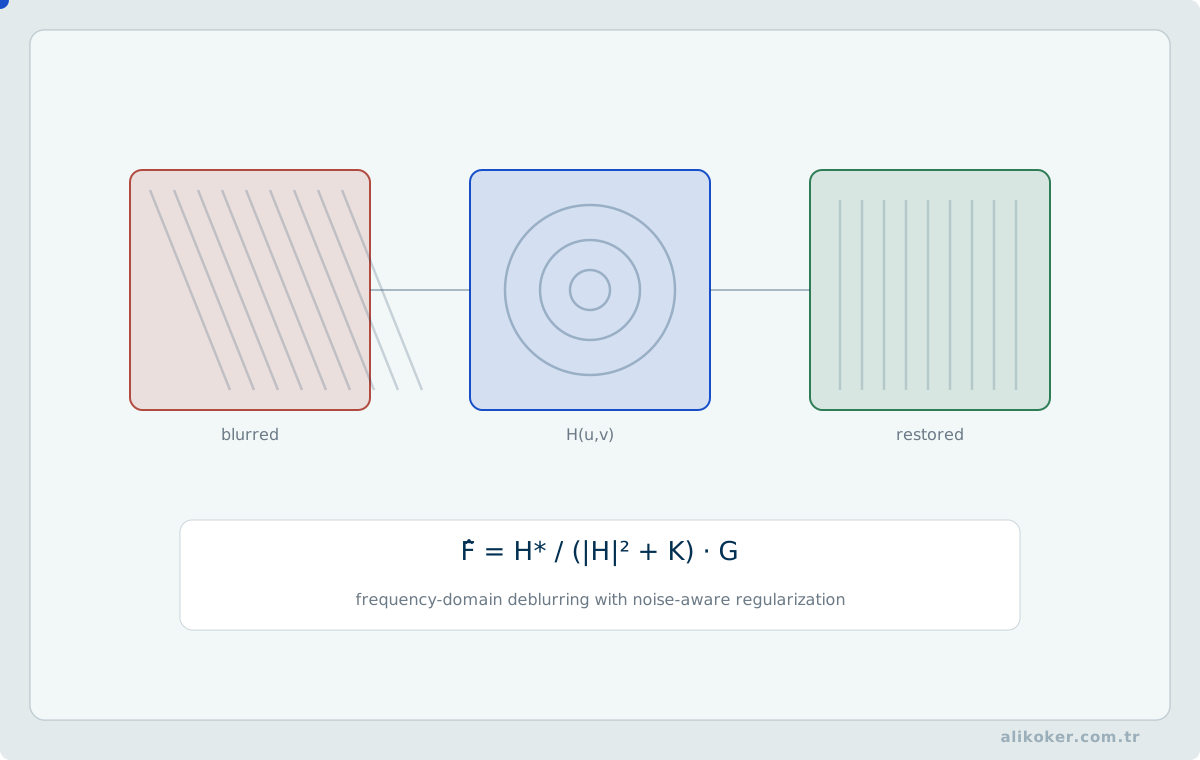
Blur can result from defocus, camera motion or object motion. Wiener filtering and deconvolution methods estimate sharper content when the degradation function is sufficiently known. Blind deconvolution estimates both the image and the blur model.
Contrast and missing regions
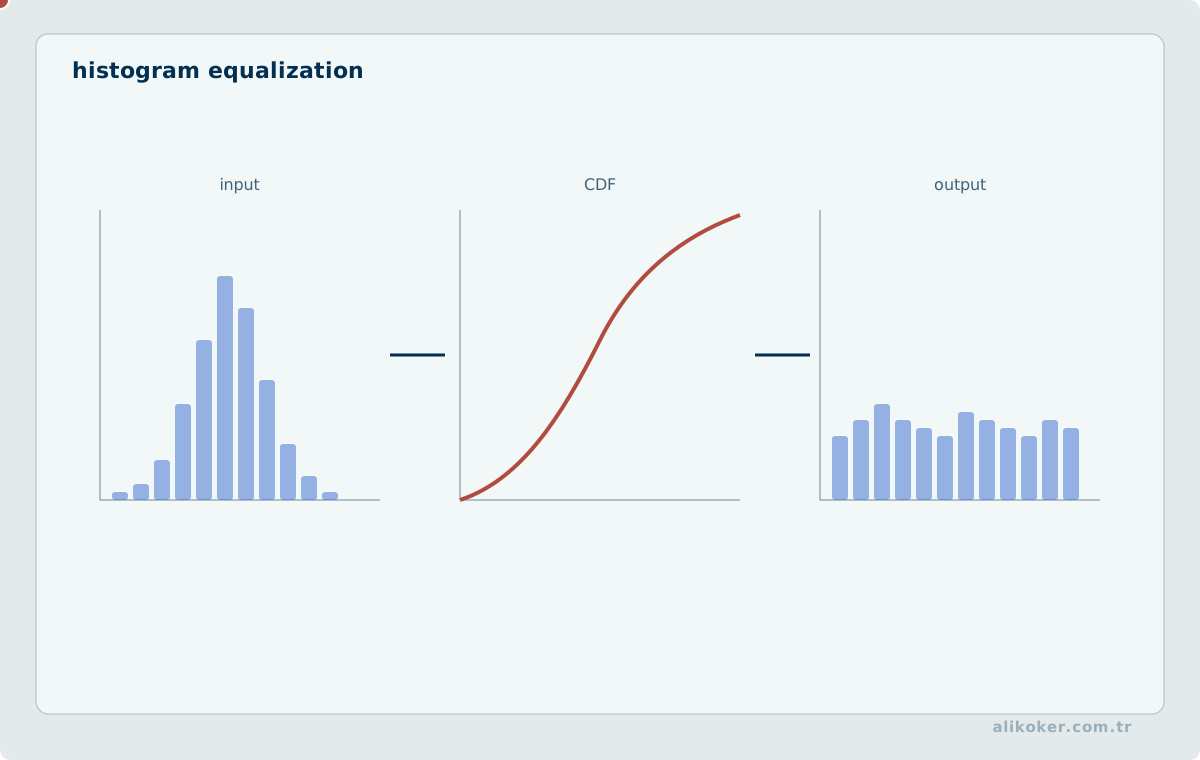
Histogram equalisation, gamma correction and local-contrast methods can expose low-contrast structure. Inpainting fills missing regions from surrounding structure or learned priors.
Details generated by a learned completion model are not direct measurements from the source image. Preserving the original recording separately from derived versions is therefore important in measurement and forensic workflows.
Super-resolution
Super-resolution estimates a higher-resolution representation from one or more lower-resolution observations. Pixel-oriented objectives usually produce conservative outputs, while perceptual or adversarial objectives may create sharper but more synthetic detail.
The value of restoration depends not only on appearance but also on whether measured information can be distinguished from estimated information.
Parent topic: Image and Audio Processing
Image Restoration as an Inverse Problem
An image affected by blur, noise, or missing samples can often be written as an inverse problem rather than as a sequence of arbitrary filters:
y = Hx + n,where x is the unknown clean image, H the acquisition or degradation operator, n noise, and y the observation. The forward model explains how y would be produced from a known x; restoration attempts the reverse inference.
The inverse problem may be ill-conditioned. Small measurement errors can produce large solution changes, or several candidate images can explain the observation almost equally well. Data fit alone is therefore insufficient.
Regularization and Prior Information
Regularization balances agreement with the observation against assumptions about plausible image structure:
min_x data_fit(Hx,y) + lambda * R(x).R(x) may represent smoothness, sparse gradients, low rank, or a learned prior. If lambda is too large, real detail can be suppressed; if too small, noise and inverse-problem instability can dominate.
This provides a common view spanning classical Tikhonov/Wiener reasoning and modern learned or plug-and-play priors. Whatever the method, the assumption used to infer unmeasured detail should remain explicit.
Interpolation, Super-Resolution, and Real Detail
Interpolation estimates values between existing samples. Super-resolution aims to infer a higher-resolution representation from a lower-resolution observation and generally relies on stronger prior information.
Bicubic enlargement and learned super-resolution therefore make different claims. The first is a local resampling rule. The second can infer high-frequency structure learned from data. Such detail may look plausible without being identical to detail that was physically measured.
This distinction is especially important for forensic, scientific, or evidential imagery. Systems should separate measured pixel information from algorithmically inferred or generated detail and preserve the original data unchanged.
References
- Rafael C. Gonzalez; Richard E. Woods. Digital Image Processing, Fourth Edition. Pearson, 2018.
- Richard Szeliski. Computer Vision: Algorithms and Applications, Second Edition. Springer, 2022.