Depth and Distance Estimation from Images

Depth and distance estimation through stereo geometry, disparity, monocular cues and sensor fusion, including the sources of metric uncertainty.
Depth estimation infers the distance of scene points from one or more visual observations. Stereo cameras, monocular models, structured light and time-of-flight sensors rely on different measurement principles.
Stereo geometry
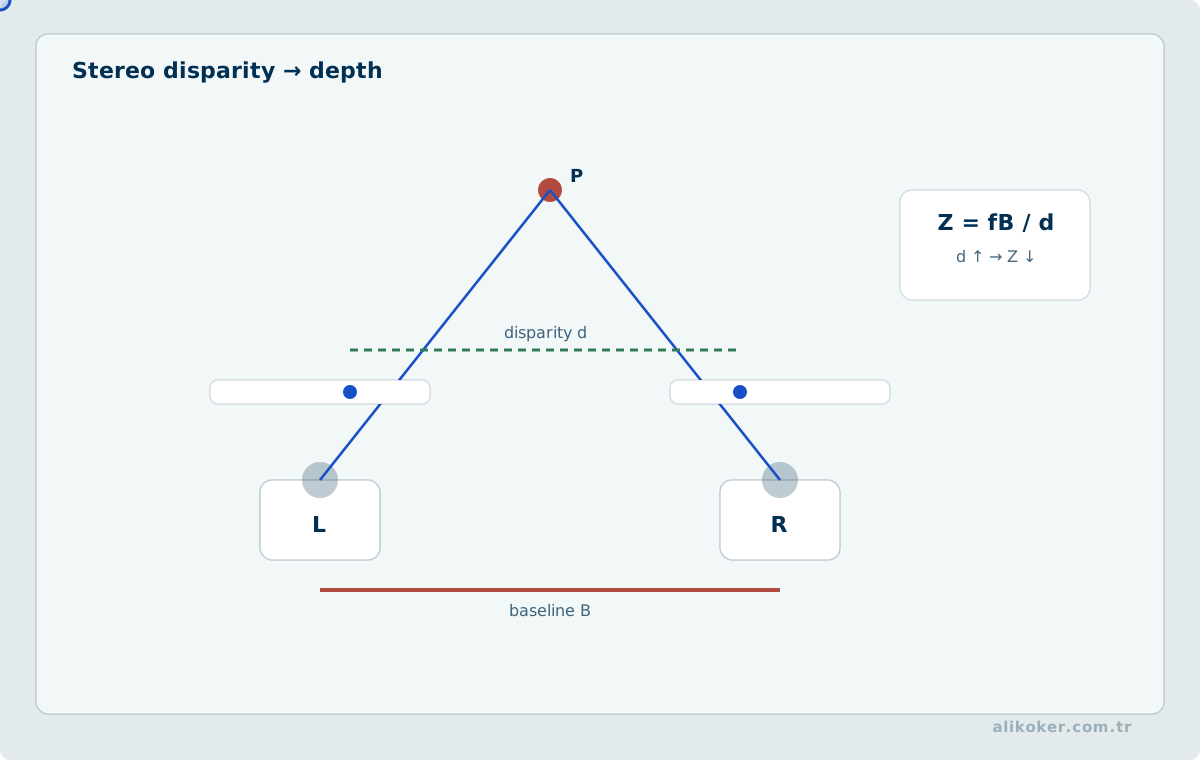
Stereo vision uses correspondences between two cameras observing the same scene from different viewpoints. In rectified images, the horizontal position difference of a scene point is called disparity.
Under a simplified pinhole model, depth is proportional to focal length and baseline and inversely proportional to disparity. Small disparity errors can therefore become large metric errors for distant objects.
Correspondence
Textureless surfaces, repetitive patterns, reflections and occlusions make correspondence difficult. Block matching, Semi-Global Matching and learned stereo networks provide different accuracy-computation trade-offs. Epipolar geometry constrains search to a line and reduces cost.
Monocular depth and sensor fusion
Monocular models infer depth from statistical cues such as perspective, object size, texture and occlusion. Absolute scale may require additional calibration or reference information.
LiDAR, radar and cameras can combine geometry with semantics when coordinate systems and timestamps are accurately aligned.
Parent topic: Image and Audio Processing
References
- Rafael C. Gonzalez; Richard E. Woods. Digital Image Processing, Fourth Edition. Pearson, 2018.
- Richard Szeliski. Computer Vision: Algorithms and Applications, Second Edition. Springer, 2022.