Object and Boundary Detection in Images

Object detection engineering across one- and two-stage detectors, IoU, NMS, boundary extraction and end-to-end latency.
Object detection identifies both what objects are present and where they are located. Depending on the application, outputs may be bounding boxes, contours or masks.
Detector families
Two-stage detectors first generate candidate regions and then classify and refine them. One-stage methods such as YOLO predict class and location in a single pass and are widely used in low-latency applications.
Small objects, dense scenes and high input resolution change the trade-off between computation and accuracy.
Overlap and post-processing
IoU measures overlap between predicted and reference boxes. When many candidates correspond to the same object, Non-Maximum Suppression removes duplicates according to confidence and overlap thresholds.
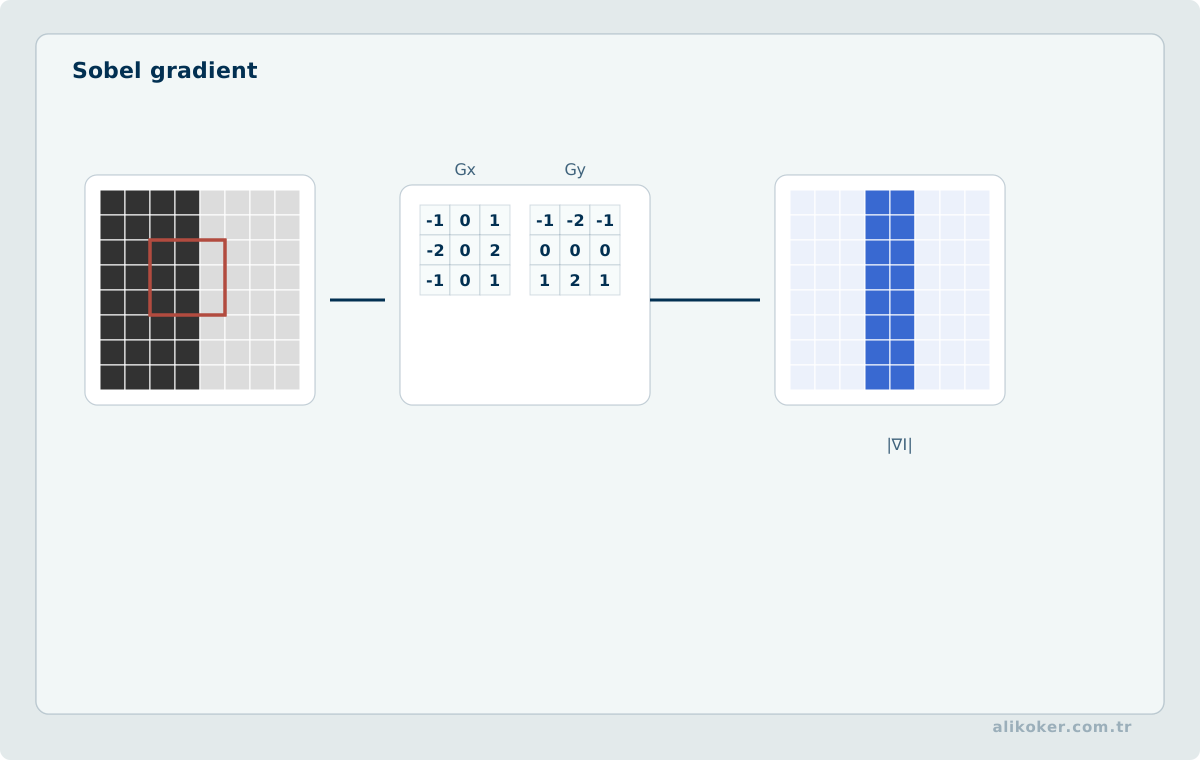
Boundary extraction can use gradient-based techniques such as Canny, active contours or instance-segmentation models.
Real-time performance
FPS alone does not describe end-to-end latency. Decode, resize, memory transfers, model execution, NMS and serialisation all contribute to total delay.
Throughput and single-frame latency should be measured separately, with target hardware and the surrounding data path treated as part of the detector system.
Parent topic: Image and Audio Processing
References
- Rafael C. Gonzalez; Richard E. Woods. Digital Image Processing, Fourth Edition. Pearson, 2018.
- Richard Szeliski. Computer Vision: Algorithms and Applications, Second Edition. Springer, 2022.