Software Test Engineering: Applied Verification and Validation from Requirements to Production

A practical software test engineering study note covering testable requirements, unit and integration testing, TDD, property-based and mutation testing, fuzzing, Testcontainers, performance, security, resilience, CI/CD, and production verification.
A good test does more than demonstrate that software works. It defines the conditions under which the software must refuse an operation, preserve an invariant, fail safely, or expose a violation. The value of test engineering is not the green report; it is the ability to make a false assumption visible as early and as cheaply as possible.
Unit 1: Testing Foundations, Verification, Validation, and Risk
Introduction: Testing is more than finding defects; it is producing evidence
When testing is introduced late in a project, the pattern is usually familiar: the feature is completed, the application is started, a few happy paths are exercised manually, and only then does automation begin. A test suite built this way tends to follow the code rather than guide it. Hundreds of scenarios may turn green and code coverage may increase, yet the first unexpected data shape, concurrent request, network delay, or configuration error can still reveal a completely different behavior in production.
What is missing is often not the number of tests. The question that should have been answered earlier is more fundamental: Which behavior are we trying to establish confidence in, and what evidence will justify that confidence?
It is useful to treat a test as a small, reproducible experiment. We establish an initial state, apply a particular input or event, collect an observable result, and compare it with an independently defined expectation:
initial state
       -> input / event
       -> system behavior
       -> observation
       -> comparison with expected result
       -> decision
If any link in this chain is ambiguous, the confidence produced by the test becomes ambiguous as well. If the requirement is unclear, we cannot define the correct result. If the data is uncontrolled, we cannot reconstruct the same condition. If the environment is detached from production, we may test the right behavior on the wrong representation of the system. If observability is insufficient, a fault may occur without the test being able to see it. More dangerously, if the expected value is calculated with the same logic as the production code, the test and the system can share the same error.
For that reason, learning JUnit, Selenium, JMeter, Mockito, or any CI tool explains only the tooling layer of test engineering. Tools change; the underlying epistemic problem does not: How much confidence can we place in a software behavior, and what independent evidence supports that confidence?
Testing is one engineering problem that extends from requirements to production. The same evidence chain spans testable requirements; unit, integration, system, and acceptance levels; TDD and test doubles; property-based testing, mutation testing, and fuzzing; and database, API, web, mobile, performance, security, resilience, and concurrency testing. CI/CD is not the end of the loop: behavior observed in production must feed back into test design. The goal is not to apply every available technique, but to select the method that can test a particular risk with sufficient evidential strength at the lowest reasonable cost.
This approach is consistent with the concepts, processes, documentation, and test design techniques defined by the ISO/IEC/IEEE 29119 series; the ISO/IEC 25010:2023 product quality model; and the risk and test design perspective of ISTQB CTFL 4.0.1. The 2026 revision of IEEE 730, which addresses software quality assurance throughout the life cycle, reinforces the same principle: testing is not a detached activity performed at the end of development, but part of the process by which quality is engineered.
1. Quality and testing are not the same thing
A product passing all of its tests does not guarantee that the product is high quality. Testing produces evidence about quality; it does not create quality by itself.
In large systems, defect count alone is too narrow a description of quality. A service can return the functionally correct answer in 30 seconds and still have a usability or performance problem; it can compute correctly while steadily growing memory use; it can show the right data to one user while failing access control on another user's object. A desktop application can implement every required function and still be unreliable if an upgrade corrupts user data. Functional correctness is one part of the quality picture, not the whole of it.
ISO/IEC 25010:2023 organizes product quality under nine major characteristics. A test strategy does not need to assign equal weight to all of them, but it must explicitly decide which characteristics are critical for the product. Functional suitability, performance efficiency, compatibility, interaction capability, reliability, security, maintainability, flexibility, and safety require different kinds of evidence.
This leads to the first principle that I use when designing a test strategy:
The structure of the source code should not determine test scope; product risk should.
A one-cent rounding error can be critical in a payment function. A 100 ms delay may be acceptable on a telemetry screen yet alter system behavior in a real-time control loop. A short outage may be tolerable for a content website but operationally unacceptable in an incident-management system.
The question “How many tests do we have?” is therefore usually weak. A better question is:
Which quality risks have we constrained with which evidence, and where does uncertainty remain?
1.1 Quality assurance, quality control, and testing
These concepts overlap in daily conversation, but separating them is useful in engineering work.
Quality Assurance (QA) establishes processes intended to reduce the probability that defects are introduced into the product. Code review policy, Definition of Done, engineering standards, test strategy, automation policy, and change management belong here.
Quality Control (QC) evaluates how well the resulting product satisfies defined quality criteria.
Testing is a central instrument in that evaluation, but it is not the only source of evidence. Static analysis, technical review, formal verification, telemetry, and production measurements can reveal defect classes that executable tests may not expose.
Organizations that place quality entirely on a test team often create a familiar loop: developers produce, testers find defects, developers fix them, and testers try again. Defects move between teams instead of being prevented near the point at which they are introduced. A more mature model pushes testability into analysis and design so that uncertainty can be reduced close to its source.
2. Verification and validation: are we building the right product correctly?
The classical distinction remains useful:
- Verification: Are we building the product in accordance with its specified requirements and design?
- Validation: Does the product we built satisfy the real need of its users and stakeholders?
A system may satisfy every item in a technical specification and still fail its users. The opposite is also possible: the visible workflow may appear correct while data integrity, security, or failure-handling requirements are violated underneath it.
A test plan should therefore do more than confirm that requirement statements were implemented. It must also expose whether those requirements are measurable, internally consistent, and representative of the real need.
For example, the following statement is weak from a testing perspective:
The system shall respond quickly.Testing it requires context. A falsifiable requirement might instead say:
P95 API response time shall not exceed 250 ms
under 400 concurrent sessions and 1200 requests per second.
The error rate shall remain below 0.1%.
Measurement shall be taken during a 30-minute steady load period.
The second statement is more than more detailed. It is more valuable because it can be disproved by measurement.
Writing testable requirements is not a task that begins with the tester. It begins with analysis and software engineering.
3. The fundamental limit of testing: we cannot exercise every possibility
The state space of a real system grows rapidly. An API with only ten independent Boolean options already has 1024 combinations. Ten fields with ten values each theoretically produce 10^10 combinations. Add roles, data state, date, locale, network behavior, operation order, and concurrency and exhaustive testing becomes impractical very quickly.
Professional test engineering begins at this point: instead of trying to consume the entire state space, we select the examples that produce the most information about risk.
Several consequences follow:
- Testing always samples.
- Sampling should be informed by risk.
- One test that reaches a previously untested boundary may be more valuable than a hundred tests that repeat the same behavior.
- Passing tests do not prove absence of defects; they only show that no observable defect was found in the exercised cases.
- New tests should be written not merely for new code, but for new information.
I therefore do not evaluate a test suite by its test count. A more useful measure is information density: when a test fails, can it narrow the broken behavior? When it passes, is it clear which risk it provides confidence about? Is there a cheaper layer that can test the same assumption with equal reliability?
4. Risk-based testing: first identify where being wrong is expensive
Every test has a cost: implementation, execution, test-data setup, failure diagnosis, and long-term maintenance. Since that budget is finite, test investment must be tied to risk.
A simple reasoning model is:
Risk ≈ probability of occurrence × impactThis is not a claim of quantitative precision. It is a prioritization device. More elaborate models may also consider detectability, exposure duration, recovery cost, or security impact.
When deciding the test investment for a change, I first clarify questions such as:
- What do we lose if this behavior fails?
- How likely is the failure to occur in production?
- At which layer can the failure be observed before release?
- Can automation detect it reliably?
- Is recovery easy, or can the failure cause data loss?
- How frequently is the code path executed?
- How many other components does the change affect?
- Does the behavior depend on concurrency, timing, or an external system?
High-risk behavior may justify techniques stronger than a few example-based tests: property-based testing, mutation testing, concurrency testing, or fault injection. For a low-risk administrative screen, a large E2E suite may create more maintenance cost than useful evidence.
The strategy must make this distinction deliberately.
5. Testability: an overlooked design quality
If testing one class requires starting half of the application, the problem may not be limited to the tests. The design is telling us something.
A testable component usually has properties such as:
- explicit inputs,
- observable outputs and side effects,
- dependencies that can be supplied from outside,
- limited global state,
- controllable time and randomness,
- clear boundaries around external systems,
- explicit failure behavior,
- deterministic behavior under the same initial conditions.
Consider code that reads the system clock directly:
public boolean isExpired(final Instant expiresAt) {
    return Instant.now().isAfter(expiresAt);
}
The logic is simple, but precise boundary testing is unnecessarily difficult. Making time a dependency improves both testability and design:
public final class ExpirationService {
    private final Clock clock;

    public ExpirationService(final Clock clock) {
        this.clock = clock;
    }

    public boolean isExpired(final Instant expiresAt) {
        return clock.instant().isAfter(expiresAt);
    }
}
The behavior at 23:59:59, a daylight-saving transition, or an exact expiration instant can now be reproduced deterministically.
The purpose is not to manufacture abstractions merely for tests. Time, the network, the file system, random-number sources, process environment, and external services are already sources of uncertainty in production. Making those boundaries explicit is good engineering even before testing is considered.
6. From requirement to test condition: deriving acceptance criteria
One expensive mistake in test design is to start writing test cases before defining the test condition: which behavior or risk is the test intended to verify?
Consider this requirement:
After five consecutive failed password attempts, a user shall be unable to log in for 15 minutes.
That sentence yields not one test, but a behavioral model:
- The first four failures must not lock the account.
- The fifth failure must lock it.
- The lock must not expire before 15 minutes.
- Behavior at exactly the 15-minute boundary must be defined.
- Does a successful login reset the counter?
- Does an attempt from another IP address change the behavior?
- Are concurrent attempts against the same account counted atomically?
- Is lock state consistent across distributed nodes?
- Can an administrator release the lock?
- Does the response leak whether the user account exists?
If these questions do not emerge from the requirement, increasing the number of test cases may not improve quality.
6.1 Given–When–Then is useful, but it is not the objective
A behavior-oriented test can be written as:
Given: the account has four consecutive failed login attempts
When: a fifth incorrect password is submitted
Then: authentication is rejected and the account is locked for 15 minutes
This format can provide a shared language between stakeholders. It should not, however, become a ritual imposed on every test. A parameterized test for a mathematical function may become less readable if forced into ceremonial Given/When/Then phrasing.
A format is useful only to the extent that it makes the behavior easier to understand.
7. Test levels: define the boundary by behavior, not by label
Two teams can use the term “unit test” to mean different things. One may mean a single method; another may mean the entire service layer excluding the database. “Integration test” is similarly ambiguous.
In practice, it is clearer to classify tests along two separate dimensions.
7.1 Classical test levels
- Unit test: exercises a small unit of behavior in isolation or with controlled dependencies.
- Integration test: exercises contracts and interaction between components.
- System test: exercises the whole system, or a broad slice of it, through externally visible behavior.
- Acceptance test: verifies that business and operational acceptance criteria are satisfied.
7.2 Test size
Google’s Small/Medium/Large classification addresses a different concern by looking at resource dependencies rather than naming conventions. As network access, real databases, file systems, processes, and runtime duration increase, so does test size.
This is particularly useful in CI design:
Small   -> every commit, seconds
Medium  -> every commit / PR, minutes
Large   -> selected PR / main / nightly, longer
A test’s position in the pipeline should be determined by its feedback cost, not by its name.
8. The test pyramid: an economic model, not a dogma
The important idea behind the test pyramid is economic rather than geometric. Narrow tests are usually fast and diagnostic; broad UI/E2E tests are more expensive and weaker at localizing the cause of a failure. That difference explains the familiar preference for many small tests and fewer end-to-end tests.
Turning the pyramid into fixed percentages is a mistake. A compiler, a data pipeline, a mobile application, and a microservice ecosystem do not require the same distribution.
I read the pyramid through one question:
What is the cheapest test level that can establish this behavior reliably?
Testing a pure discount rule through a browser is expensive. Testing REST serialization only in a service unit test is incomplete. Database transaction isolation cannot be established with a mocked repository.
The right layer is the narrowest boundary at which the risk actually exists.
9. Anatomy of a test: is Arrange, Act, Assert enough?
A useful structure for many unit tests is:
Arrange -> establish initial state
Act     -> execute the behavior
Assert  -> evaluate the observation
For production-grade tests, four additional questions matter:
- What is the oracle? How do we know what the correct result should be?
- What is the isolation boundary? Can the test be affected by other tests or environmental state?
- What is observable? Which side effects can the test actually see?
- What is the diagnostic power? If the test fails, can we understand why?
For example, checking only HTTP 200 is usually weak:
assertEquals(200, response.statusCode());If the test does not verify the response schema, business result, persistent state, or security consequence, the endpoint may behave incorrectly and still return 200.
A good assertion should not merely state that “something happened.” It should identify which contract remained intact.
10. The test oracle problem: who tells us the right answer?
A test oracle is the source used to decide whether an observed result is correct. It may be a requirement, mathematical property, reference implementation, previous version, independent calculation, or domain rule.
One of the most dangerous patterns is calculating the expected result in the test with the same algorithm used in production.
Production code:
final BigDecimal result = price.multiply(rate).setScale(2, RoundingMode.HALF_UP);If the test calculates its expectation with the same expression, both sides can agree on the wrong algorithm. In critical financial calculations, expected values should come from an independent oracle: fixed domain examples, an authoritative table, or a separately verified method.
Some problems do not have an exact oracle. Image processing, optimization, machine learning, and large simulation may not provide one uniquely correct output. Property-based testing and metamorphic relations become useful in such cases. We will return to them later.
Unit 2: Test Design Techniques and Developer-Level Testing
Test-case design begins by defining acceptance and rejection conditions. Partition the input domain into equivalence classes and test boundaries and expected transitions separately. When generating random inputs, retain seeds and minimized counterexamples so failures are reproducible. The meaningful traceability metric is what requirement or invariant each test verifies, not the number of tests alone.
11. Equivalence partitioning: reducing an enormous input space to behavioral classes
If an age field accepts values from 0 to 120, testing every value is usually unnecessary. We can partition the domain into behaviorally equivalent classes:
x < 0         -> invalid
0 <= x <= 120 -> valid
x > 120       -> invalid
Selecting representatives from each class reduces the number of tests substantially. The most important defects, however, often occur at the edge rather than in the middle of a class.
Equivalence partitioning should therefore be combined with boundary-value analysis.
12. Boundary-value analysis: where defects like to live
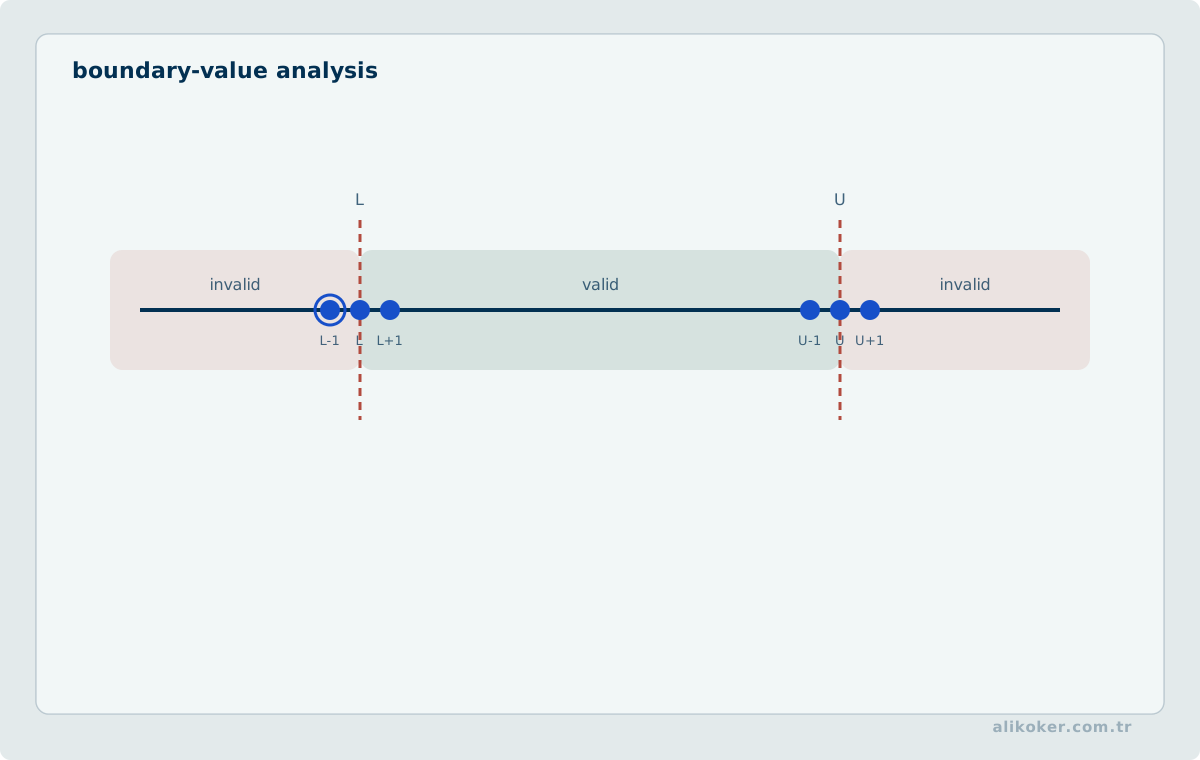
Off-by-one comparisons, array limits, pagination offsets, date ranges, and numeric overflow frequently fail at boundaries.
For a 0–120 range, typical examples are:
-1, 0, 1, 119, 120, 121Real systems have many boundaries that are not simply numeric:
- empty string / one character / maximum length / maximum + 1,
- 23:59:59 / 00:00:00,
- end of month / end of year / leap day,
- full queue / one free slot / capacity + 1,
- first page / last page / empty page,
- the exact timeout instant,
Long.MAX_VALUE,NaN, infinity,- Unicode combining characters,
- the interval between one transaction committing and another operation reading.
Restricting boundary thinking to forms wastes much of the technique’s value. Every threshold in system behavior is a potential test boundary.
13. Decision tables: making combinations in business rules explicit
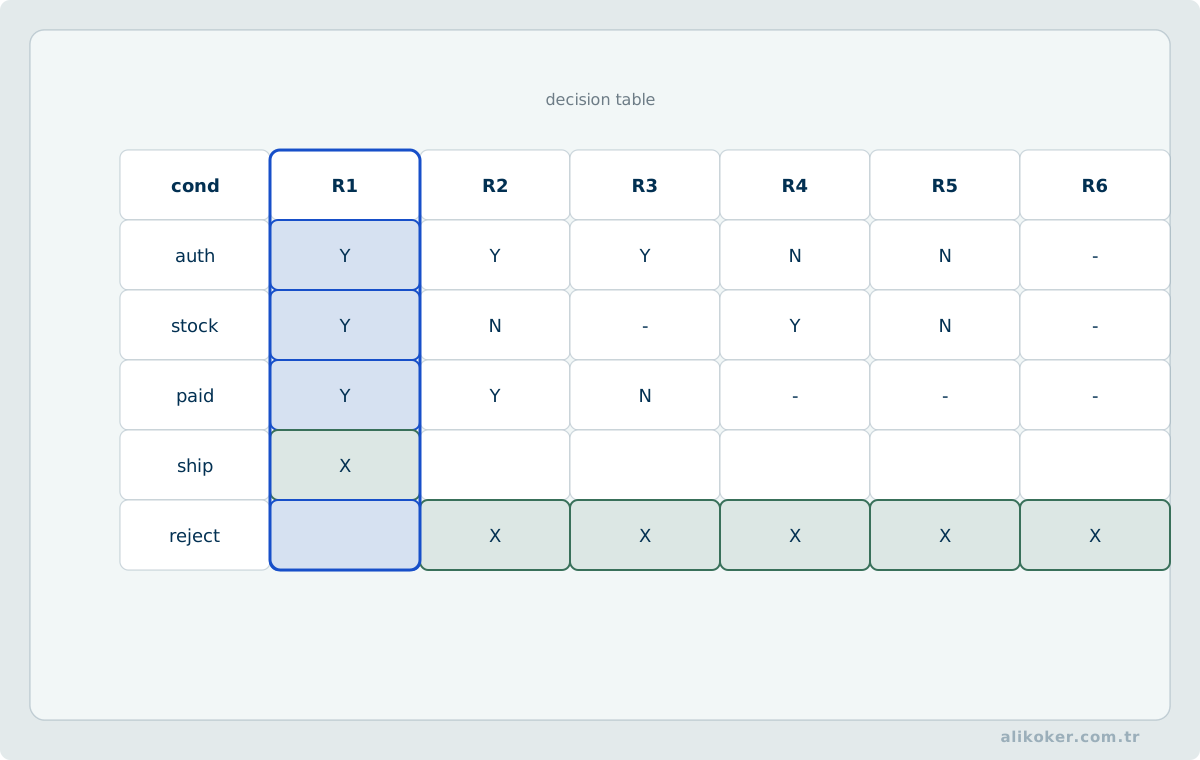
When behavior depends on several conditions at once, a linear list of test cases becomes difficult to reason about. A decision table makes the relationship between conditions and outcomes explicit.
For a money transfer:
- Sufficient balance: Yes; Account active: Yes; Daily limit valid: Yes; Result: Transfer
- Sufficient balance: No; Account active: Yes; Daily limit valid: Yes; Result: Insufficient balance
- Sufficient balance: Yes; Account active: No; Daily limit valid: Yes; Result: Account inactive
- Sufficient balance: Yes; Account active: Yes; Daily limit valid: No; Result: Limit exceeded
- Sufficient balance: No; Account active: No; Daily limit valid: No; Result: According to error-priority rule
The last row matters. If more than one condition fails and the system does not define which error has priority, the test has found a requirement gap before it has found a code defect.
Good test design exposes ambiguity in requirements as well as faults in implementation.
14. State-transition testing: test the history, not only the value
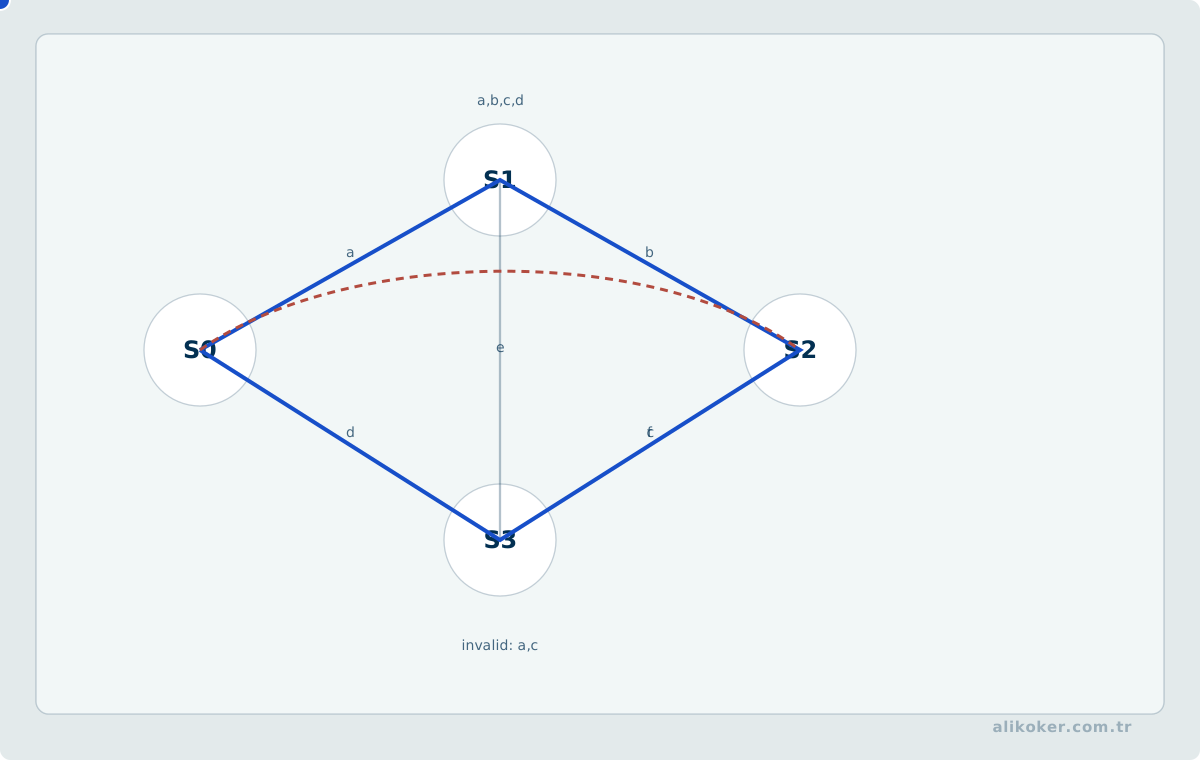
In many systems, the same input produces a different result depending on prior state. Sessions, orders, payments, calls, connections, device controllers, and workflow engines require state-machine reasoning.
For example:
NEW -> APPROVED -> PROCESSING -> COMPLETED
              \-> CANCELLED
Valid transitions are not enough. Invalid transitions matter as well:
COMPLETED -> NEW        must be rejected
CANCELLED -> PROCESSING must be rejected
NEW -> COMPLETED        must be rejected by business rule
A harder defect appears when two requests attempt to change the same state at the same time. Every test may pass under one thread while a race condition remains in production. State-machine tests therefore need to be combined with concurrency testing where the domain allows competing transitions.
15. Pairwise and combinatorial testing: target interactions instead of the full Cartesian product
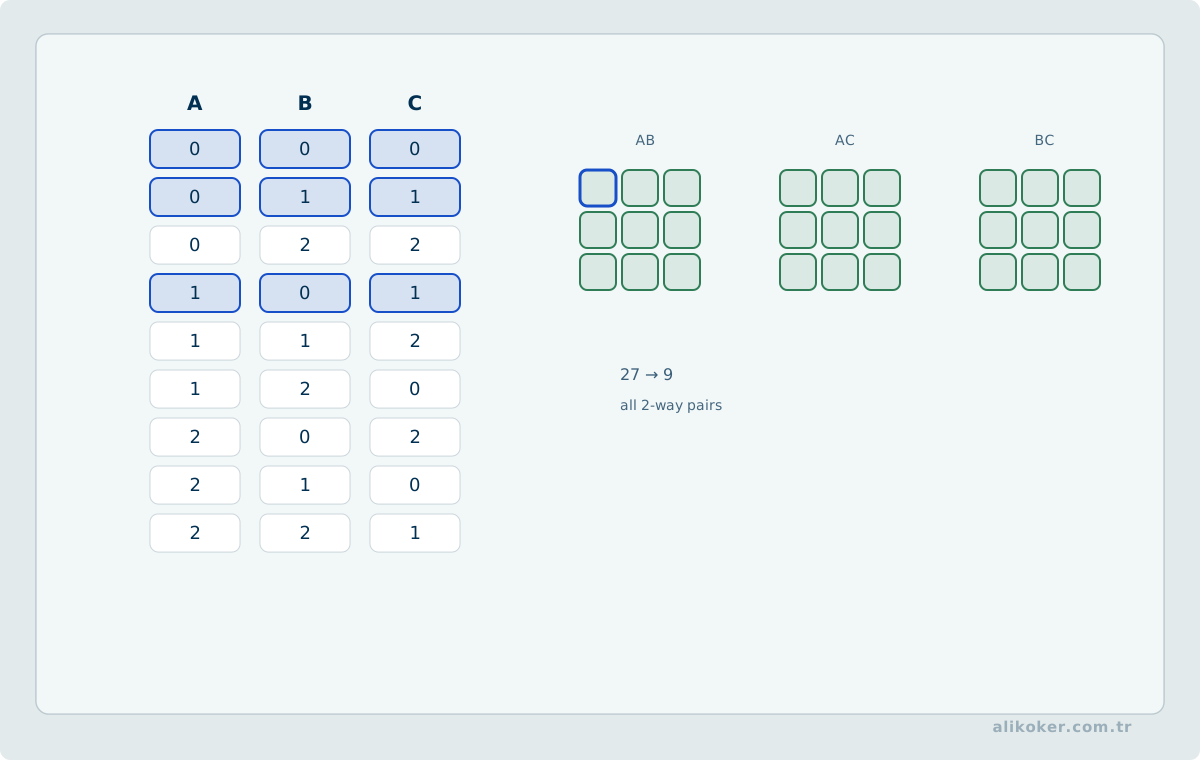
Testing every combination of operating system, browser, locale, database, authorization role, and feature flag may be prohibitively expensive.
Pairwise testing builds a smaller set in which every pair of parameter values appears together at least once. It is often effective because many integration defects are caused by interactions between a small number of parameters.
For example:
OS:      Linux, Windows
DB:      PostgreSQL, Oracle, MySQL
Locale:  tr-TR, en-US, de-DE
Auth:    local, OIDC
The full Cartesian product contains 2 × 3 × 3 × 2 = 36 combinations. A pairwise generator can cover all pairs with a much smaller set.
The guarantee is not “all defects will be found.” If three-way or four-way interaction is critical, coverage must be increased to the appropriate t-wise level. The decision still belongs to risk analysis.
16. Exploratory testing: let the system answer questions the test case did not ask
Automation is strong when behavior is repeatable, but it can only ask questions we have already formulated. Exploratory testing combines learning, test design, and test execution in the same disciplined activity.
It is not “random clicking.” A useful exploratory session starts with a charter:
Mission: examine boundary and failure behavior of the file-upload workflow
Focus: file size, extension, MIME type, network interruption, retry, duplicate names
Timebox: 45 minutes
Evidence: screen recording, request/response, log correlation id, anomalies found
Domain experience matters considerably here. The UI may display “success” while the transaction has rolled back in the background. The first browser tab may look correct while a second tab contains stale state. The back button, rapid double-clicking, a network transition, or an operation order that the application did not anticipate may never have appeared in an automated scenario.
Findings from exploration should later become automated regression tests when they represent stable behavior worth preserving. Exploration and automation are not competitors: one discovers new information; the other locks in what has been learned.
17. Static testing: finding defects without executing the program
Not every defect requires dynamic execution. Requirement inspection, design review, code review, static analysis, dependency scanning, and formal checks can expose defects before the software runs.
The economic advantage is timing. Ambiguity in an API contract found during design may require changing a few lines of specification. Correcting the same ambiguity after dozens of services have implemented it may require compatibility work, data migration, and coordinated deployment.
During code review, questions such as the following often reveal more than style checks:
- Does the behavior match the requirement?
- Is the failure path designed?
- Is there a race-condition opportunity?
- Are null, empty, and boundary semantics explicit?
- Are side effects idempotent where they need to be?
- Is resource lifetime correct?
- Where is the trust boundary?
- Is sensitive data being logged?
- How will this code be tested?
The last question frequently exposes a design problem before it exposes a test problem.
As of 2026, work on an additional ISO/IEC/IEEE 29119 part covering static analysis is still at committee-draft maturity. ISO/IEC 20246 and established review and quality processes therefore remain more mature reference points for static review practice.
18. Unit testing: the goal is not “small code,” but one explainable behavior
The principal value of a unit test is fast feedback with a narrow diagnostic radius.
Weak unit tests commonly show patterns such as:
- starting a Spring context unnecessarily,
- requiring a database for a pure decision,
- sharing data between test classes,
- using reflection to reach private methods,
- verifying ten unrelated behaviors in one test,
- producing an assertion failure that does not reveal what contract broke.
A clean example is deliberately uneventful:
final class PriceCalculatorTest {
    private final PriceCalculator calculator = new PriceCalculator();

    @ParameterizedTest
    @CsvSource({
        "100.00,0.10,90.00",
        "100.00,0.00,100.00",
        "0.00,0.50,0.00"
    })
    void appliesDiscount(final BigDecimal price, final BigDecimal rate, final BigDecimal expected) {
        assertEquals(expected, calculator.applyDiscount(price, rate));
    }
}
The purpose of this test is to verify a business rule, not to prove that a class can be created by a framework. If Spring is not part of the risk, Spring should not be started.
Spring Framework documentation makes the same architectural point from another direction: well-applied IoC/DI makes POJOs easy to instantiate directly with new and test under JUnit. The benefit is not only speed; it is evidence that architectural boundaries are understandable.
19. Assertion quality: a test should speak clearly when it fails
A test must not only run correctly. It should fail informatively.
The following assertion is technically valid:
assertTrue(result.size() == 3);Its diagnostic value is weak. If the contract concerns both size and content, an assertion that expresses the collection expectation directly will usually produce more useful evidence.
Two extremes are worth avoiding.
Under-assertion: the test proves little more than “no exception was thrown.”
Over-assertion: the test freezes dozens of details that are not part of the behavior and breaks on harmless refactoring.
A test should not fossilize the entire internal state of the application. It should stabilize the contract.
For a REST response, verifying the exact millisecond of createdAt may be noise if the requirement does not depend on that value. Verifying status, id, and the domain result may be the actual contract.
20. Test doubles: when should a real dependency be replaced?
“Test double” is an umbrella term. Different doubles solve different problems.
- Dummy: fills a parameter position; no behavior is expected.
- Stub: returns prepared answers for selected inputs.
- Fake: a lightweight but working implementation, such as an in-memory repository.
- Mock: verifies whether expected interactions occurred.
- Spy: observes calls on real or partially real behavior.
The distinction matters because the wrong double can create confidence in behavior that never existed in the real system.
If a repository is mocked, JPA mapping, generated SQL, constraints, collation, and transaction semantics are not being tested. A mock can be appropriate for testing the service decision that depends on the repository; it is not evidence that persistence works.
final class UserServiceTest {
    private final UserRepository repository = mock(UserRepository.class);
    private final UserService service = new UserService(repository);

    @Test
    void returnsActiveUser() {
        final User user = new User(7L, true);
        when(repository.findById(7L)).thenReturn(Optional.of(user));

        final User result = service.getActive(7L);

        assertEquals(7L, result.id());
    }
}
This test verifies a UserService decision. It does not test the database.
21. Using mocks without losing reality
Mocks are powerful, but overuse can couple the test suite to implementation mechanics.
Tests dominated by interactions such as the following are often fragile:
verify(repository).findById(7)
verify(mapper).toDto(user)
verify(logger).info(...)
verify(metrics).increment(...)
If externally visible behavior remains the same but most tests break when the internal algorithm changes, the suite is protecting the implementation rather than the behavior.
Interaction verification is particularly valuable when the interaction itself is part of the requirement:
- a message must actually be published,
- a payment provider must not be called twice,
- an audit record is a business requirement,
- a side effect must not occur at all.
In other cases, state verification through observable results can be more stable.
Deep stubbing is another warning sign:
when(a.getB().getC().getD()).thenReturn(...)When a test requires a chain like this, the coupling in the production design deserves attention as well.
22. TDD: more a design feedback loop than a test-writing recipe
Test-Driven Development is often reduced to “write the test first.” Its real mechanism is a short feedback loop:
Red -> Green -> RefactorRed: write a small test that describes the desired behavior and fails for the intended reason.
Green: make the smallest correct change that satisfies the behavior.
Refactor: improve the design while preserving externally observable behavior.
One of TDD’s strongest effects appears in API design. A class that is awkward to use is often awkward to test. The test behaves like the first client of the API, exposing excessive dependencies, complex construction, global state, and blurred responsibility early.
TDD does not solve every testing problem. UI exploration, performance characteristics, production configuration, or distributed failure modes cannot be established with unit-level TDD alone. TDD is one feedback mechanism inside a broader strategy.
22.1 Writing the test first does not automatically make it a good test
A test that uses a weak oracle, exercises the wrong layer, or binds itself to implementation detail remains weak even if it was written before the production code. Instead of ritualizing TDD, preserve the question:
What design feedback does this test provide?
23. BDD and Specification by Example: turning requirements into executable examples
BDD addresses a shared-language problem as much as a technical testing problem. When a product owner says “the customer receives a discount,” the developer and tester should not silently implement different interpretations.
Examples sharpen the requirement:
Given the customer is GOLD tier
And the basket total is 1000 TRY
When payment is calculated
Then an 8% loyalty discount is applied
BDD files become costly when every low-level technical condition is forced into hundreds of mechanical Gherkin scenarios merely because the automation stack supports it.
Specification by Example uses examples that stakeholders can understand as durable verification assets. Domain-significant boundaries are particularly valuable here.
24. Property-based testing: verify invariants instead of a handful of examples
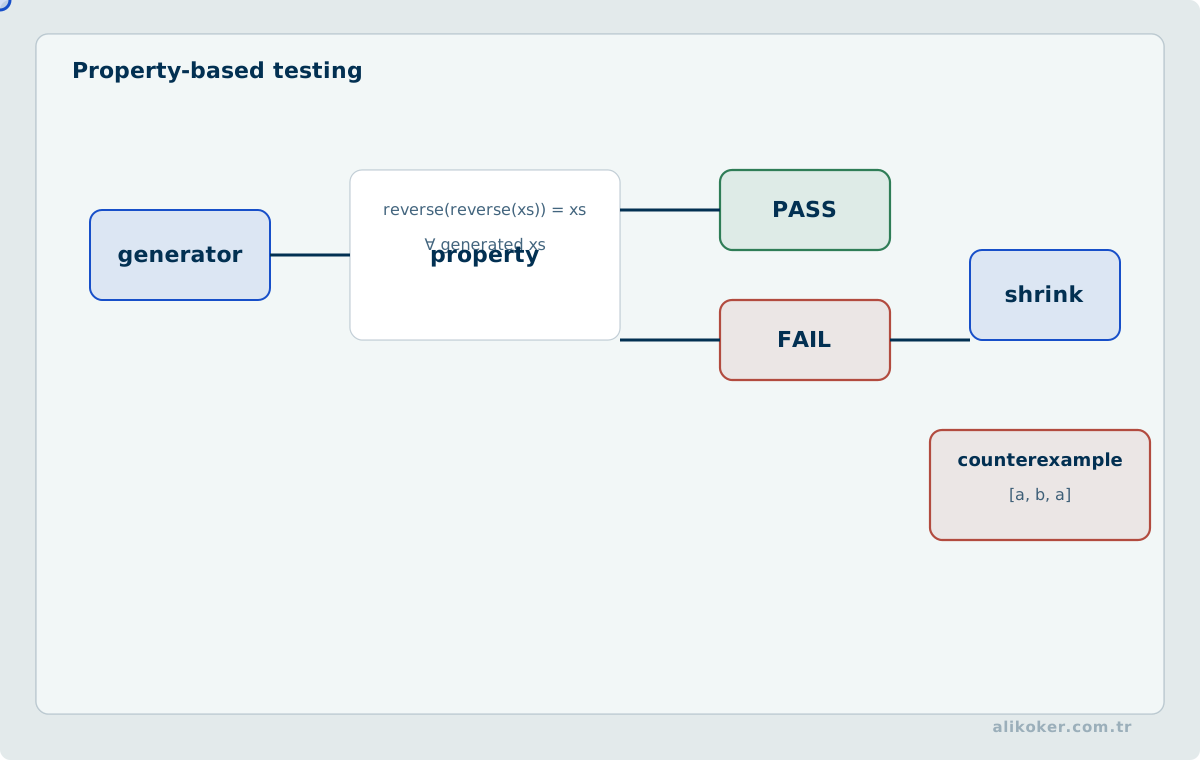
Example-based testing chooses specific inputs. Property-based testing defines a more general property and evaluates it over many generated inputs.
For a sorting algorithm, instead of testing only:
[3, 1, 2] -> [1, 2, 3]we can express properties such as:
the output is ordered
the output contains the same elements as the input
sort(sort(x)) == sort(x)
output length == input length
The technique is effective at reaching combinations that a developer did not think to write by hand. JVM tools such as jqwik can also shrink a failing input to a smaller counterexample.
Conceptually:
@Property
void reversingTwiceReturnsOriginal(@ForAll final List<Integer> values) {
    final List<Integer> reversed = new ArrayList<>(values);
    Collections.reverse(reversed);
    Collections.reverse(reversed);
    assertEquals(values, reversed);
}
The difficult part is not generating thousands of values. It is identifying a property that represents the domain correctly. A weak property produces little confidence no matter how many inputs exercise it.
25. Mutation testing: measure whether tests notice meaningful faults
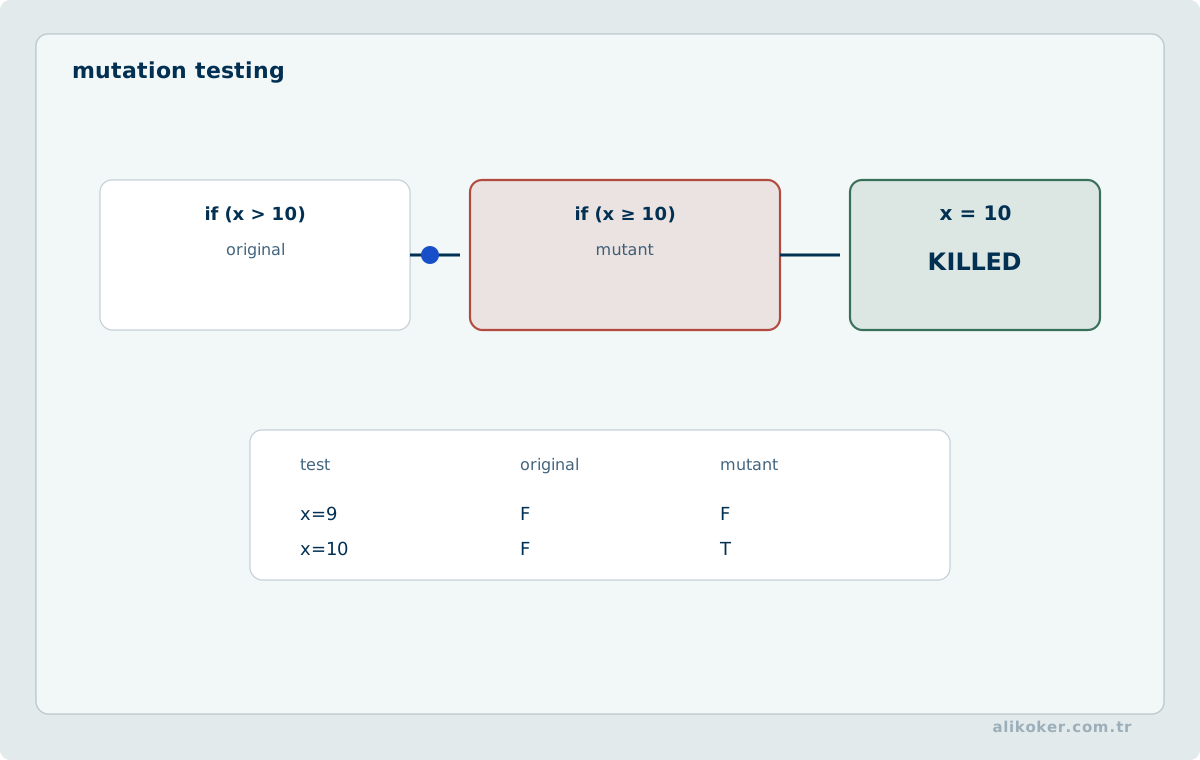
Code coverage tells us which code executed. It does not tell us whether the tests would notice a relevant behavioral change.
Mutation testing makes controlled small changes to production code, for example:
>  -> >=
+  -> -
true -> false
remove a condition
change a return value
The suite is then executed again. If a test fails, the mutant is “killed”: the suite noticed the behavioral change. If the suite remains green, either the tests are missing evidence or the mutant is semantically equivalent.
This is especially revealing in projects with high code coverage but weak assertions.
Original:
if (age >= 18) {
    return ADULT;
}
Mutant:
if (age > 18) {
    return ADULT;
}
If age 18 is not tested, the mutant may survive even with 100% branch coverage.
PIT/PITest is widely used for this purpose on the JVM. Mutation score should not become a blindly optimized target, but it is valuable when we want to ask whether tests around critical business rules can actually detect plausible faults.
26. Fuzzing: remove human imagination as the limit on input generation
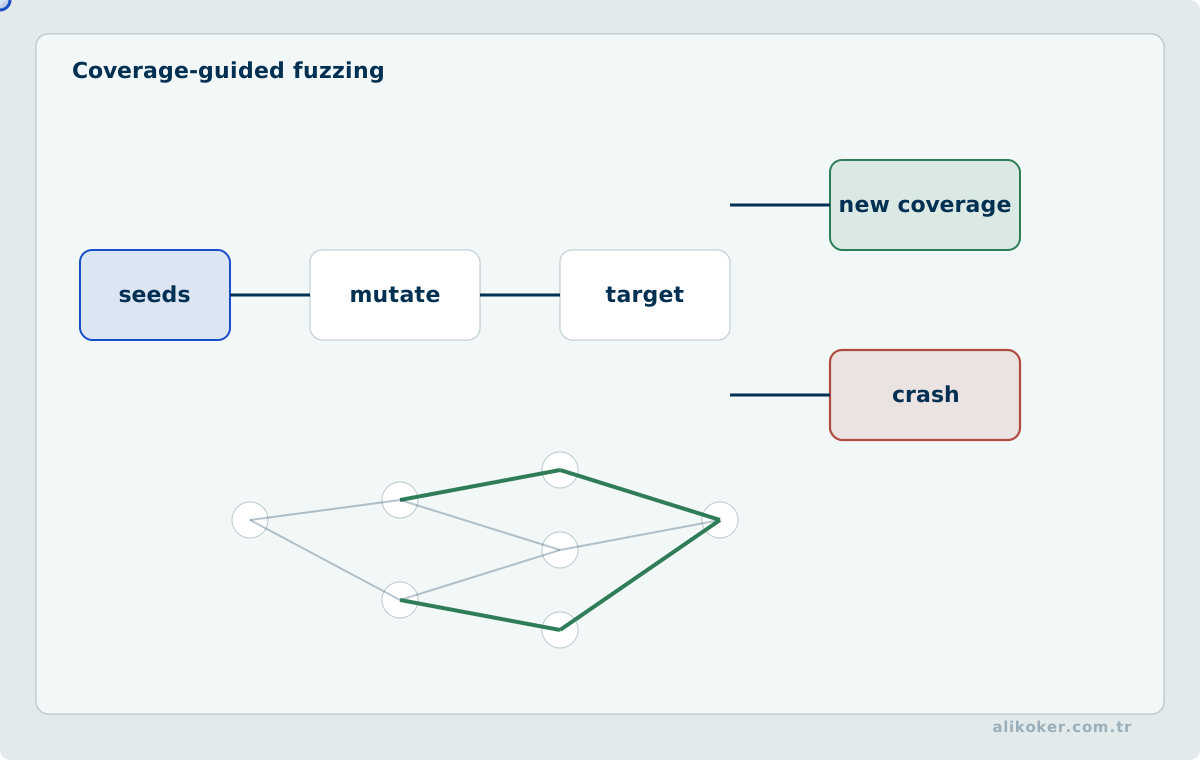
Fuzz testing feeds a program large numbers of unexpected, malformed, or generated inputs and looks for crashes, hangs, memory errors, assertion failures, and security-relevant behavior.
It is particularly effective for parsers, protocol implementations, file formats, binary decoders, network services, and native code.
Pure random input can be a starting point, but modern fuzzing may be coverage-guided or structure-aware. The goal is not simply to produce random bytes; it is to reach program states that previous tests have not explored.
In web security, fuzzing can stress input-validation boundaries. In native code, pairing fuzzing with runtime instrumentation such as AddressSanitizer can expose memory corruption. In API testing, an OpenAPI schema can drive generation of valid and invalid request variants.
Every interesting crash discovered by a fuzzer should become a reproducible regression asset. Otherwise the same defect can silently return later.
27. Metamorphic testing: test relationships when the exact answer is unknown
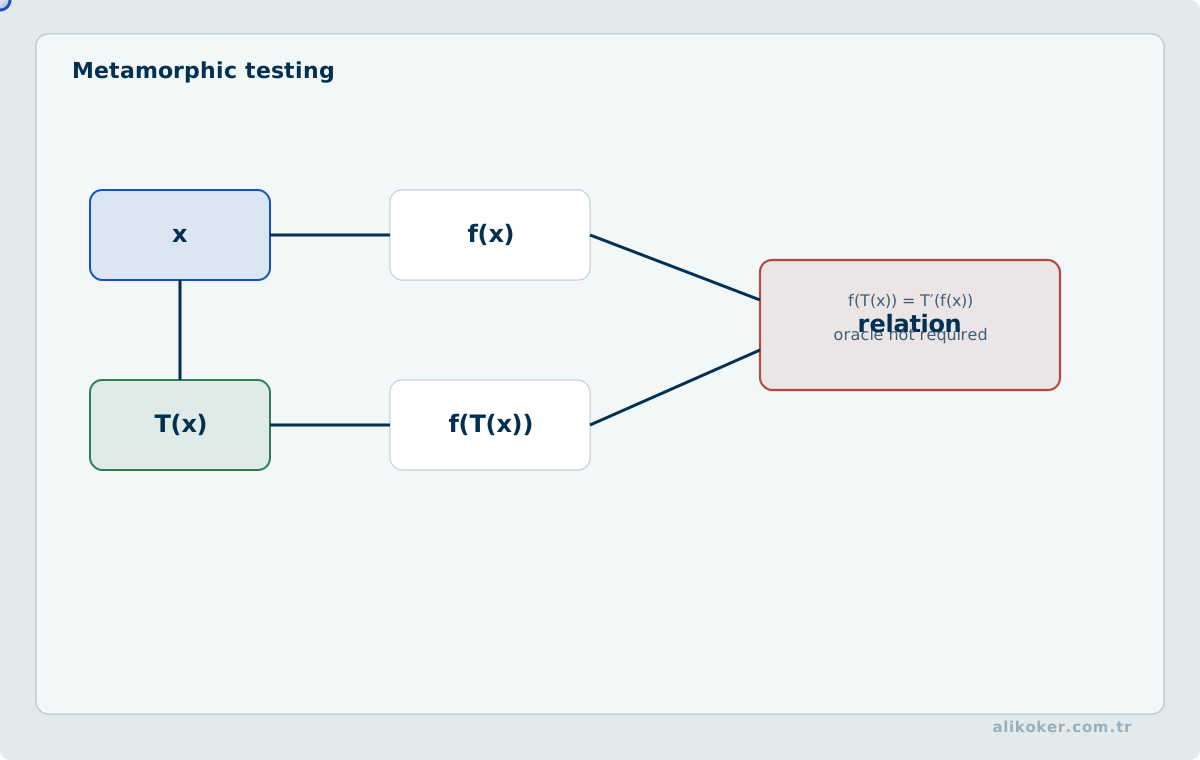
For some systems, calculating one exact correct output is too expensive or impossible. Search engines, image processing, scientific computing, optimization, and machine-learning systems are common examples.
Metamorphic testing evaluates expected relationships between inputs and outputs rather than a single absolute expected value.
For an image classifier, a small brightness change should not ordinarily move the image to a completely unrelated class. For a distance function:
d(a, b) == d(b, a)
d(a, a) == 0
can serve as oracle properties.
In taxation software, proportional changes to inputs may be expected to preserve defined monotonicity relations. In a route planner, adding an unused, remote node to the road graph should not change an existing route.
The metamorphic relation comes from domain knowledge. Automation merely evaluates that relation across many generated cases.
Unit 3: Integration, Data, API, UI, and Asynchronous System Testing
28. Integration testing: where the mock ends, the real contract begins
Unit tests give us control over dependencies. Integration tests deliberately exercise the actual boundary between components.
Typical risks live in details such as:
- serialization and deserialization,
- SQL dialect,
- transaction semantics,
- HTTP headers and content type,
- timeout and retry behavior,
- message ordering,
- schema migration,
- TLS and certificates,
- authentication tokens,
- encoding and collation,
- network failure.
A mocked service may return a perfect User object while the real HTTP service sends user_id where the client expects userId. A mocked repository may not reproduce duplicate-key behavior. A fake broker may hide the real acknowledgment semantics.
The speed gained through test doubles creates distance from the real integration. That distance must be closed with a smaller number of high-value tests that exercise the actual contract.
29. Database testing: in-memory success is not production correctness
One recurring source of false confidence is treating repository tests that pass against a different in-memory engine as proof of production-database behavior.
H2 and other embedded engines are fast and useful for some tests, but SQL dialect, null ordering, collation, transaction isolation, locking, sequences, date types, JSON functions, constraints, and optimizer behavior may differ materially from the production database.
Real-engine testing is particularly important for:
- vendor-specific SQL,
- complex JPA mappings,
- pessimistic or optimistic locking,
- native queries,
- migration scripts,
- large indexed queries,
- concurrent updates,
- transaction propagation.
Testcontainers is useful because it can start temporary instances of real PostgreSQL, MySQL, or other supported services and allow tests to exercise a contract much closer to production.
Example:
@Testcontainers
@DataJpaTest
final class AccountRepositoryTest {
    @Container
    static final PostgreSQLContainer<?> POSTGRES = new PostgreSQLContainer<>("postgres:18");

    @DynamicPropertySource
    static void properties(final DynamicPropertyRegistry registry) {
        registry.add("spring.datasource.url", POSTGRES::getJdbcUrl);
        registry.add("spring.datasource.username", POSTGRES::getUsername);
        registry.add("spring.datasource.password", POSTGRES::getPassword);
    }
}
The container image tag should be pinned and controlled by the project. Reproducibility should not depend on a moving latest tag.
29.1 Test databases should be realistic but independent
Copying a production dump directly into a test environment creates privacy, regulatory, and reproducibility risk. The necessary data should be synthetic or properly anonymized, and each test should be able to establish the state it depends on.
A test environment should never become the easiest path for production data to leak.
30. Transaction, locking, and concurrency tests
Single-threaded CRUD tests exercise only the easiest path through a transactional system.
Real failure modes include:
- lost update,
- dirty read,
- non-repeatable read,
- phantom read,
- duplicate-insert races,
- deadlock,
- incorrect lock scope,
- lazy loading after the transaction has ended,
- duplicate side effects during retry.
If two threads decrement the same stock record at the same time, an invariant such as the following must still hold:
stock >= 0A test can coordinate two operations with a barrier and repeatedly exercise the contested region. Thread.sleep() should not be used as a substitute for synchronization; CountDownLatch, CyclicBarrier, or another appropriate concurrency primitive provides a controlled test fixture.
If the race cannot be made fully deterministic, the test should at least enlarge the race window deliberately. “Run it 1000 times and hope it fails” can be useful as a stress technique, but it is a weak foundation for a regression test.
31. API testing: test the contract, not merely the endpoint
For a REST or RPC service, checking the HTTP status code is only a small part of an API test. The real contract includes:
- request schema,
- response schema,
- required and optional fields,
- null semantics,
- error model,
- idempotency,
- pagination,
- ordering,
- authentication and authorization,
- rate limits,
- timeouts,
- versioning,
- backward compatibility.
An API returning 200 OK does not prove that the business operation succeeded. A transfer request may return 200 without persisting anything. A response can look correct while a repeated request with the same idempotency key creates a second transfer.
It is useful to distinguish at least three layers:
controller slice          -> HTTP mapping and validation
application integration   -> service + persistence + security
external contract         -> real network boundary and wire format
Turning everything into full E2E testing makes diagnosis difficult. Leaving everything at the controller-mock level misses the real contract.
31.1 Negative API testing
The successful path is only the beginning. Valuable negative cases include:
- missing required field,
- incorrect content type,
- malformed JSON,
- oversized payload,
- unknown field,
- invalid enum value,
- unauthorized object access,
- expired token,
- duplicate request,
- concurrent request,
- rate-limit violation.
Error responses should have a stable contract. Exposing stack traces or internal exception messages directly to clients damages both testability and security.
32. Contract testing: can services evolve independently?
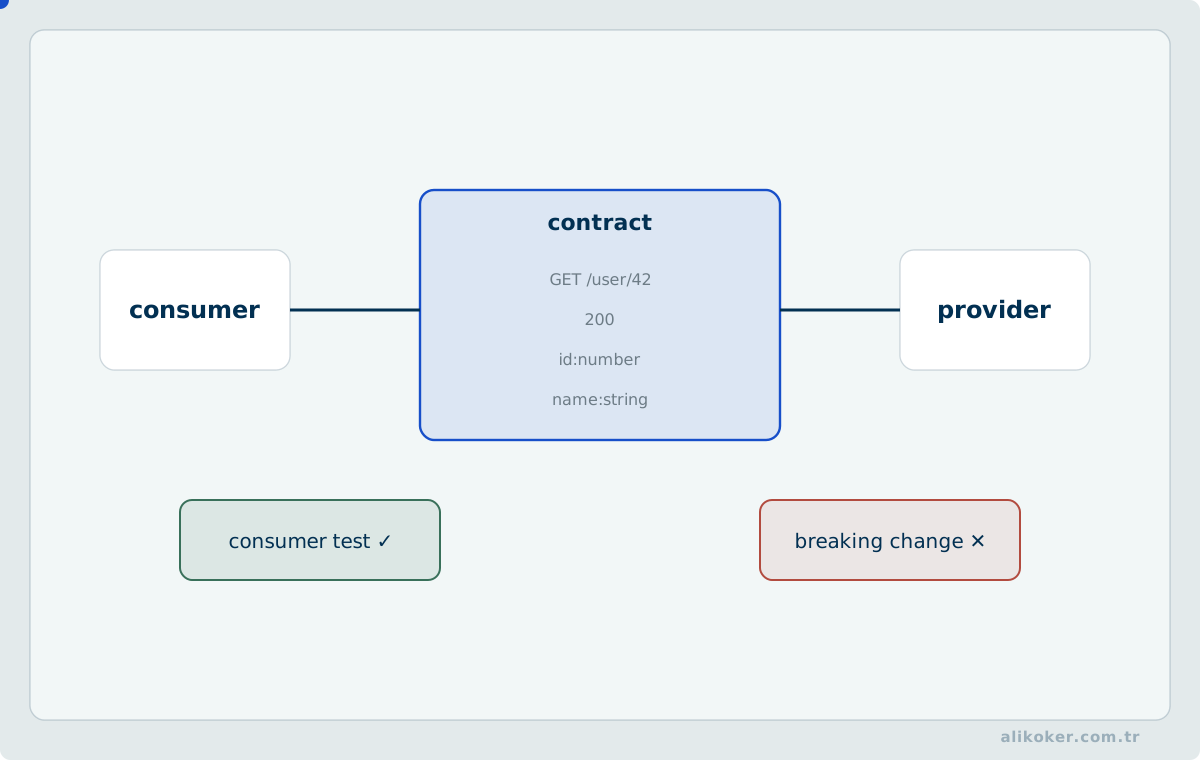
In a microservice or distributed architecture, verifying every integration in one shared E2E environment is expensive and fragile. Consumer-driven contract testing verifies, against the provider, the contract that the consumer actually depends on.
Suppose the consumer only uses:
{
  "id": 42,
  "status": "ACTIVE"
}
Adding a new provider field should not be a problem. Removing status, or changing its type, should break the relevant contract test.
Contract testing does not eliminate E2E testing. Network routing, authentication infrastructure, deployment configuration, and real data flow still require broader verification. Its value is that schema and interaction incompatibilities between services can be found much earlier.
33. Spring Boot test slices: load only as much context as the risk requires
One of Spring Boot’s useful testing features is the ability to start only the portion of the application needed for a test.
@WebMvcTest targets the MVC/controller boundary. @DataJpaTest targets JPA data access. @SpringBootTest is appropriate when the complete ApplicationContext is part of what must be verified.
Using these boundaries correctly can have a large effect on suite duration.
33.1 Controller test
Conceptual example:
@WebMvcTest(UserController.class)
final class UserControllerTest {
    @Autowired
    private MockMvc mvc;

    @MockitoBean
    private UserService service;

    @Test
    void returnsUser() throws Exception {
        when(service.get(7L)).thenReturn(new UserDto(7L, "Ali"));

        mvc.perform(get("/api/users/7"))
            .andExpect(status().isOk())
            .andExpect(jsonPath("$.id").value(7))
            .andExpect(jsonPath("$.name").value("Ali"));
    }
}
SQL is not the target here. Request mapping, JSON serialization, validation, and HTTP behavior are.
33.2 When is a full context justified?
@SpringBootTest is useful when the risk includes:
- bean wiring,
- configuration properties,
- the security filter chain,
- application events,
- actual repository/service integration,
- custom auto-configuration,
- startup failure.
Using @SpringBootTest for every test class slows the suite unnecessarily. Context caching helps, but changing profiles and property sets fragments the cache.
The scope of the test should not exceed the risk it needs to verify.
34. Web UI testing: the DOM is not the user experience
Browser-driven tools such as Selenium remain useful because they exercise real JavaScript, browser behavior, routing, form interaction, and end-user flows.
A browser test is naturally broad:
browser
 -> frontend
 -> API
 -> authentication
 -> backend
 -> database
A failure in any element of the chain can break the test. A UI-heavy suite therefore tends to be slower and more vulnerable to environmental instability.
34.1 Selector choice
A selector tightly coupled to CSS structure:
body > div:nth-child(3) > div > table > tr:nth-child(2) > td:nth-child(4)will fail under a minor refactor that does not change user-visible behavior.
Semantic roles or explicit stable test identifiers are usually better. That does not mean production DOM should be filled with meaningless attributes for every test. If an element already has a meaningful accessible role and name, use that first.
34.2 The job of UI tests
Browser tests are most valuable when they protect critical user journeys rather than re-executing every low-level business-rule boundary with hundreds of datasets:
login
 -> search
 -> open record
 -> modify
 -> save
 -> reload
 -> verify persistence
Boundary combinations for the underlying rules belong in faster layers where possible.
35. Usability testing: software can be technically correct and still wrong for the human operator
Usability testing asks more than whether a button works. Can the user complete the intended task correctly, efficiently, and with an acceptable error rate?
Useful measures include:
- task completion rate,
- time on task,
- number of errors,
- number of reversals or cancellations,
- need for assistance,
- learnability,
- user satisfaction.
Think-aloud sessions, screen recording, observation, and controlled tasks provide qualitative evidence. Telemetry, funnels, and A/B experiments can provide quantitative evidence.
A/B testing is not automatically quality testing. The variant that receives more clicks may be less accessible or less secure. The measured metric must represent the actual user objective.
In critical systems, usability can become a safety and security property. If an operator misreads an alarm, a screen that is technically “working” has still failed its operational purpose.
36. Accessibility testing: usability without assuming a privileged user
Web and mobile applications should be exercised for keyboard navigation, semantic HTML, screen-reader behavior, focus order, contrast, zoom, and motion constraints.
Automated accessibility tools can identify part of the problem space, but not all of it. The presence of an accessible name, for example, does not prove that the name is meaningful to a user.
A practical manual pass can include:
complete the critical flow without a mouse
inspect focus order
listen to heading and landmark structure with a screen reader
exercise the flow at 200% and 400% zoom
check whether meaning depends on color alone
Accessibility is cheaper to test when it is built into component design instead of being added as a late compliance layer.
37. Mobile application testing: device variation is a real system parameter
Mobile software introduces risks that desktop testing may not exercise:
- operating-system version,
- display size and density,
- memory pressure,
- CPU constraints,
- battery consumption,
- mobile-network transitions,
- offline operation,
- permissions,
- application backgrounding,
- call and notification interruptions,
- orientation changes,
- installation and upgrade.
A mobile test strategy should combine emulators/simulators with real devices. Emulators are economical for broad combination coverage; camera, Bluetooth, sensor, thermal, radio, and manufacturer-specific behavior may require real hardware.
37.1 Interruption testing
Consider a file upload interrupted by a phone call. The network changes from Wi-Fi to LTE. The application is sent to the background and the operating system later kills the process.
The system should still:
- avoid losing committed data,
- leave partial operations in a consistent state,
- recover meaningful state after restart,
- avoid submitting the same operation twice.
The happy path becomes inadequate very quickly on mobile platforms.
38. Test-data engineering: data is a system input, not incidental fixture material
In many projects, test data becomes a larger maintenance problem than the test code itself.
Warning signs include:
- every test depending on the same massive SQL dump,
- test order mattering,
- hundreds of tests breaking when one fixture changes,
- production personal data appearing in test environments,
- nobody being able to explain why a particular dataset is required.
Good test data should be minimal and purpose-specific wherever possible.
An authorization test rarely needs one hundred users. Three identities may express the behavior more clearly:
owner
otherUser
admin
A builder can improve readability:
final User user = UserTestData.user()
    .id(7L)
    .role(USER)
    .active(true)
    .build();
But if the builder silently assigns random defaults to every other field, it can hide which values the test actually depends on. Critical attributes should remain explicit.
38.1 Synthetic data and anonymization
Performance tests that require realistic distributions can generate synthetic data from a statistical profile. If production-derived data is unavoidable, irreversible anonymization and strict access control are required.
The test environment must not become an easier side channel for sensitive data.
39. Environment management: “it passes on my machine” is not a test result
A test result is a function of more than code:
result = f(code, config, data, OS, runtime, network, dependencies, time)If the environmental conditions that produced a result are not visible, reproducing that result becomes difficult.
Containers and infrastructure-as-code help make environments reproducible, but a container is not identical to production. Kernel behavior, storage, network policy, service mesh, TLS, secret providers, and external dependencies can still differ.
Useful environment policies include:
- version pinning,
- deterministic configuration,
- automated provisioning and cleanup,
- environment-drift control,
- separation of secrets,
- production-equivalent treatment of critical dependencies.
40. Flaky tests: a test that sometimes passes is not trustworthy evidence
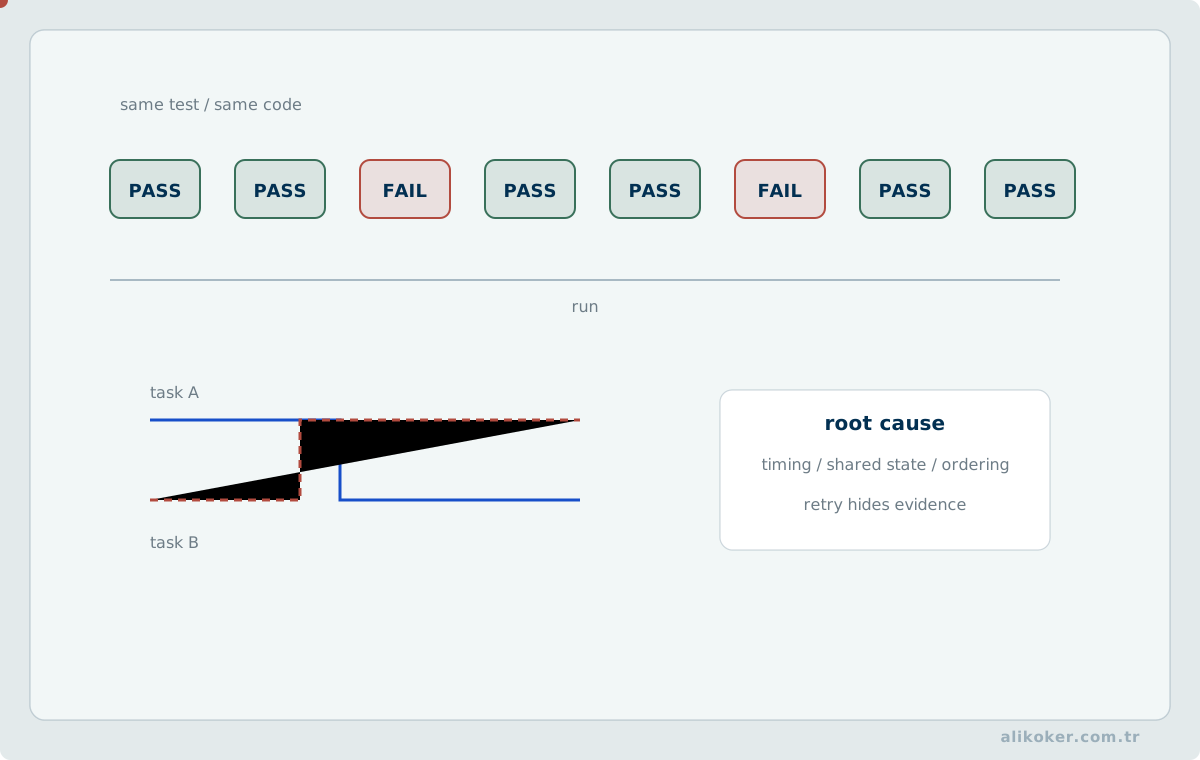
If the same commit, input, and nominal environment produces alternating pass and fail results, the suite is not producing reliable evidence. Over time, engineers stop trusting the signal and a real failure is dismissed as “probably flaky” and rerun.
Published Google testing data has shown that larger tests are considerably more prone to flakiness. This is unsurprising: network, threads, processes, disk, and external services add nondeterministic behavior.
Common causes include:
- wall-clock time,
- uncontrolled random seed,
- order dependence,
- shared static state,
- external network access,
- assertions close to timeout boundaries,
sleep,- race conditions,
- incomplete cleanup,
- port or file collisions during parallel execution,
- asserting immediately against an eventually consistent system.
“Retry three times” is not a fix for a flaky test. Retry can be a temporary diagnostic instrument; it should not conceal the root cause.
41. Testing time: control it instead of sleeping
Time-dependent code is one of the most common sources of nondeterminism in a suite.
Weak approach:
Thread.sleep(1000);
assertTrue(cache.isExpired(key));
The test is both slow and fragile. A slow CI runner can change the outcome.
A better design makes time controllable:
final Clock clock = Clock.fixed(Instant.parse("2026-08-31T08:00:00Z"), ZoneOffset.UTC);
final CachePolicy policy = new CachePolicy(clock);
When asynchronous behavior genuinely requires elapsed real time, a bounded polling wait is often better than a fixed sleep:
wait for at most 10 seconds
poll the condition at controlled intervals
continue as soon as the condition is satisfied
Sleeping for a fixed 10 seconds wastes nine seconds in the fast case and can still fail in the slow case.
42. Testing randomness: the seed is a debugging asset
Randomized testing is useful, but much of its value is lost if a failure cannot be reproduced.
The seed used by a test run should be recorded:
seed=784311257The same seed should regenerate the same sequence. Property-based frameworks typically provide this mechanism automatically.
Do not weaken a production CSPRNG merely to make security code deterministic in tests. Instead, make the source of randomness a controllable boundary while keeping the production implementation cryptographically appropriate.
43. Testing asynchronous and event-driven systems
Request/response thinking is insufficient for message-oriented systems. A message may be published, consumed later, produce another event, and only eventually make a result visible.
The test model should consider questions such as:
- Is a message processed at least once or at most once?
- Are duplicate events handled idempotently?
- Is ordering guaranteed where the domain requires it?
- What happens if the consumer crashes?
- Does the dead-letter queue behave correctly?
- Can a poison message block progress?
- Is retry backoff correct?
- Is there a dual-write risk between a database transaction and message publication?
publish(); assertDatabaseImmediately(); is often the wrong test. If the contract is eventual, the assertion should also be bounded and eventual.
For example:
publish order-created
within 5 s:
    invoice status == CREATED
The five seconds are not an instruction to sleep for five seconds. They define the maximum accepted system behavior.
Designing a concurrency test through event order, not sleeps. Let two transactions read the same record at version v = 0. Transaction T1 updates using expected version 0 and commits with v = 1. When T2 attempts to write based on its stale version 0, an optimistic concurrency check must reject that write. If the system retries, T2 must re-read the current value and recompute against the new version. The test uses controlled synchronization between the two reads and writes instead of arbitrary delays. Assertions verify that no lost update occurs and that the documented error or retry contract is honored. Database transaction isolation alone may not protect a business decision derived from stale application data.
Redelivery is a normal operating condition, not an exotic failure. If a consumer produces its business effect and then crashes before an offset or acknowledgement becomes durable, the event may be delivered again. Integration tests should create this failure window deliberately and assert how many durable business effects remain after replaying the same event identifier. Checking that a listener method was invoked once does not verify a cross-system delivery guarantee.
The test matrix should cover crash-before-publish, lost acknowledgement after processing, duplicate delivery, consumer restart, poison messages, delayed retry, and reordered arrival. Do not assume global ordering where the business flow does not require it. Replace arbitrary sleeps with an observable completion condition, controlled clocks, and bounded timeouts.
Unit 4: Performance, Resilience, Security, Regression, and Quality Measurement
Before load testing, define the expected traffic distribution, request mix, and failure criteria. As load grows, observe when queue delay dominates response time, how error rates change, and which dependencies saturate. Generator limitations must not be mistaken for system throughput. Cold start, sudden bursts, and sustained workload tests may expose different failure modes.
44. Performance testing: answer “under what load?” before asking “is it fast?”
Performance is not one number. At minimum, separate:
- latency,
- throughput,
- concurrency,
- resource utilization,
- queueing,
- error rate,
- saturation.
A service responding in 10 ms for one user tells us little about capacity. As load increases, the limiting resource may become the connection pool, thread pool, garbage collector, database locks, storage, or an external service.
44.1 Types of performance tests
Load test: measures behavior under expected normal or high workload.
Stress test: pushes beyond expected capacity to observe the degradation and failure mode.
Spike test: exercises sudden changes in demand.
Soak/endurance test: maintains load long enough to expose memory leaks, connection leaks, or accumulating resources.
Capacity test: estimates the maximum load that can satisfy the defined SLO.
Scalability test: measures how added resources affect capacity and performance.
44.2 The workload model should come from production traffic
If the real workload is 90% reads, 8% writes, and 2% expensive reports, a test that sends every virtual user to the same endpoint is not representative.
A useful workload model includes:
arrival rate
request mix
payload distribution
session behavior
think time
cache warm/cold state
data cardinality
JMeter, k6, Gatling, or another tool is a secondary decision. The best tool still produces the wrong answer when the workload model is wrong.
A fixed virtual-user population is not a fixed arrival rate. Suppose 50 closed-loop virtual users wait one second after each response. As response time increases, each user completes fewer iterations; “50 users” does not imply 50 requests per second. In an open-loop arrival-rate experiment, request starts are scheduled against the requested rate, and the generator's inability to sustain that rate must be exposed rather than silently omitted.
Use the same data distribution, endpoint mix, preparation state, connection reuse, TLS conditions, and client pacing for both versions. Measure resource limits in the load generator as well. Average RPS alone is insufficient: report p99, timeouts, rejections, failed assertions, and completed valid business operations together. A version that runs faster by returning incorrect or incomplete results has not achieved a valid performance improvement.
45. Average latency often hides the behavior that matters
Latency distributions are frequently right-skewed, making the average a poor description of user experience.
Example:
900 requests = 50 ms
90 requests  = 100 ms
9 requests   = 500 ms
1 request    = 10 s
The average may still look acceptable while P99 and maximum latency reveal serious queueing or timeout behavior.
A performance report should therefore read several measures together:
- median/P50,
- P90,
- P95,
- P99,
- maximum,
- throughput,
- error rate.
Percentiles can also be measured incorrectly. Coordinated omission, for example, can cause a load generator to make latency look better than users would actually experience. The engineer should know whether the test uses an open-loop arrival-rate model or a closed-loop user model and what each model implies.
A performance test is not only a report on the system under test. The measurement system itself must be validated.
Account for requests missing from the latency histogram. If a tool drops timed-out requests or includes only successes, the reported p99 can improve artificially as the service degrades. Keep success and failure latency distributions distinct while preserving the count of every attempted request. The arithmetic mean of minute-level p99 values is not the p99 of the combined experiment; raw samples or an appropriately mergeable histogram representation are required.
A regression gate can combine several constraints: minimum valid throughput at the target load, maximum timeout rate, a p99 threshold, and a resource budget. Distinguish warm-up from the steady observation window at each load step, and state uncertainty when there are too few samples to characterize a tail percentile. A system whose distribution becomes unstable near saturation must not be summarized as exhibiting normal steady-state behavior.
46. Explain performance results with a system model before blaming the code
One of the weakest forms of performance report is:
Test successful: 10,000 users supported.By itself, that sentence is almost meaningless. Were the 10,000 users concurrent? How frequently did each send a request? How large was the dataset? Was the cache warm? What was the error rate? How long did the test run? Which resource saturated first?
A more useful report looks like this:
1200 req/s constant arrival rate
400 active sessions
30 minutes steady state
P95 = 182 ms
P99 = 410 ms
error rate = 0.04%
DB pool peak utilization = 86%
CPU = 64-72%
GC pause P99 = 9 ms
Now the measurements support causal reasoning.
46.1 Consistency checks with Little’s Law
For a stable system, approximately:
L = λWL: average number of work items in the system,λ: throughput or arrival rate,W: average time an item remains in the system.
If throughput is 1000 req/s and average response time is 100 ms, we would expect roughly 100 active requests in the system on average. A measurement far from that estimate is a reason to inspect queueing, instrumentation, or the workload model.
Performance engineering is more than running a benchmark. It includes checking whether the measurement is physically and mathematically coherent.
46.2 Change one variable at a time
If JVM heap, thread-pool size, Hikari pool size, SQL indexes, and cache policy are changed simultaneously and performance improves, we do not know which change mattered.
A better experiment is:
measure the baseline
change one variable
apply the same workload
compare
assess the hypothesis
This is one of the places where test engineering most visibly converges with the scientific method.
47. Resilience testing: if failure cannot be eliminated, test its behavior
In a distributed system, network interruption, timeout, process restart, full disk, or dependency failure are not exotic exceptions. They belong to the system model.
Resilience tests should ask questions such as:
- What happens if a dependency returns HTTP 500?
- Does a connection timeout accumulate blocked threads?
- Can retry multiply one logical request?
- Does the circuit breaker open when it should?
- If one node dies, is traffic moved safely to another?
- What happens to transactions during database failover?
- If the cache disappears, does the system preserve correctness?
- Can a full disk or blocked logging pipeline stop the application?
Fault injection creates these conditions under controlled circumstances.
47.1 Testing retry behavior
Retry deserves particular attention because a poorly configured retry policy can amplify load during an outage.
normal traffic: 1000 req/s
retry count per failed call: 3
if the dependency collapses: theoretical request pressure ~4000 req/s
Backoff and jitter are not decorative resilience patterns. They are observable system behavior and should be tested as such.
47.2 Idempotency
Safe retry depends on operation semantics. GET is naturally repeatable in ways that a side-effecting money-transfer POST is not. If the system uses an idempotency key or another deduplication mechanism, the test should deliberately send duplicates and verify the business invariant.
47.3 Degradation and recovery matrix
A resilience test should not end with a fault was injected and the service stayed up. For each fault, define the behavior that must remain invariant, the signal to observe, and the condition that demonstrates recovery.
- dependency latency: Invariant to preserve: waiting work must remain bounded; Signals to observe: in-flight work, queue, P95/P99, pool wait; Recovery evidence: backlog drains in a controlled way after latency clears.
- connection refusal: Invariant to preserve: no thread or connection leak; Signals to observe: active threads, connection count, error rate; Recovery evidence: new calls return to normal after dependency recovery.
- saturated DB pool: Invariant to preserve: admission remains bounded; Signals to observe: acquisition time, timeout, queue depth; Recovery evidence: acquisition latency approaches baseline after pressure subsides.
- retries triggered: Invariant to preserve: retry traffic must not multiply the primary load; Signals to observe: retry/original ratio, request rate; Recovery evidence: retry traffic stops after the fault disappears.
- consumer backlog: Invariant to preserve: recovery must not overload the database; Signals to observe: lag, consume rate, DB saturation; Recovery evidence: backlog is reduced at a controlled rate.
- disk or memory pressure: Invariant to preserve: degradation follows a defined policy; Signals to observe: free space, heap/native memory, rejection; Recovery evidence: temporary resources are released and the system returns to its safe band.
The key property of the matrix is that it observes what happens after the fault is removed. If the queue does not drain, resources remain elevated, or capacity does not recover, the experiment has exposed an unstable lifecycle even if availability never reached zero.
Degradation must also preserve functional correctness. A low-priority report may be rejected under pressure, for example, but overload must not bypass authorization, weaken transaction semantics, or turn incomplete data into a successful response.
The resilience oracle is therefore broader than availability:
availability
+ bounded resource use
+ correctness
+ isolation
+ recovery time
This turns chaos and fault injection into repeatable verification rather than a demonstration.
48. Chaos engineering: test a hypothesis, do not simply break things
Chaos engineering is sometimes caricatured as “turning off services in production.” A disciplined experiment begins by defining steady-state behavior and an explicit hypothesis:
Hypothesis:
If one application node is lost, successful request rate will remain at or above 99.9%
and P99 latency will not exceed 1 second.
A controlled fault is then introduced, measurements are observed, and the experiment is reversed.
Prerequisites include:
- strong observability,
- blast-radius control,
- automated rollback or stop mechanisms,
- explicit ownership,
- prior verification in narrower environments.
Do not inject chaos into a system that cannot be observed. Without observability, the activity is an outage, not an experiment.
49. Security testing is not functional testing with hostile-looking input
Security testing changes the question. Functional testing asks, “Can an authorized user perform this operation?” Security testing adds, “Can an unauthorized user achieve the same result through another path?”
The attack-surface model developed in Secure Software Engineering – Applied Cybersecurity becomes a direct test model here:
identity
 -> authorization
 -> session
 -> input
 -> data access
 -> file system
 -> external service
 -> configuration
 -> logs
The OWASP Web Security Testing Guide organizes this problem space around information gathering, configuration, identity, authentication, authorization, session management, input validation, error handling, cryptography, business logic, and client-side testing.
49.1 Positive authorization tests are not enough
User A can read record A -> PASSThis is functional evidence, but not sufficient security evidence.
The corresponding negative case is essential:
User A cannot read record B -> PASSThen extend the matrix:
User A cannot reach the admin endpoint
User A cannot use an expired token
revoked authorization does not survive in cache
changing an object identifier does not expose another user's resource
Authorization testing is often clearer when modeled as role × resource × action.
49.2 What security automation still misses
SAST, DAST, and dependency scanners are useful, but they do not automatically understand every business-logic flaw. “A customer can apply the same coupon one hundred times” is usually not a syntactic pattern that a generic scanner can infer.
Automation scales known checks. Human analysis asks whether the system’s meaning can be abused.
50. Compatibility, installation, upgrade, and rollback testing
Software that works only on a clean installation has tested only a small fraction of its life cycle.
Production evolves through transitions such as:
v1 -> v2 -> v3Database schemas, configuration formats, cache contents, persisted files, and external clients arrive from older versions.
At minimum, treat these paths as separate test scenarios:
- clean installation,
- upgrade from the previous supported release,
- interrupted migration,
- rollback,
- old client with new server,
- new client with old server,
- removed or renamed configuration fields,
- persistent data-format conversion.
A migration test is more than a syntax check on a script. It should also evaluate data loss, default values, constraints, and migration duration at realistic scale.
50.1 Is rollback actually possible?
Writing “rollback if necessary” in a deployment plan is easy. If the migration performs an irreversible data transformation, redeploying the previous binary does not constitute rollback.
Rollback that has never been exercised is only an assumption.
51. Regression testing: manage change risk instead of rerunning everything forever
Regression suites tend to grow monotonically. A test is added for every discovered defect, but old tests are rarely questioned. Over time the suite can take hours while a large proportion of it produces very little new information.
It is useful to stratify regression feedback:
smoke            -> can the system start and perform basic work?
changed area     -> behavior affected by the change
critical path    -> indispensable business flows
full regression  -> broad coverage
CI can schedule these levels according to change velocity and risk.
51.1 A regression test has a life cycle too
A test should not be immortal merely because it once found a defect. Periodically ask:
- Does the behavior still exist?
- Is another test now exercising the same risk more cheaply?
- Is the test protecting obsolete implementation detail?
- Does it discover real defects when it fails?
- Is its maintenance cost justified by the confidence it provides?
Test code deserves refactoring and deletion just as production code does.
52. Code coverage: a map, not a quality certificate
Statement and branch coverage provide useful information about which code was executed, but high coverage does not prove that assertions are strong or that the oracle is correct.
Consider:
@Test
void callsMethod() {
    service.calculate(10);
}
This test may execute many lines and increase coverage without checking a single result.
Coverage is useful for:
- locating completely untested areas,
- finding critical branches that never execute in tests,
- inspecting gaps between changed code and exercised code.
Coverage is weak as a tool for:
- measuring team performance,
- claiming that “90% means quality,”
- incentivizing low-value test generation.
52.1 Branch coverage is not the end of structural coverage
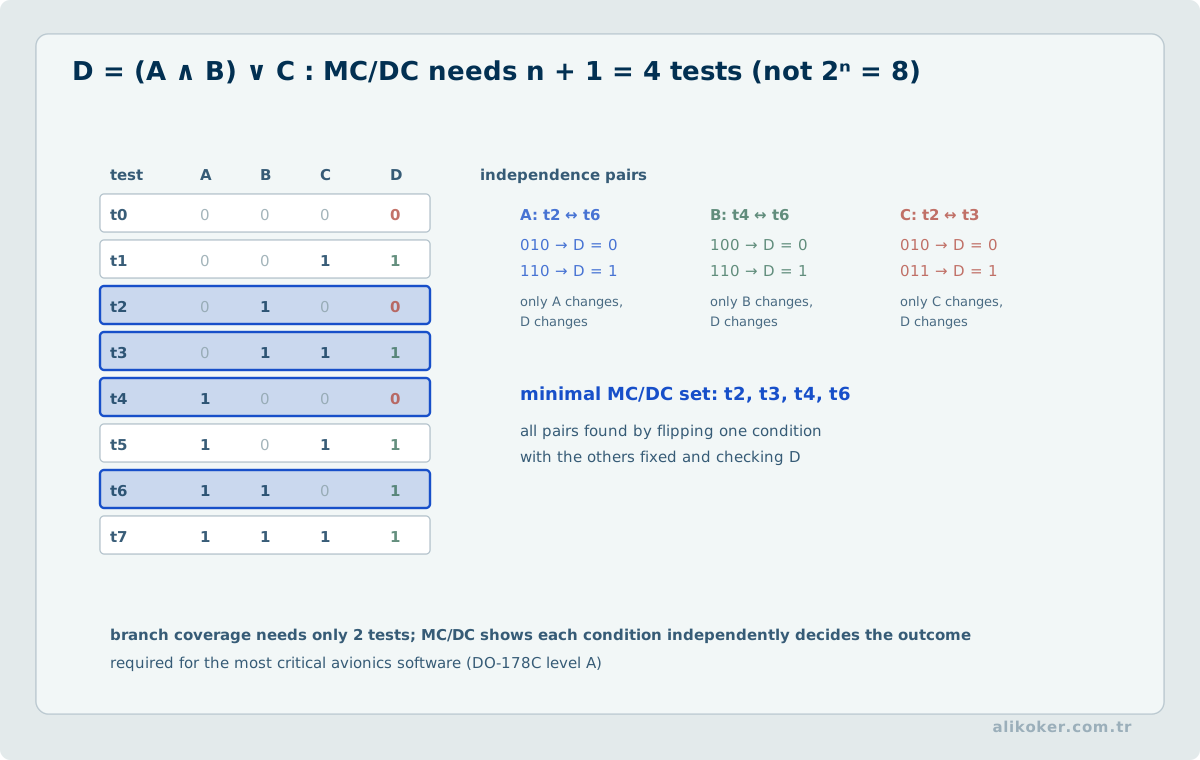
Even when both outcomes of a Boolean decision are exercised, the independent effect of each condition may remain untested. Safety-critical software may require stronger criteria such as MC/DC.
The appropriate coverage objective should follow system risk, not fashion.
High line or branch coverage does not prove that each Boolean condition independently affects a decision. For A && B, testing only A=false and A=true, B=true can exercise both decision outcomes without demonstrating B's independent effect. Modified condition/decision coverage requires suitable test pairs showing that each elementary condition can change the decision outcome while relevant others are held fixed. This strengthens testing of safety-relevant decision logic, but cannot by itself detect code that correctly implements an incorrect requirement.
53. Test metrics: measurement changes behavior
Once a metric becomes a management target, people naturally optimize for the number. Ignoring Goodhart’s effect can turn the measurement system itself into a quality problem.
Potentially useful indicators include:
- escaped defect rate,
- defect detection phase,
- test execution duration,
- flaky-test rate,
- mean time to diagnose a failed test,
- mutation score,
- code-coverage trend,
- regression coverage for production incidents,
- distribution of test-failure causes.
Raw test-case count and raw defect count are usually weak performance indicators. A tester finding many defects can mean strong testing, poor product quality, or both.
53.1 Defect Removal Efficiency
Conceptually:
DRE = defects found during development/testing /
      (defects found during development/testing + defects escaped to production)
Metrics like DRE are useful for observing trends, but should not become management targets without considering defect severity and classification.
54. Defect reports: an unreproducible defect is incomplete evidence
A good defect report minimizes the amount of guessing required to reproduce and diagnose the problem.
Useful context often includes:
version / commit
environment
precondition
test data
steps
expected behavior
actual behavior
timestamp
correlation/request id
log/trace/screenshot
reproduction rate
There is a large diagnostic difference between “there is a bug” and “sending POST /api/orders twice with the same idempotency key 200 ms apart produces two ORDER_CREATED events.”
54.1 Severity and priority are not the same thing
Severity expresses technical or business impact. Priority expresses when the issue should be addressed. A low-severity visual defect can be high priority before a launch. A technically severe defect in an unused legacy feature may temporarily receive lower delivery priority.
Keeping the concepts separate makes the decision explicit rather than arbitrary.
55. Root-cause analysis: fix the control system, not only the failing test
When a production defect is found, adding one bug fix and one regression test may not be enough.
Ask the entire control chain:
Why was the defect introduced?
Why was it not found in review?
Why did unit/integration testing miss it?
Why did it not appear in staging?
Why did monitoring fail to signal it earlier?
The purpose is not to find a person to blame. It is to locate the missing control.
If a BOLA vulnerability is discovered in production, for example, the remedy should not stop at adding one authorization check to one endpoint. Review:
- authorization-policy architecture,
- shared security interceptors,
- the role/resource/action test matrix,
- code-review criteria,
- security integration tests.
A single defect should create information for systemic improvement.
56. Testing in CI/CD: feedback time is an architectural decision
The pipeline does not need to run every test at every step. It needs to produce the right evidence at the right time.
For example:
commit
  -> compile
  -> static checks
  -> small tests
  -> changed-module integration
  -> package
  -> medium tests
  -> security/dependency checks
  -> deploy ephemeral environment
  -> smoke / contract
  -> selected E2E
  -> scheduled performance/security suites
If a developer waits 45 minutes for feedback on a small change, the suite begins to detach from the development loop. Engineers stop running it locally, stop waiting for results, or learn to bypass it.
56.1 Quality gates
A quality gate should not collapse to one coverage percentage. A project might instead require:
unit/integration tests pass
critical mutation regression pass
no new critical vulnerability
migration validation pass
flaky rate below threshold
performance regression within budget
Every gate should have a reason. A gate that is routinely overridden becomes ceremony rather than control.
57. Test-suite performance is a performance-engineering problem too
At thousands of tests, the test infrastructure becomes a workload of its own.
Common sources of slowness include:
- restarting context for every class,
- creating unnecessary containers,
- loading huge fixtures,
- serial execution where isolation would permit parallelism,
- external network access,
- repeated schema migration,
- unnecessary UI testing,
- starting a new process per test.
Optimization should follow the same discipline used for production performance:
measure
locate the hotspot
change one thing
measure again
57.1 Parallel execution
JUnit 6 supports parallel execution, but enabling it often exposes hidden coupling:
- shared port,
- shared file,
- shared database schema,
- static singleton,
- global system property.
A failure that appears only under parallel execution is frequently an isolation problem rather than a JUnit problem.
Independent tests provide both reliability and safe parallelism.
58. Testing legacy code: characterize behavior before changing it
Refactoring untested legacy code is risky because the “correct” behavior may not be documented anywhere.
A characterization test records observable behavior before change. It does not assert that the current behavior is ideal; it makes change visible.
A cautious loop is:
execute current behavior
observe output
protect the necessary behavior with a test
make a small refactoring
run tests
repeat
58.1 Find a seam
Legacy code may be tightly coupled to a database, static function, or file system. Create the smallest safe seam that makes the dependency controllable.
For example, replacing direct use of:
System.currentTimeMillis()with a time provider can be a safer first step than introducing a broad architectural redesign.
58.2 Golden master
When a legacy system produces complex output whose complete correctness is not yet understood, existing output can be captured as a golden master and compared after a change.
The technique is powerful and dangerous for the same reason: it can preserve existing defects. A diff still requires domain review; equality with history is not proof of correctness.
59. Test smells: what test code tells us about design
Common test smells include:
Mystery Guest
The data required by the test is hidden in a file or database. Reading the test does not reveal why it passes.
Eager Test
One test exercises too many behaviors. When it fails, the cause is unclear.
Fragile Test
The test breaks under small refactoring even though externally visible behavior did not change.
Slow Test
A narrow behavior requires unnecessary infrastructure.
Test Code Duplication
Fixture setup is repeated across many tests.
Conditional Test Logic
The test contains complicated if or loop logic and becomes a defect source itself.
Assertion Roulette
Many similar assertions fail without making it clear which expectation mattered.
Sleepy Test
The test depends on sleep for timing.
Overspecified Interaction
The mock call sequence is frozen in unnecessary detail.
A test smell often accompanies a production design smell. If a test is extremely difficult to construct, the domain object may have too many dependencies. If private methods feel as if they need independent tests, the class may have accumulated too much responsibility.
Offline contract tests and connection-free verification
Verification that does not require production dependencies can provide very fast feedback in large, long-lived systems. The goal is not to imitate the real database or network so completely that integration testing becomes unnecessary. The goal is to isolate contracts that do not require those dependencies and verify them deterministically.
Useful evidence at this layer can include:
- successful compilation and packaging,
- preservation of expected contract signatures in critical classes and files,
- successful loading of client-side modules,
- basic user flows over fixed fixtures,
- pure authorization, state-transition, or data-format rules,
- detection of unexpected changes outside the intended scope.
source
  |
  +--> build
  +--> contract check
  +--> offline fixture
  +--> smoke flow
  |
  v
fast evidence before integration environments
This is particularly valuable when a database cannot be reached or production data cannot be copied into a test environment. Test data can be small and explicit, while time, network, and external-service variability are removed from the result. The more deterministic the test becomes, the easier it is to localize a regression.
A contract-signature test should not be reduced to text search. A function can keep its name while changing behavior. Static signature checks, behavioral fixtures, and browser smoke tests are therefore complementary layers rather than substitutes. None is sufficient evidence on its own.
Offline tests also make failure states cheap to reproduce. Network timeout, empty response, invalid state transition, or an interrupted client lifecycle can be simulated without disturbing a live dependency. This layer connects the change-risk material in Software Engineering with behavioral equivalence in Clean Code and Maintainability Engineering.
Adding Performance and Resilience Testing to Functional Verification
Security and reliability are not independent bolt-on features; both shape how a system contains faults and abuse. In test engineering, resource limits and blast radius are testable contracts rather than production-only safeguards; fault injection is incomplete unless privilege separation, secure defaults, rollback time, and recovery procedures are also verified under controlled failure. In denial-of-service scenarios in particular, the protection mechanism itself must not consume the availability it is intended to preserve.
- Find the onset of saturation rather than only maximum throughput during load tests.
- Observe dependency timeouts, retry storms, and recovery behavior with fault injection.
- Add p95/p99 latency and resource-consumption bounds to regression criteria.
Known-answer and negative testing of cryptography
The property decrypt(encrypt(m))=m may be necessary but is not sufficient: the same defect may exist in both functions and leave a round-trip test passing. Separate official known-answer vectors, cross-implementation checks, negative tests for modified tags or AAD, and boundary-length tests. Integrity testing must also verify that no execution path releases unauthenticated plaintext.
Reports should record key generation, nonce policy, library version, platform, and expected error class. Fixed keys belong only in deterministic tests. Passing these tests does not prove IND-CCA security or absence of side channels. Cryptology covers the security definitions; this unit designs automation and regression evidence.
Unit 5: Automation, AI, Production, and Observability
60. Test automation: automate repetition, not human judgment
Not every test should be automated. Automation is particularly strong at:
- frequent repetition,
- deterministic oracles,
- high regression risk,
- large data combinations,
- performance measurement,
- API and contract verification.
Human judgment remains strong at:
- exploration,
- usability evaluation,
- understanding a new feature,
- challenging an ambiguous requirement,
- interpreting unexpected behavior.
A target such as “100% automation” is usually meaningless. A better principle is:
Automate high-value controls that are repeatable and machine-evaluable with confidence; reserve human attention for ambiguity, exploration, and interpretation.
60.1 Limits of record/playback
UI record/playback tools can generate a first scenario quickly, but maintenance cost rises rapidly if the resulting test code is not engineered. Reusable page or component abstractions, semantic selectors, and data independence still matter.
Automation code is production-quality engineering code. It needs version control, review, refactoring, and performance discipline.
61. AI-assisted test generation: an accelerator, not an oracle
Research and tooling in 2025–2026 increasingly explored LLM-based test generation, REST API test amplification, multi-agent test generation, and automated evaluation of test suites. These tools can generate unit-test skeletons, suggest boundary candidates, or propose API scenarios from existing code.
Their most useful role is often search-space expansion: producing candidates that an engineer can evaluate. Three risks remain important:
- The model may treat an incorrect behavior in production code as the expected behavior.
- It may generate many superficial tests that increase code coverage without increasing mutation effectiveness.
- Generated tests may couple themselves too tightly to frameworks and implementation detail.
An AI-generated test should therefore pass through an engineering filter before entering the suite:
which risk?
which oracle?
which boundary?
which mutant would it kill?
which production defect could it reveal?
A test that cannot answer these questions may be automated noise rather than useful evidence.
61.1 AI-assisted review of existing tests
LLMs can also suggest missing boundaries, duplicate tests, and untested combinations in an existing suite. The suggestion is still a hypothesis. Whether it represents an important risk remains a domain decision.
62. Testing machine-learning systems: the code can be correct while the model is wrong
Machine-learning systems add sources of uncertainty beyond conventional software:
code
model
data
feature extraction
preprocessing
postprocessing
threshold
runtime
A unit test can establish that a preprocessing function behaves as designed. It cannot, by itself, establish that the model is good enough for its intended use.
Relevant test areas include:
- training/serving skew,
- data schema,
- label quality,
- class imbalance,
- distribution shift,
- robustness,
- latency,
- determinism,
- fairness requirements,
- model-version compatibility.
62.1 A single accuracy number is not enough
A classifier can have high global accuracy while performing poorly on the minority class that matters most operationally. Confusion matrix, precision, recall, F1, ROC/PR behavior, and domain-specific error cost should be evaluated together.
62.2 Metamorphic relations for ML
In speech recognition, for example, a small amplitude normalization that does not change the linguistic content should not produce a completely unrelated transcript. In image classification, prediction consistency can be evaluated under transformations that preserve semantic meaning.
The oracle problem is even more visible in ML than in conventional deterministic software.
62.3 Data and model versions are part of the test input
A learning system can regress without a source-code change. The same binary may behave differently with another model, tokenizer, feature schema, preprocessing version, or runtime. Regression results therefore need a fixed artifact set:
code version
+ model version
+ data / feature contract
+ runtime version
+ evaluation set
62.4 Model regression is not a single metric
A new model can improve a global metric while regressing on a critical subgroup or failure mode. Comparison may need sliced confusion matrices, calibration, latency, memory, and robustness in addition to the headline task metric. Acceptance criteria should come from system requirements rather than a generic claim that a model is “better.”
62.5 Define the required determinism
GPU kernels, parallel reductions, and stochastic preprocessing may prevent bit-identical output. Tests should state whether they require bit equality, numerical tolerance, or stability of a task-level metric. Otherwise they become either unnecessarily brittle or too weak to catch real regressions.
The common principle is the same for AI-generated tests and testing AI systems: do not delegate the test oracle to the model; define expected behavior through requirements, data contracts, and independent measurement.
In analytical testing, the correct answer is not always a single known number. If a transformation is supposed to be invariant to input row ordering, computing the same summary after several permutations is a metamorphic test. When joining datasets on a group key, preservation of unique entities can be asserted under an explicit cardinality contract. For learned systems, changing the input distribution without altering test labels permits evaluation of how metrics degrade under shift. These checks go beyond proving that a program executes without exceptions: they test statistical and functional invariants of the analysis.
63. Testing real-time and cyber-physical systems
In a real-time system, the requirement is not only a correct result but a correct result at the correct time.
functional correctness + timing correctnessA control command that is logically correct but arrives 500 ms too late may be physically wrong.
Relevant test dimensions include:
- worst-case response time,
- deadline misses,
- jitter,
- sensor noise,
- clock drift,
- packet loss,
- actuator failure,
- fail-safe state,
- degraded mode.
Modern autonomous-driving research makes heavy use of probabilistic model checking, scenario generation, and simulation because the physical-world combination space is far too large to exhaustively exercise with real vehicles.
63.1 Hardware-in-the-loop
Hardware-in-the-loop (HIL) testing combines real control hardware with a simulated physical environment. It exposes timing, I/O, driver, and hardware interaction that pure software simulation may miss.
In safety-critical systems, traceability and reproducibility of test evidence must be held to a stricter standard than in an ordinary application.
64. Testing in production: a test environment is not the whole truth
Staging can resemble production, but it is not production. Real traffic distributions, data cardinality, network topology, and resource contention become fully visible only in the live environment.
Controlled production-verification techniques can reduce the remaining uncertainty.
Smoke after deploy
Critical endpoints and essential flows are verified automatically after deployment.
Canary
The new version receives a small share of traffic while error rate and latency are compared with the existing version.
Blue/Green
A new environment is prepared in parallel and traffic is moved in a controlled step.
Shadow traffic
Copies of production requests are sent to the new system, while its responses are not returned to users.
Feature flag
New behavior is enabled only for a limited population.
None of these techniques replaces pre-production testing. They form the last controlled verification layer where the full production environment matters.
65. Observability extends the test oracle
When a test fails and the system cannot explain what happened, diagnosis becomes expensive. In production the cost is higher still.
Useful observability combines:
- structured logs,
- metrics,
- distributed traces,
- correlation identifiers,
- domain events and audit evidence.
A test can verify the observability contract as well as the business result:
failure occurs
 -> correct status is returned
 -> correct metric changes
 -> correlation id appears in the trace/log path
 -> sensitive data is not logged
Observability is not only an operations concern. It increases what a test can observe and therefore strengthens the oracle.
66. Let production incidents teach new test-design rules
Some of the highest-value test ideas arrive from production incidents. The weak response is to convert the exact incident input into one regression test and stop there. The stronger response is to generalize the defect class.
Example:
Bug: the report was not generated on February 29.Weak follow-up:
add one test for 2024-02-29Stronger conclusion:
date-boundary class:
- end of month
- end of year
- leap year
- DST transition
- timezone conversion
A single defect should teach a new test-design rule that prevents related failures, not merely preserve one historical input.
67. Test documentation: preserve decision memory, not paperwork
ISO/IEC/IEEE 29119-3 systematizes test documentation, but the amount of documentation should be proportional to project risk.
A hundred-page test plan may have little value in a small agile team. The following decisions should nevertheless remain recoverable:
- test scope,
- explicit exclusions,
- risk priorities,
- environment,
- entry and exit criteria,
- critical datasets,
- ownership,
- known limitations.
Critical or regulated systems usually need more detailed traceability:
requirement -> risk -> test condition -> test case -> result -> defectThe value of documentation is not filling a folder for an audit. It is the ability to reconstruct later why a decision was made and what evidence supported it.
Unit 6: Test Strategy, Advanced Techniques, and Conclusion
68. A practical algorithm for building a test strategy
When I approach a new system or a substantial change, the following order tends to produce less unnecessary work than starting from a catalog of test types.
Step 1 — Define the quality objective
What is the most expensive form of failure in this system?Functional error? Data loss? Security compromise? Latency? Outage? Unsafe physical behavior?
Step 2 — Draw the system boundaries
UI -> API -> service -> DB -> broker -> external serviceEach boundary carries a different kind of risk.
Step 3 — Make requirements testable
Turn vague adjectives into measurable conditions:
fast -> P95 < 250 ms @ 1200 req/s
highly available -> monthly availability >= ...
Step 4 — Rank the risks
Consider impact, probability, change intensity, and detection cost together.
Step 5 — Choose the cheapest reliable layer for each risk
pure business rule -> unit
SQL semantics -> real DB integration
wire format -> API/contract
critical user flow -> E2E
capacity -> performance
Step 6 — Define the test data and the oracle
State where the expected result comes from. If the oracle is not independent, the confidence is weaker than it looks.
Step 7 — Design negative paths as seriously as positive paths
what should happen?
what must not happen?
what happens at the boundary?
what happens concurrently?
what happens when a dependency fails?
Step 8 — Automate economically
Put frequent deterministic checks into the fast feedback path. Schedule expensive broad tests at the cadence justified by their cost and risk.
Step 9 — Measure the test system itself
duration
flaky rate
diagnosis time
mutation effectiveness
Step 10 — Feed production evidence back into test design
Incidents, telemetry, and real usage are sources of new hypotheses and new test conditions.
The purpose of this algorithm is not to maximize the number of tests. It is to reduce uncertainty systematically.
69. End-to-end example: making an order service testable
Consider a simple-looking endpoint:
POST /ordersBusiness rules:
- an active user can create an order,
- stock must be sufficient,
- payment must be collected,
- the order must be persisted,
- an event must be published.
One E2E test may appear sufficient at first. The behavior becomes clearer when decomposed by risk.
69.1 Unit layer
Price and discount calculations are exercised as pure functions:
boundary values
rounding
zero
invalid quantity
69.2 Service layer
If stock is insufficient, the payment provider must not be called. Mock interaction is meaningful here because “no payment call occurs” is itself business behavior.
69.3 Repository layer
Against the real database, verify:
constraints
transactions
concurrent stock decrement
locking
69.4 API layer
Verify:
JSON validation
status code
error contract
authentication
authorization
69.5 Event layer
When the order transaction completes, verify that the event is produced according to the delivery semantics chosen by the system: exactly once at the business level, or idempotently under an at-least-once transport model.
69.6 E2E
Run one or a few critical scenarios through the real chain of services.
69.7 Performance
Measure P95/P99 under a representative traffic mix and stock contention.
69.8 Resilience
Exercise payment-provider timeout, broker unavailability, and database failover.
69.9 Security
Attempt to read or modify another user’s order, tamper with quantity, and replay requests.
None of these tests is a duplicate of another. Each challenges a different assumption. That is a useful sign of a well-structured test architecture.
70. Black-box, white-box, and gray-box: perspective is not a test level
Black-box and white-box are often confused with unit and integration levels. They actually describe which information is used to design the test.
Black-box testing derives tests from externally visible contracts without depending on implementation knowledge. Requirements, inputs, outputs, and user behavior drive the design.
White-box testing uses knowledge of code structure, control flow, branches, conditions, and internal state.
Gray-box testing combines the two perspectives. An engineer may call an API through its public interface while deliberately choosing scenarios based on knowledge of its transaction model or authorization architecture.
An API integration test can be white-box. A unit test can be written black-box. Binding these perspectives to test levels creates terminology arguments without improving the evidence.
70.1 Structural testing and control-flow coverage
Common white-box coverage criteria include:
statement coverage
branch/decision coverage
condition coverage
path coverage
MC/DC
Statement coverage asks whether a statement executed. Branch coverage exercises each decision outcome. Condition coverage examines the constituent conditions of a compound expression. MC/DC is especially relevant in critical systems because it demonstrates that each basic condition can independently affect the decision outcome.
In airborne software assurance, structural coverage is not an independent quality score that replaces requirements-based verification. The DO-178C context makes the distinction useful: verification evidence remains linked to requirements, while structural coverage helps expose implementation that was not exercised or that requires additional analysis. The flight-control and critical-software context is developed in Avionics Systems and Unmanned Aerial Vehicles.
Path coverage is theoretically strong, but loops make the number of paths explode rapidly. Finite test budgets therefore require risk-based selection again.
70.2 Testing loops and iterative behavior
Classical loop boundaries remain useful:
0 iterations
1 iteration
2 iterations
normal n
maximum - 1
maximum
maximum + 1
Modern iterative behavior is not limited to a for statement. Stream pipelines, retry loops, pagination, queue consumers, and recursive traversal require the same boundary reasoning.
71. Model-based testing: deriving test cases from behavior models
As the number of states grows, manually enumerating test cases becomes increasingly fragile. In stateful systems, it is often more reliable to define the behavior model first and derive tests from that model.
A protocol model might look like this:
DISCONNECTED
   -> CONNECTING
   -> AUTHENTICATED
   -> ACTIVE
   -> CLOSING
   -> DISCONNECTED
The model contains more than the valid states. It also captures transition guards, forbidden transitions, and—when necessary—the conditions under which a transition must occur. A test generator can then traverse the model and produce paths that would be tedious to maintain by hand.
Model-based testing is particularly useful for:
- protocols,
- workflow engines,
- embedded systems,
- telecommunications software,
- GUI state machines,
- safety-critical controllers.
71.1 A wrong model produces systematically wrong tests
Automatic generation does not compensate for an incorrect model. It can instead reproduce a modeling error with impressive consistency. Reviewing the behavior model is therefore an engineering activity of its own, separate from generating and executing the tests.
71.2 Timed models
In real-time protocols, state may change because time passes, not only because an event arrives:
if ACK does not arrive within 200 ms -> TIMEOUTTimed automata and model checking become valuable in this class of system. Research on quiescence, timeout behavior, and timed state models illustrates why conventional state-transition testing must be extended when timing is part of correctness rather than merely a performance characteristic.
72. Formal verification and testing: complements, not rivals
Testing executes a program on a finite set of observations. Formal methods can instead attempt to prove a property of a model or program mathematically under stated assumptions.
Examples include:
- model checking,
- symbolic execution,
- bounded model checking,
- contract verification,
- theorem proving.
Tools such as CBMC, Dafny, and Isabelle/HOL can provide assurance for classes of properties that finite testing cannot exhaustively cover. That assurance still depends on the model assumptions, the environment model, and the boundary between what has and has not been verified.
Proving that an arithmetic routine cannot overflow is valuable. The proof does not tell us that a deployment connected the application to the wrong service because of an incorrect configuration value.
For critical software, stronger assurance usually comes from layers rather than from choosing one technique:
formal property
 + static analysis
 + unit/property tests
 + integration tests
 + system observation
The question “testing or formal verification?” is therefore often a false dichotomy.
73. Smoke, sanity, acceptance, alpha, and beta: purpose matters more than the label
These terms are used somewhat differently across organizations, so the team should define what each package means in its own delivery process.
A smoke test quickly checks whether a build or deployment is basically usable: does the system start, do critical services respond, and does the simplest essential path work?
A sanity test is a narrow package used to establish that the main behavior around a focused change still appears coherent. Teams do not need to use this term at all; shared meaning matters more than terminology.
An acceptance test verifies that the product satisfies defined business or operational acceptance criteria. User acceptance testing (UAT) is the stakeholder-oriented form of that activity.
An alpha test evaluates the product under controlled, usually internal, conditions that approximate real use.
A beta test exposes a limited or pre-release version to a broader real-user population and observes behavior that controlled environments may not reveal.
Alpha and beta testing do not replace automated regression. Their value is the diversity of real usage and the information that diversity produces.
74. Compatibility and localization testing: what changes outside the default environment?
Testing only one browser, locale, time zone, runtime, or database leaves a substantial part of the state space unexplored.
A compatibility matrix may include:
OS × runtime × browser × database × locale × timezoneExercising the full Cartesian product is usually wasteful. Risk, actual usage distribution, and combinatorial techniques such as pairwise testing provide a more economical sample.
74.1 Localization is more than translated strings
Localization testing must also cover:
- date formats,
- decimal separators,
- currencies,
- case-conversion rules,
- Unicode normalization,
- text expansion,
- right-to-left rendering,
- sorting and collation.
The Turkish I, İ, ı, and i characters are a classic example. Code that performs toUpperCase() under an English-locale assumption can produce genuine defects in identity matching, search, or normalization logic.
Time zones deserve the same attention. Converting a UTC timestamp to a user's local time can move an event across a day, month, year, billing period, or reporting boundary.
75. Backup, restore, and disaster-recovery testing: a backup that cannot be restored is not evidence of recoverability
A backup job reporting success proves that the job reached a particular status. It does not prove that the organization can recover the system.
The actual recovery path must be exercised:
create backup
restore into an isolated environment
start the application on the restored data
verify integrity
measure RPO/RTO
RPO (Recovery Point Objective) defines the acceptable amount of data loss. RTO (Recovery Time Objective) defines how quickly service must be restored.
A restore exercise can reveal problems that routine backup monitoring never sees:
- a missing encryption key,
- a broken incremental chain,
- schema/application version incompatibility,
- objects omitted from the backup,
- restore time exceeding the RTO,
- incorrect access permissions.
A disaster-recovery document that has never been executed is still a hypothesis. An incident is the worst time to run that hypothesis for the first time.
76. Test automation architecture: where data-driven and keyword-driven approaches help
The source notes contain many tools and automation techniques, but tool selection should follow the automation architecture rather than define it.
Data-driven testing executes the same behavior against different data sets. It is effective for boundary analysis, equivalence classes, and decision-table scenarios.
@ParameterizedTest
@CsvSource({"0,FREE", "100,STANDARD", "1000,PREMIUM"})
void classifies(final int score, final String expected) {
    assertEquals(expected, classifier.classify(score));
}
Keyword-driven testing represents steps as domain actions such as LOGIN, SEARCH, or SAVE and drives those actions from data. ISO/IEC/IEEE 29119-5:2024 is the current part of the series dedicated to this approach.
A keyword-driven layer can help non-programming testers construct scenarios, but an over-generalized DSL can become another software product to maintain. Debugging becomes indirect, the real API disappears behind abstractions, and tests may become harder to read than the code they replaced.
The criterion is simple: an abstraction is useful when it removes repeated meaning while preserving diagnostic clarity. If it exists mainly to demonstrate another framework, it has become overhead.
77. Conclusion: the objective is trustworthy change, not green tests
When software test engineering is reduced to a collection of tools and test types, the predictable result is an ever-growing test suite. After a while there may be hundreds of unit tests, dozens of integration tests, and long end-to-end scenarios, yet the team still approaches a small production change with uncertainty.
At that point the original purpose of testing has been displaced by the mechanics of maintaining tests.
A useful test system should allow an engineer to say:
I know which behaviors this change can affect; the critical assumptions will be exercised automatically; a failure will produce a sufficiently narrow signal; and broader system risks will be verified at the layers where those risks actually exist.
Unit tests provide fast feedback. Integration tests expose the truth at boundaries. Contract tests protect independent evolution between services. End-to-end tests show that critical paths operate together. Property-based testing escapes the limits of hand-picked examples. Mutation testing asks whether the tests would notice meaningful behavioral changes. Fuzzing creates inputs the engineer did not anticipate. Performance testing measures capacity and latency under a defined workload. Resilience testing explores how the system degrades. Security testing follows the attacker's path. Production observation reveals behavior that the laboratory could not reproduce.
None of these techniques is sufficient by itself. Using all of them on every project is not engineering either.
The practical loop is smaller:
understand the risk
 -> define the behavior
 -> choose the boundary
 -> establish the oracle
 -> write the cheapest reliable test
 -> measure the result
 -> learn from production
 -> remove tests that no longer earn their cost
Test-suite size matters less than the confidence produced per unit of maintenance and execution cost.
Testing software is not an attempt to prove that no defect exists. It is a disciplined search for the conditions under which our assumptions fail, followed by an explicit account of why the remaining evidence gives us confidence.
That is why the value of a test engineer cannot be reduced to the number of defects reported. The deeper contribution is to expose ambiguous requirements, unnecessary coupling, measurement bias, nondeterministic infrastructure, and hidden production assumptions before users are forced to discover them.
Characterization and Risk-Adaptive Verification in Proven Legacy Systems
Verification in a long-running production system is not limited to testing the new requirement. A change made without understanding existing reliable behavior can implement the new feature correctly while breaking an older contract. For critical paths, a strong sequence is to characterize current behavior first, apply the change, and then verify the same contract again.
observe current behavior
  -> state the contract to preserve
  -> apply the small change
  -> verify the same behavior again
  -> accept only the intended difference
A characterization test does not claim that current behavior is ideal. Its purpose is to make the real pre-change behavior visible. If that behavior is deliberately changed later, the difference between the old and new expectations should be explicit. This is closely related to safe refactoring in Clean Code and Maintainability Engineering.
Verification depth should follow change risk. A color or spacing change does not require the same investigation as a change to authorization, transactions, identity mapping, or locking. A simple model can be useful:
low risk     -> local behavior and direct dependencies
medium risk  -> affected end-to-end path and state transitions
high risk    -> data, authorization, concurrency, failure paths, rollback contracts
The goal is not to test the entire application for every high-risk change. It is to avoid missing the contracts that the change can actually affect.
Verification is still possible when connecting to a production database or an external service would be unsafe. Running the real service and persistence code while replacing the external boundary with a controlled test double can provide useful characterization evidence for generated SQL, transaction calls, and error contracts. An in-memory database should not automatically be treated as an exact representation of Oracle behavior; the scope of the evidence must be stated.
The wording of a validation report is itself part of technical accuracy. These statements are not equivalent:
test passed
build succeeded
verified by source inspection
could not run because the environment was incomplete
production equivalence was not verified
Treating an unexecuted test as passed, or a successful compilation as proof of production behavior, creates false confidence. From a Software Engineering perspective, reliable change management includes an explicit statement of the strength and limits of the evidence.
Using Standards and Tools Together
A standard is not a test tool. ISO/IEC/IEEE 29119 provides common concepts, processes, documentation, and test techniques; ISO/IEC 25010 helps classify quality objectives; ISTQB provides shared terminology and foundational practice; IEEE 730 addresses software quality assurance processes. JUnit, Spring Test, Testcontainers, Selenium, JMeter, PITest, and property-based testing libraries solve more specific engineering problems.
Choosing a tool from a standard, or deriving a test strategy from a preferred tool, reverses the engineering decision. Risk and evidence requirements should come first; the mechanism follows.
Mutation testing and test-suite sensitivity
High coverage does not prove that tests can detect faults. Mutation testing introduces small artificial defects and checks whether the suite fails.
A surviving mutant does not always imply a missing test; some mutations are equivalent or irrelevant. The useful signal is whether critical business rules are actually sensitive to mistakes.
Testing the reliability of a test result
A passing test is evidence only for the contract and conditions it actually exercises. It should be clear whether the same result is expected when data, environment, time, ordering, or external services change.
A flaky test is not a reliable signal. Random seeds, time sources, shared state, and external dependencies should be controlled before pass rate is treated as a quality indicator.
Coverage helps locate untested areas but does not prove correctness. Decision tables, boundary analysis, mutation testing, and property-based testing can show whether the suite is sensitive to defects in critical rules.
Verifying Adaptive and Degraded Operating Modes
Resilience testing is not limited to crashing a service and confirming restart behavior. In complex human-machine systems the more important questions are which functions remain available, which capabilities are deliberately restricted, and whether the practitioner can correctly understand the new state under failure or resource pressure. This connects directly to Cognitive Systems Engineering.
Nominal scenarios are not sufficient
A test matrix can include operating mode as well as input and output values:
normal capacity
high load
stale data
partial dependency loss
automation unavailable
delayed feedback
post-interruption continuation
Invariants can differ by mode. Full functionality may be required under nominal operation, while a degraded mode can preserve correctness and integrity while disabling secondary analysis capabilities.
Human-perceivable correctness
A technically correct state does not guarantee a correct user mental model. If a service fails over to a standby instance while the interface continues to imply that the old source is active, backend tests can pass while the operational system remains wrong. Critical workflows should therefore verify properties such as:
- correct presentation of active source and mode,
- visibility of data age,
- ability to take over after automation failure,
- recovery of work context after interruption,
- intelligibility of alert cause-and-effect relations.
These tests do not replace unit testing. They extend system and human-factors validation around technical invariants.
Transformations and expected relations in metamorphic testing
For some software, an independent expected output is difficult to compute for every input. Metamorphic testing instead checks a necessary relationship between executions on transformed inputs. Permuting the input of a sorting algorithm must preserve its sorted output multiset. Adding an irrelevant record to a search collection should not change the identities of previously matching records. Such relations must be derived from the specification, not merely from intuitive plausibility.
In audio processing, changing sample-rate metadata while leaving PCM samples untouched changes the physical time axis; expecting identical timestamps would be an invalid property. By contrast, for a fixed PCM sequence, varying file-read chunk size should often preserve the reconstructed sample stream and segment boundaries in a lossless, chunk-independent processing pipeline. The processing algorithm's actual contract must still be checked before promoting this to a test invariant.
A rigorous metamorphic test states three things: preconditions on the original input, the allowed transformation, and the required relationship between outputs. If deliberate mutations of the implementation do not cause the test to fail, the oracle may be weak. Property-based testing and mutation testing can complement metamorphic relations; none of them constitutes a general proof of correctness.
Unit 7: Regression Testing Deterministic Analytical and Conversational Systems
Analytical and conversational software creates a different testing problem from ordinary CRUD applications. The same phrase can mean different things under different dialogue states; a result can belong to one analytical snapshot; a small routing change can invoke the wrong action; and a visible UI action can diverge from the same phrase typed into a conversational interface.
The test strategy must therefore cover routing, state, data versioning, capability boundaries, and deterministic behavior, not only whether a function returned some output.
Pure core and effectful shell
A highly testable design separates:
PURE CORE
├─ normalization
├─ matching
├─ similarity
├─ analytical computation
├─ evaluation
└─ decision rules

EFFECTFUL SHELL
├─ DOM
├─ network
├─ database
├─ file system
├─ media
└─ user events
The pure core can satisfy:
same input + same state -> same outputwhich enables fast, browser-free regression tests.
7.1 Positive routing corpus
A routing system needs more than a few happy-path cases.
For example:
"show the time analysis"
"inspect by hour"
"compare daily change"
may all be expected to reach the same intent.
Tests can verify both the intent and, when relevant, the provenance of the match:
expected intent      = ANALYZE_TIME
expected provenance  = EXACT / PATTERN / CONTEXT / RETRIEVAL
Reaching the right intent through the wrong path can hide a priority or threshold regression.
7.2 Negative routing tests
False-positive routing is one of the most dangerous regressions in natural-language interfaces.
A test can explicitly state:
input X
 -> must NOT route to intent Y
This is especially important for neighboring intents with overlapping vocabulary.
7.3 Collision tests
Two high-precision intents must not own the same exact utterance.
If configuration contains:
Intent A -> "same phrase"
Intent B -> "same phrase"
the system should fail during configuration or test initialization instead of silently choosing the first match at runtime.
7.4 UI labels as executable contracts
If a UI exposes a button such as:
[Is the data sufficient?]typing the exact same phrase should not route somewhere else.
Visible action labels can therefore be part of the regression corpus:
UI label
   ↓
exact match
   ↓
expected intent
7.5 Test precedence rules
If the router uses:
EXACT
 > PATTERN
 > CONTEXT
 > DOMAIN GRAMMAR
 > RETRIEVAL
 > FUZZY
 > FALLBACK
tests should lock that priority.
If a phrase matches both exact routing and retrieval, exact routing must win. Otherwise a corpus or vector change can unexpectedly override a deterministic command.
7.6 Score and margin boundary tests
Retrieval routing should not treat:
top1 = 0.62
top2 = 0.60
the same as:
top1 = 0.62
top2 = 0.20
Tests should cover values just below and above the score threshold and the top1–top2 margin threshold.
This is a direct application of boundary-value analysis.
7.7 Dialogue-context tests
At least two cases are required.
Without a meaningful previous turn:
"why?"
 -> should not be forced into an unrelated action
With an active analytical result:
analytical result
"why?"
 -> explain the current finding
The same surface form changing meaning with state is a state-transition testing problem.
7.8 Preserve selection across non-data turns
After a user selects a finding, a conversational turn such as:
"expand that"
"summarize"
that produces no new analytical data should not silently reset the selection.
A useful test sequence is:
1. create analytical result
2. select second finding
3. ask contextual follow-up
4. verify second finding remains selected
This is a conversation-state invariant.
7.9 Reset stale selections when data changes
The opposite case must also be tested.
When a genuinely new analytical result or snapshot arrives, an old selection should not be automatically attached to the new result.
If analytical results are versioned, the invariant is:
A selection is valid only inside the analysis version that created it.
7.10 Determinism tests
For a pure analytical function:
same snapshot
+ same selected finding
+ same request
should produce the same structured output across repeated calls.
r1 = evaluate(x)
r2 = evaluate(x)

assert deepEqual(r1, r2)
Hidden dependencies on time, randomness, global mutable state, or the DOM make such tests fail and reveal impurity in the core.
7.11 Missing-data and graceful-degradation tests
Analytical systems should be tested on more than complete data.
A useful matrix includes:
complete data
partial timestamps
partial direction information
partial duration information
zero observations
one observation
insufficient comparison period
partial network
Expected behavior:
if evaluable     -> compute
if not evaluable -> explain why
never            -> invent a value
7.12 Metamorphic tests for what-if analysis
What-if analysis may not always have one easy precomputed oracle, but it has invariants.
For:
scenario = remove the last seven dayswe can assert:
- scenario data cannot be larger than baseline data,
- removed dates cannot appear in the scenario result,
- baseline data must not be mutated,
- repeating the same scenario must produce the same result.
These are metamorphic properties.
7.13 Tool-contract tests
If conversational tools share a contract such as:
reply
data
context
the system should normalize multiple raw forms consistently.
Test tools that return text only, data only, null, or partial objects and verify that the conversation engine still receives a stable shape.
7.14 Capability and authorization behavior
Finding the correct intent is not enough to authorize execution.
Test the invariant:
correct intent
+
missing capability
=
tool must not be invoked
and separately verify that the authorized case invokes the expected tool.
This is both a security and a behavioral-regression concern.
7.15 Core execution with stub tools
Real external dependencies can be replaced with stubs:
NLU
 ↓
routing
 ↓
stub tool
 ↓
conversation state
 ↓
response
This can verify intent selection, entity transfer, tool invocation, state updates, and response composition without a browser or real backend.
It does not replace end-to-end tests; it provides much faster feedback.
7.16 Fallback tests
Unsupported or meaningless inputs should not be forced into the nearest command.
The corpus should intentionally contain:
nonsense
out-of-domain question
incomplete command
two nearly tied candidates
A successful result can be:
intent = nullSafe uncertainty is a feature, not a classifier failure.
7.17 Regression matrix
- Normalization: Positive: language variants; Negative: information loss; Boundary: Unicode; State: preserve original.
- Exact: Positive: correct intent; Negative: not another intent; Boundary: duplicate; State: collision fails.
- Pattern: Positive: quantity/unit; Negative: wrong pattern; Boundary: regex edge; State: deterministic.
- Context: Positive: follow-up; Negative: no prior context; Boundary: short/long input; State: preserve selection.
- Retrieval: Positive: close paraphrase; Negative: low similarity; Boundary: score/margin; State: stable top-k.
- Fuzzy: Positive: typo; Negative: distant phrase; Boundary: threshold; State: no forced route.
- Entity: Positive: period/ordinal; Negative: false identifier; Boundary: limits; State: separate state.
- Tool: Positive: invocation; Negative: no capability; Boundary: null/partial result; State: contract.
- Analysis: Positive: evaluable data; Negative: missing data; Boundary: small sample; State: expose scope.
- What-if: Positive: transformation; Negative: no mutation; Boundary: empty scenario; State: reproducible.
Conversation outcome taxonomy: separate defects from controlled outcomes
In conversational-system testing, every case where no direct answer is produced is not the same kind of defect. Useful measurement requires at least a small outcome taxonomy:
SUCCESS

QUALIFIED SUCCESS
  content is correct, presentation can improve
  answer is correct, structure is unnecessarily long
  source is correct, access path is weak

FAILURE
  wrong intent
  missed entity
  wrong person / wrong period
  false-positive routing
  wrong source
  execution failure

CONTROLLED OUTCOME
  clarification required
  no data
  not authorized
  unsupported request
  user cancellation
This distinction protects the meaning of quality metrics. If no data exists and the system correctly reports that fact, the application has not failed. A system that selects the wrong person and produces a persuasive answer has failed.
The taxonomy is useful because repeated defects can be grouped by root cause. Many failures around "the second one," for example, may belong to one coreference or conversation-state defect rather than dozens of independent bugs. Once corrected, representative cases should enter the regression corpus.
Capability-transition matrix: test edges, not only nodes
Each conversational capability can work correctly in isolation while transitions between capabilities fail. A test model should therefore cover not only the feature list but also the edges between features.
Example nodes:
text analysis
relationship analysis
time analysis
record
transcript
audio
Important regression risks live on edges such as:
text -> relationship
relationship -> time
time -> record
record -> transcript
transcript -> audio
finding -> evidence -> record
A system may correctly answer "where does topic X occur in the conversations?" yet fail on the follow-up "who are these related to?" if the first result was never committed to the shared conversational state. Isolated capability tests will miss this defect.
A practical matrix therefore uses:
source capability × target capabilityand verifies for each critical transition that:
- references are carried correctly,
- obsolete scope is not preserved accidentally,
- stale selection is cleared when new data arrives,
- authorization remains enforced across the transition.
Test task success at four levels
In natural-language systems, a metric such as "the correct intent was selected" can overstate real user success. A stronger model separates four levels:
L1 — interpretation success
     Was the user's request understood correctly?

L2 — execution success
     Did the correct operation or tool run?

L3 — result success
     Was the correct record, period, or finding produced?

L4 — task success
     Did the user actually reach the intended outcome?
For the request "play the first record," selecting the playback intent is L1. Invoking the playback function is L2, resolving the correct record is L3, and starting audio at the relevant segment is L4.
Acceptance criteria for high-impact systems should approach L4 whenever feasible. Lower levels remain valuable for diagnosing the cause of a failure; the top level determines whether the product actually completed the user's job.
This prevents linguistic fluency from being mistaken for behavioral correctness. A polished answer that completes the wrong task is a failure. A short clarification that prevents an unsafe action can be a successful outcome.
Safety invariants of the test harness
Test code is often treated as a neutral instrument that evaluates production code, yet an incorrectly designed test harness can become a risk surface of its own. Where tests can reach real data sources or persistent environments, the conditions under which the test system must not run should be explicit and executable.
Useful negative invariants include:
- execution must not begin in an environment identified as production,
- an unconfirmed environment should fail closed rather than be assumed safe,
- command-line arguments or environment properties must not provide a hidden bypass,
- forbidden external dependencies must not be touched before the safety gate succeeds,
- temporary outputs must remain inside the designated test area.
If two independent environment checks are used, their combination rule should also be explicit: execution is admitted only when both confirm the allowed state. A failure in one check must not be masked by a positive result from the other. This is fail-closed behavior applied to the test infrastructure itself.
Artefact neutrality can be verified separately. Comparing cryptographic digests of a production artefact before and after the test/build path provides strong regression evidence that the verification process did not mutate the artefact it was meant to protect.
The important distinction is:
Passing tests do not, by themselves, prove that the test harness is safe or neutral.
For high-impact systems, a regression strategy should therefore cover the safety gate, environment identification, forbidden side effects, and artefact neutrality in addition to application behavior.
7.18 The goal of the strategy
For this class of system, the important questions are not merely:
"did it return an answer?"but:
does the same condition produce the same behavior?
is the correct conversational context preserved?
are unsafe routes rejected?
is missing data visible?
can stale state contaminate new results?
are execution capabilities enforced after language understanding?
A deterministic analytical core turns regression testing into a behavioral contract that is distinct from model accuracy.
Invariant tests for summarization and dialogue continuation
Testing only that a source-grounded summarizer returned text is insufficient. Every extracted quotation must correspond exactly to a character span in the original document, its source identifier must be valid, and timestamps must not appear when the source has none. An incomplete source must not yield a claim of complete coverage. Sentence scores may change between versions, but violating these invariants cannot be justified as a quality improvement.
Metamorphic tests are particularly useful. Adding meaningless leading whitespace should not change the meaning of selected facts; reordering source documents must not corrupt record identifiers; duplicating one sentence must not cause it to dominate the entire summary. A request such as “open but do not play” must produce no playback action, and an ordinal reference such as “the third one” must be revalidated whenever the previous result list changes. These are separate adversarial scenarios.
The contribution of a new ranking method is established through controlled ablation: baseline alone, new feature enabled, and combined methods. Overall accuracy is accompanied by false positives, unnecessary clarification, section coverage, quotation correctness, and latency. Small spelling variations of one template do not create independent train/test samples; utterance families must be separated. None of these experiments should weaken the authorization or side-effect boundaries enforced by functional tests.
References
- Adzic, G., Bridging the Communication Gap: Specification by Example and Agile Acceptance Testing, Neuri, 2009.
- Ammann, P.; Offutt, J., Introduction to Software Testing, 2nd ed., Cambridge University Press, 2016.
- Apache Software Foundation, Apache JMeter Documentation. https://jmeter.apache.org/
- Beck, K., Test Driven Development: By Example, Addison-Wesley, 2002.
- Copeland, L., A Practitioner's Guide to Software Test Design, Artech House, 2004.
- Crispin, L.; Gregory, J., Agile Testing: A Practical Guide for Testers and Agile Teams, Addison-Wesley, 2009.
- Current proceedings of the IEEE/ACM International Conference on Automation of Software Test (AST) and the International Conference on Software Testing, Verification and Validation (ICST).
- Feathers, M., Working Effectively with Legacy Code, Prentice Hall, 2004.
- Fowler, M., Test Pyramid, 2012. https://martinfowler.com/bliki/TestPyramid.html
- Freeman, S.; Pryce, N., Growing Object-Oriented Software, Guided by Tests, Addison-Wesley, 2009.
- Google Testing Blog, Test Sizes, 2010. https://testing.googleblog.com/2010/12/test-sizes.html
- Google Testing Blog, Where do our flaky tests come from?, 2017. https://testing.googleblog.com/2017/04/where-do-our-flaky-tests-come-from.html
- Heather Adkins; Betsy Beyer; Paul Blankinship; Piotr Lewandowski; Ana Oprea; Adam Stubblefield. Building Secure & Reliable Systems: Best Practices for Designing, Implementing, and Maintaining Systems. O’Reilly Media, 2020.
- IEEE, IEEE 730-2026 — IEEE Standard for Software Quality Assurance Processes. https://standards.ieee.org/ieee/730/10854/
- ISO/IEC TR, 29119-6:2021 — Guidelines for the use of ISO/IEC/IEEE 29119 in agile projects.
- ISO/IEC, 25010:2023 — Systems and software Quality Requirements and Evaluation (SQuaRE) — Product quality model. https://www.iso.org/standard/78176.html
- ISO/IEC/IEEE, 29119-1:2022 — Software and systems engineering — Software testing — Part 1: General concepts. https://www.iso.org/standard/81291.html
- ISO/IEC/IEEE, 29119-2:2021 — Software testing — Part 2: Test processes.
- ISO/IEC/IEEE, 29119-3:2021 — Software testing — Part 3: Test documentation.
- ISO/IEC/IEEE, 29119-4:2021 — Software testing — Part 4: Test techniques.
- ISO/IEC/IEEE, 29119-5:2024 — Software testing — Part 5: Keyword-driven testing.
- ISTQB, Certified Tester Foundation Level Syllabus v4.0.1, 2024. https://istqb.org/certifications/certified-tester-foundation-level-ctfl-v4-0/
- jqwik, Property-Based Testing on the JVM. https://jqwik.net/
- JUnit Team, JUnit 6.1.2 User Guide, 2026. https://docs.junit.org/6.1.2/
- Meszaros, G., xUnit Test Patterns: Refactoring Test Code, Addison-Wesley, 2007.
- Meyer, B., Seven Principles of Software Testing, Computer, 41(8), 2008.
- Miller, Richard H. UX for Enterprise ChatGPT Solutions: A Practical Guide to Designing Enterprise-Grade LLMs. Packt Publishing, 2024. ISBN 978-1-83546-119-8.
- Nygard, M. T., Release It!: Design and Deploy Production-Ready Software, 2nd ed., Pragmatic Bookshelf, 2018.
- OWASP Foundation, Application Security Verification Standard (ASVS). https://owasp.org/www-project-application-security-verification-standard/
- OWASP Foundation, Web Security Testing Guide — Stable. https://owasp.org/www-project-web-security-testing-guide/stable/
- PITest, Mutation Testing for Java. https://pitest.org/
- Selected 2025–2026 research on model-based testing, automated test generation, LLM-assisted testing, metamorphic testing, and complex or critical systems under Testing Software and Systems / Advances in Intelligent and Automated Testing.
- Selenium Project, Selenium Documentation. https://www.selenium.dev/documentation/
- Spring, Spring Boot 4.1.1 Testing Reference. https://docs.spring.io/spring-boot/reference/testing/
- Spring, Spring Framework 7.0.9 Testing Reference. https://docs.spring.io/spring-framework/reference/testing.html
- Testcontainers, Testcontainers for Java Documentation. https://java.testcontainers.org/ and https://testcontainers.com/
- NIST. FIPS 197: AES, 2023 edition. https://csrc.nist.gov/pubs/fips/197/final