Audio Restoration and Enhancement

Audio restoration through noise classification and filter selection, denoising, echo control, microphone arrays, packet loss, clipping repair, and forensic processing boundaries.
Audio restoration estimates a cleaner or more task-useful signal from degraded recordings. Noise, reverberation, clipping and packet loss represent different degradation models.
Noise Type and Filter Selection
Noise is not one class of disturbance. Approximately stationary background hum, narrowband mains interference, broadband noise, impulsive corruption, wind, mechanical vibration, and competing speech have different temporal and spectral structures. A “noise filter” should therefore not be treated as one universal operation.
Classical filters serve different frequency-domain purposes:
- a low-pass filter attenuates higher frequencies,
- a high-pass filter attenuates lower frequencies,
- a band-pass filter preserves a selected interval,
- a band-stop or notch filter suppresses a selected interval.
Cutoff frequency is not a fixed recipe. The useful speech spectrum, recording device, sampling rate, and location of the interference should be considered together. A poorly selected filter can remove speech information along with the noise.
Periodic or narrowband interference may have a clear spectral signature, whereas changing environmental noise can defeat a fixed filter. Noise estimation, adaptive methods, or learned models may then be required.
Noise reduction
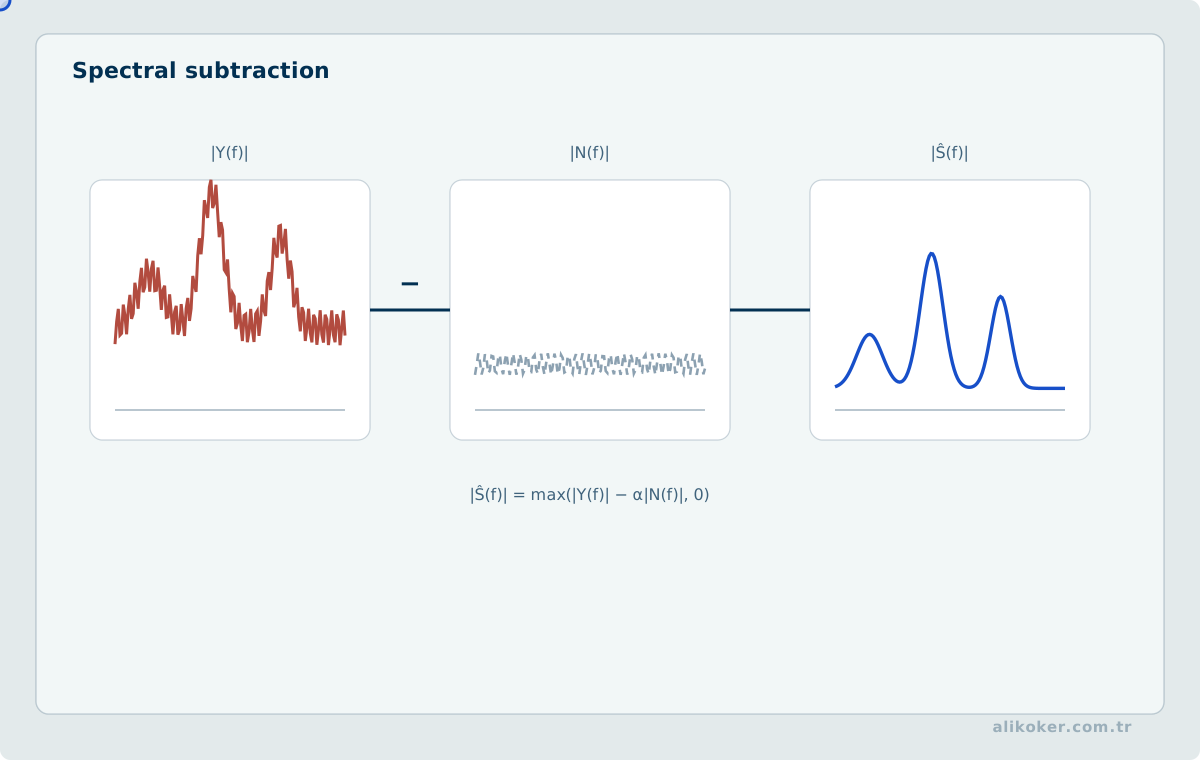
Spectral subtraction and Wiener filtering can suppress stationary or slowly varying noise when noise statistics are estimated reliably. Poor estimates may introduce musical-noise artefacts.
Learned denoisers can handle more complex noise but may also suppress signal components outside the training distribution.
Echo and microphone arrays
Acoustic echo cancellation adaptively models the path from loudspeaker to microphone. Multi-microphone beamforming uses phase and delay differences to reinforce sound arriving from selected directions.
Packet-loss concealment estimates missing samples, while declipping attempts to reconstruct saturated regions.
Task-oriented evaluation
Perceptual improvement does not always improve downstream models. In ASR, speaker recognition or acoustic-event detection, enhancement should be evaluated together with task metrics.
For forensic use, the original recording remains separate, while filter parameters, software version and derived copies are preserved as part of the processing chain.
Boundary of Forensic Audio Enhancement
In forensic audio, the objective is not merely to make a recording sound better; it is to improve examinability while preserving the original evidence. Hum or narrowband interference that masks speech can be reduced, but every filter also changes some part of the signal.
A spectrogram is useful because it shows time, frequency, and energy together, helping distinguish speech structure, interference, and recording artifacts. A single spectrogram, however, is not a deterministic “voiceprint” that proves speaker identity. Speaker comparison must be interpreted together with recording conditions, method, error rates, and uncertainty.
A defensible processing chain preserves the original file as read-only evidence and produces a separate working or derived copy. Recording filter choice, parameters, software version, input/output hashes, and processing order makes the result reproducible and auditable.
Parent topic: Image and Audio Processing
References
- Alan V. Oppenheim; Ronald W. Schafer. Discrete-Time Signal Processing, Third Edition. Pearson, 2010.
- Lawrence R. Rabiner; Ronald W. Schafer. Theory and Applications of Digital Speech Processing. Pearson, 2011.