The Organization of Turkic States and Engineering in the Turkic World

An academic examination of engineering cooperation within the OTS: institutional history, universities, industry, digital infrastructure, cybersecurity, artificial intelligence, OTS-SAT and the 2026 Ankara Summit.
Turkish Engineering History and The History of Computers, Informatics, and Public Information Systems in Türkiye examine the development of Türkiye's technical institutions and its engineering and computing capabilities. The Organization of Turkic States (OTS) provides a multilateral institutional framework through which this experience connects with the research, production, and infrastructure capacities of other Turkic states. Engineering cooperation within the Organization extends from scientific research and standardization to transport, digital systems, and joint satellite development. [1–3]
The summits of heads of state initiated in Ankara in 1992 acquired a permanent institutional framework through the Nakhchivan Agreement of 3 October 2009. The name Organization of Turkic States and the Turkic World Vision 2040 were adopted at the Istanbul Summit of 12 November 2021. Ministerial meetings on industry, science, technology, and innovation held in Istanbul on 25–26 October 2024 defined more specialized engineering cooperation through working groups and an implementation plan. The Turkistan Summit on Artificial Intelligence and Digital Development in 2026 and the Ankara meetings of 29–30 October 2026 form distinct stages in that institutional process. [3–7]
Engineering cooperation within the OTS rests on shared technical requirements, research infrastructure, interoperable systems, and the allocation of responsibilities in multinational projects. Decisions of the Organization are implemented through the activities of universities, research organizations, and national technology institutions. [4, 8–10]
Unit 1. Establishment and Institutional Development of the Organization of Turkic States
1.1. The 1992 Ankara Summit and the Beginning of Multilateral Cooperation
Summits of heads of state between Türkiye and the newly independent Turkic republics began in Ankara in 1992. Alongside political relations, the early institutional agenda addressed transport, communications, trade, education, and economic development. These fields share a practical characteristic: infrastructure and services developed at the national level require cross-border coordination. Connecting communications networks, facilitating transit transport, and enabling researchers to work in different countries require enduring technical relationships between institutions as well as regular diplomatic meetings. [3]
Subsequent summits kept scientific and technological cooperation on the interstate agenda. Bilateral initiatives among universities and sectoral ministries provided institutional experience for the multilateral mechanisms established in later years. The establishment of joint universities involving Türkiye and Kazakhstan and Türkiye and Kyrgyzstan also belongs to this period of educational relations. [3, 11, 12]
1.2. The 2009 Nakhchivan Agreement and Permanent Institutions
The Nakhchivan Agreement, signed on 3 October 2009 by Azerbaijan, Kazakhstan, Kyrgyzstan, and Türkiye, established the legal basis of the Cooperation Council of Turkic Speaking States. The permanent secretariat became operational in connection with the 2010 Istanbul Summit, creating continuity between meetings of heads of state. Sectoral meetings, the follow-up of decisions, and contacts among specialists could consequently be conducted within a common institutional framework. [3]
In an engineering project, institutional continuity enables requirements to be tracked, technical decisions to be documented, organizational responsibilities to be allocated, and unresolved matters to be carried into subsequent work. The OTS model of ministerial meetings, working groups, and national institutions supplies an administrative setting for such coordination. Detailed design and implementation remain the responsibility of the relevant technical organizations, whose expertise and project obligations determine their work. [4, 13]
1.3. The 2021 Istanbul Summit and the Turkic World Vision 2040
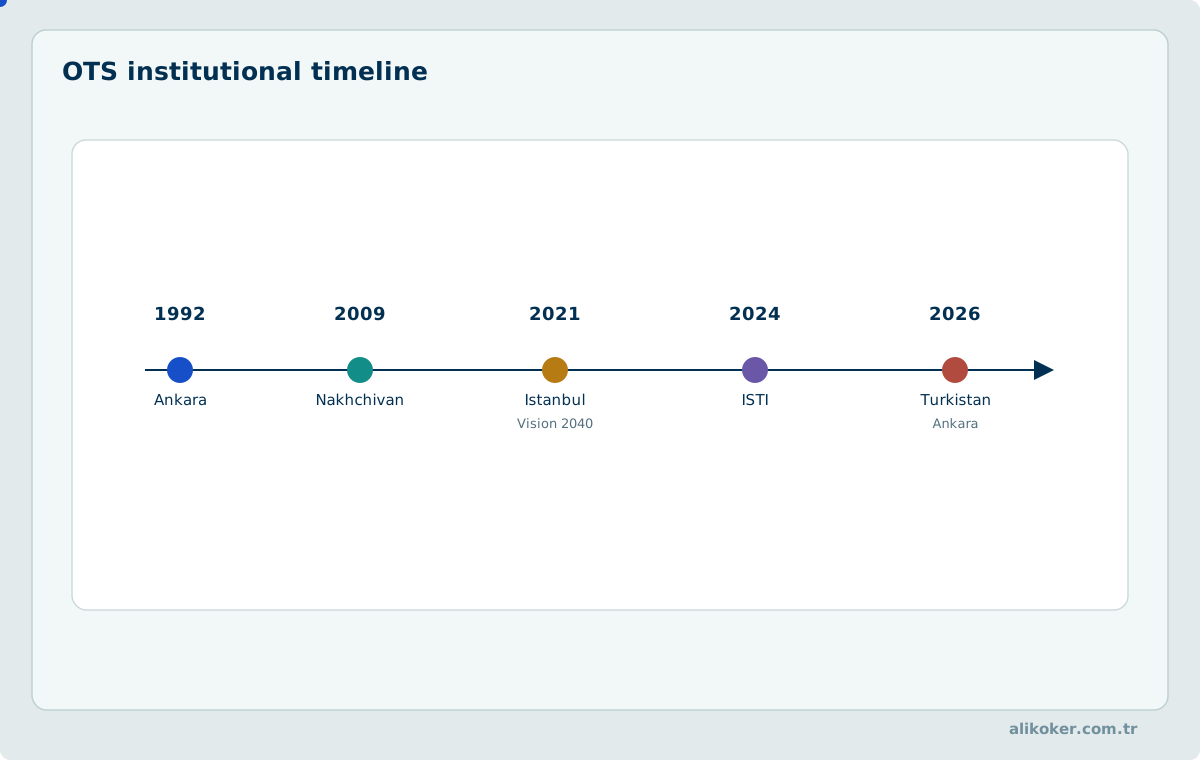
At the Istanbul Summit of 12 November 2021, the Turkic Council adopted the name Organization of Turkic States and approved the Turkic World Vision 2040. The Vision combines long-term institutional priorities concerning economic relations, transport connectivity, energy, education, science, technology, and digital transformation. Connecting sectoral objectives to strategies covering defined periods provides a framework through which public institutions in several countries can coordinate their work. [3, 5]
Following activities associated with the 2022–2026 period, the strategic framework for 2027–2031 was discussed during diplomatic contacts in 2026. In engineering cooperation, continuity involves more than concluding agreements: project scope, verification, financing, operational sustainability, and common technical standards shape the implementation of shared objectives. These criteria also characterize the engineering activities recorded by the Organization. [5, 14]
1.4. Institutional Positions of Members and Observers
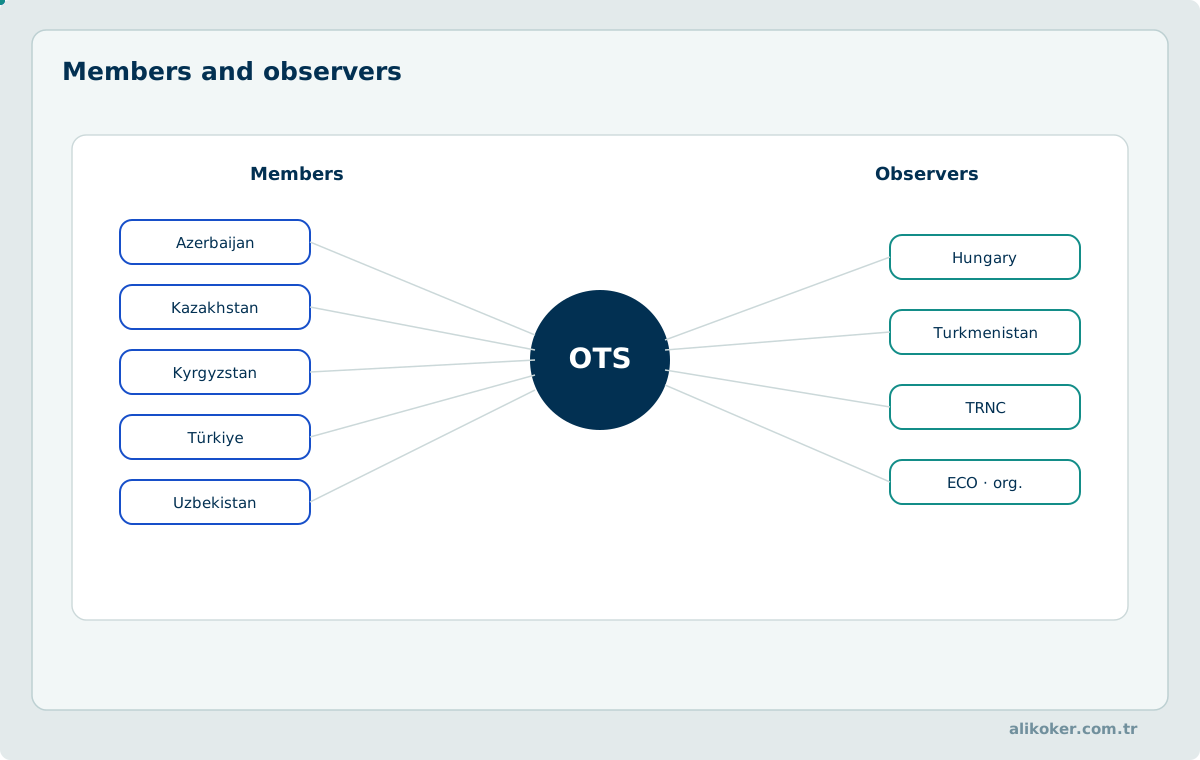
The five full members of the OTS are Azerbaijan, Kazakhstan, Kyrgyzstan, Türkiye, and Uzbekistan. Hungary, Turkmenistan, and the Turkish Republic of Northern Cyprus have observer status. Participation in sectoral meetings, the scope of a given decision, and membership in a particular bilateral agreement represent different institutional arrangements. Legal and financial responsibilities in individual projects are established through the agreements signed by the relevant participating institutions. [13]
The geographical scope of engineering cooperation encompasses states with different regulations, technical infrastructure, climatic conditions, standards bodies, and research institutions. These differences affect the definition of system interfaces, quality requirements, data exchange, and operational responsibilities in regional initiatives. The multilateral structure of the OTS provides a platform on which such issues can be addressed jointly while national organizations retain their respective institutional functions. [4, 13]
Unit 2. Engineering Cooperation in Industry, Science, Technology, and Innovation
2.1. The 2024 Istanbul Ministerial Meeting
The first meeting of the OTS Working Group on Industry, Science, Technology, and Innovation was held on 25 October 2024 in Istanbul, hosted by the Ministry of Industry and Technology of Türkiye. The first corresponding ministerial meeting followed on 26 October. The Istanbul Declaration and its Implementation Plan covered research and development, small and medium-sized enterprises, innovation ecosystems, digital and green industrial transformation, metrology, product safety, standardization, industrial property, and space technologies. [4, 15]
These documents organized engineering cooperation into specialized fields with defined institutional responsibilities. Comparability of product measurements, recognition of conformity assessment results, joint project development by research institutions, and connections among technology parks all concern the establishment of technical processes across national systems. The Istanbul meetings also addressed the creation of sub-working groups through which the participating institutions could coordinate the identified areas. [4, 15]
2.2. Metrology, Standardization, and Conformity Assessment
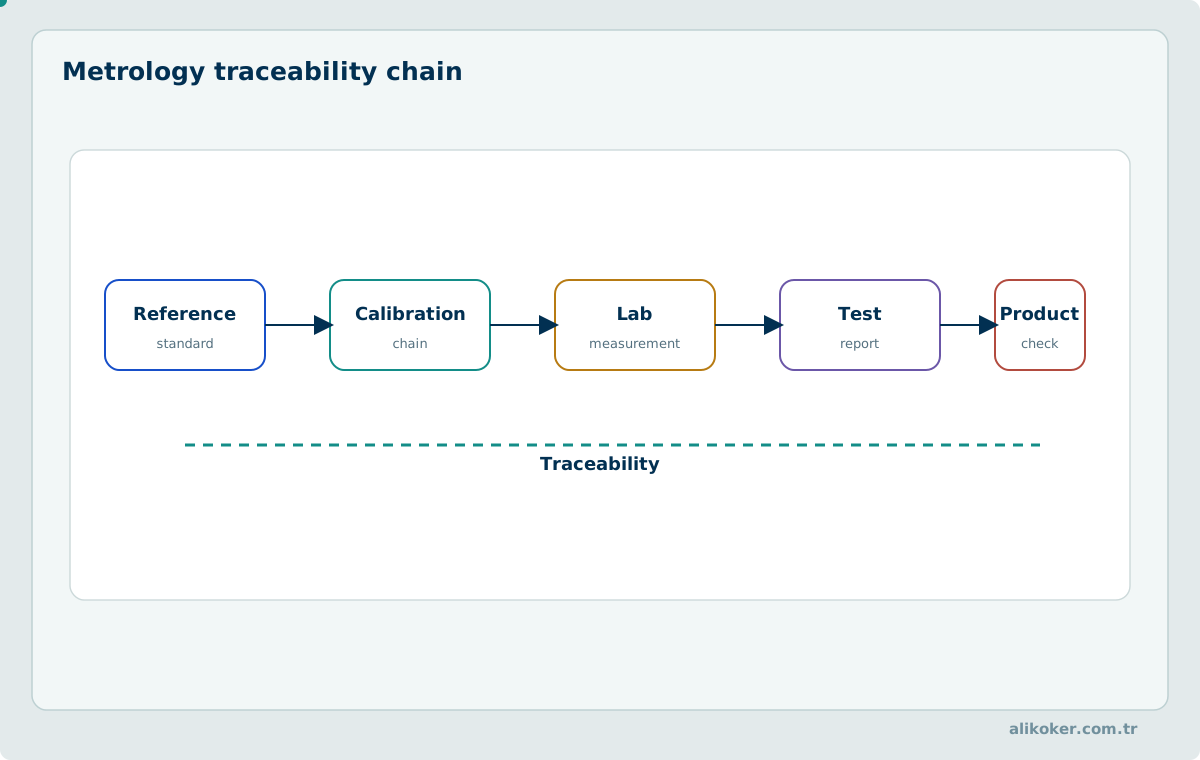
Metrology concerns the traceability and comparability of measurements. Mechanical dimensions, electrical quantities, material characterization, and environmental testing must rely on compatible measurement references if results produced in different countries are to be used in industrial supply chains and research. Standardization supports the definition of technical requirements for products and processes. Conformity assessment examines whether specific products or procedures satisfy defined standards and regulatory requirements. [4]
The 2024 Istanbul Declaration addressed these fields together. Their engineering implications include laboratory comparisons, calibration chains, the assessment of test reports, material and equipment safety, and the reduction of technical barriers between markets. These are the technical domains associated with the declared cooperation agenda. The resulting program encompasses measurement and quality infrastructure cooperation between the relevant national institutions. [4, 15]
2.3. Research, Technology Transfer, and Industrial Property
Research undertaken by several institutions requires prior agreement on intellectual contributions, ownership of data, publication of results, and rights to use the technology being developed. In networks involving universities, technology parks, and industrial organizations, prototype development, experimental validation, patent procedures, and commercialization represent related but distinct phases. The OTS innovation and industrial property agenda addresses institutional needs that arise across these phases. [4, 16]
Turkic Science and Innovation Day, held in Tashkent on 27 October 2026 within InnoWeek.Uz-2026, brought joint research, science diplomacy, academic mobility, technology transfer, intellectual property management, and entrepreneurship into a single program. Representatives of national scientific institutions, universities, and innovation organizations participated. The event documents the role of direct contacts among research and innovation institutions alongside intergovernmental decisions in the development of engineering cooperation. [16]
2.4. Institutional Coordination of Technical Projects
In multinational engineering projects, participating institutions align technical requirements while retaining research and development capabilities in their national organizations. Project management involves defining work packages, validating interim deliverables, managing changes, distributing technical risks, and ensuring that results remain usable under different regulatory regimes. OTS ministerial meetings and specialist working groups establish a channel through which the relevant organizations can discuss those matters. [4, 13]
Interoperability can be achieved through compatible interfaces between different national hardware and software environments. It requires compatible definitions of interfaces, data formats, security expectations, and responsibilities. The provision on common information and communication technology standards in the 2024 Bishkek Declaration explicitly connects that engineering requirement with the Organization's policy agenda, emphasizing compatibility and avoiding dependence on proprietary technical arrangements. [6]
Unit 3. Engineering Education and Research Infrastructure
3.1. Historical Development of Joint Universities
Khoja Akhmet Yassawi International Kazakh-Turkish University developed from Turkistan State University, established in 1991, through bilateral arrangements concluded by Türkiye and Kazakhstan in 1992. Kyrgyz-Turkish Manas University was founded under an agreement dated 30 September 1995 and began educational activities in the 1997–1998 academic year. Both joint universities therefore predate the Nakhchivan Agreement of 2009 and the permanent institutional structure of the OTS. [11, 12]
Their relevance to engineering extends beyond student exchange. Technical faculties, laboratories, joint academic programs, and researcher mobility make it possible for scientific knowledge and experimental practice to circulate between countries. The universities' own teaching and research activities and the later multilateral mechanisms developed under the OTS are historically separate levels of cooperation, but they address related functions in the development of academic and technical capacity. [8, 11, 12]
3.2. The Turkic Universities Union and the Orhun Exchange Program
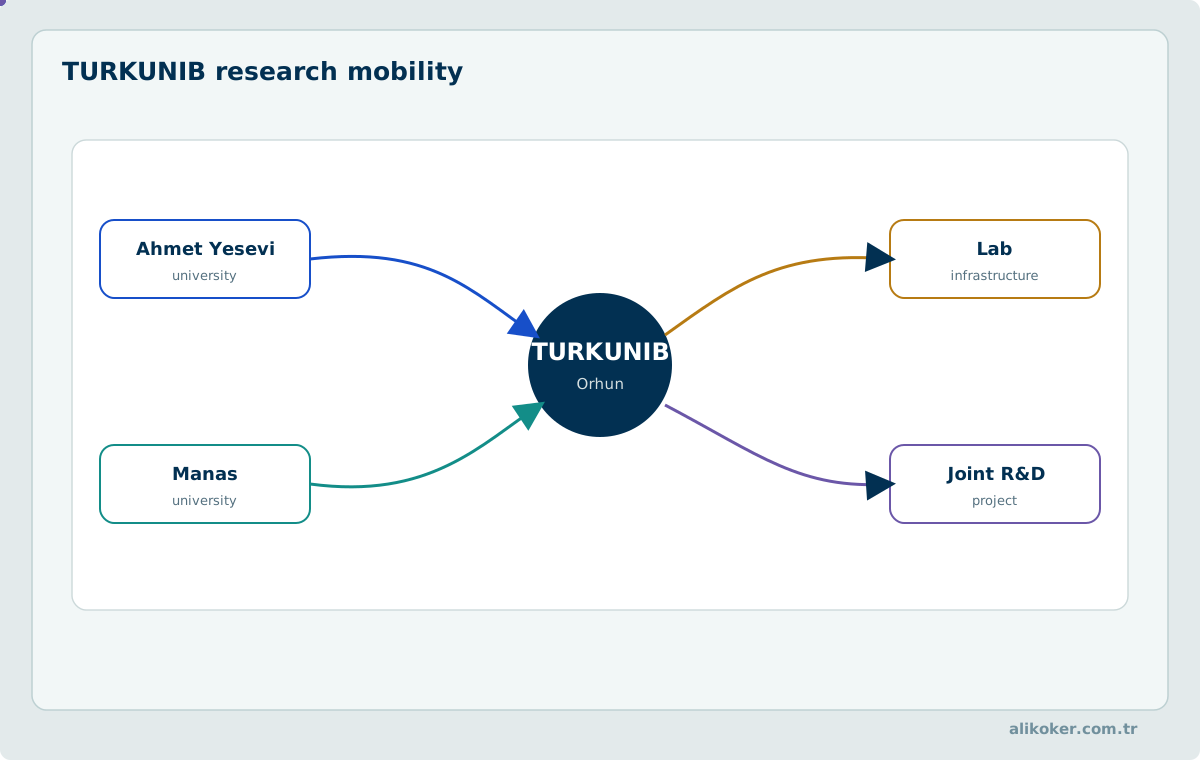
The Turkic Universities Union (TURKUNIB) was established in 2012 following decisions of education ministers and the Bishkek Summit. According to the OTS education cooperation record, the Union had 170 member universities as of 15 October 2025. The Orhun Exchange Program began with a pilot phase in the 2017–2018 academic year. The OTS reports 3,988 cumulative program mobility movements for the 2026–2027 academic year. The figure represents mobility records within the program. [8]
For engineering education, mobility may provide access to experimental facilities, research methods, laboratory safety practices, joint supervision, and scientific publication. The substantive effects of such programs also concern recognition of coursework, continuity of research partnerships, and access to technical infrastructure. The education ministers' meeting of 8 June 2026 therefore considered institutional financing and quality assurance alongside the further development of academic mobility. [8, 17]
3.3. Higher Education Data Bank and Quality Assurance
At the Turkistan meeting of 8 June 2026, ministers addressed a Turkic World Higher Education Area, a higher education data bank, cooperation among quality assurance bodies, and arrangements related to the recognition of academic qualifications. Institutional provisions for a permanent TURKUNIB secretariat and a dedicated Orhun Program fund were also discussed. Such initiatives concern the administrative and informational infrastructure of international academic cooperation. [9, 17]
The engineering requirements of a higher education data bank include matching institutional identities, using common vocabularies for study programs, maintaining data quality, controlling access, updating records, and supporting interoperability with national education information systems. OTS documentation identifies the data bank as an institutional initiative. A platform's database technology, deployment architecture, and operational characteristics constitute separate engineering specifications. [8, 17]
3.4. From University Research to Joint R&D Programs
When academic cooperation is connected with research funding, scientific findings can be developed into prototypes, validated results, and technology outputs. Bilateral calls administered by national research organizations provide concrete examples. On 20 May 2026, TÜBİTAK and the Azerbaijan Science Foundation announced decisions to support seven joint projects under their 2025 call. The program's thematic scope includes information and communication technologies, nanotechnology, sensors, energy, physics, petrochemistry, and biotechnology. [18, 19]
The joint TÜBİTAK–MHESI Uzbekistan call issued on 10 September 2026 covers the Internet of Things, robotics and mechatronics, cybersecurity, precision agriculture, artificial intelligence in healthcare, advanced materials, astronomy, and space observation. The participating national research institutions administer the bilateral call and its funding process across several engineering disciplines. [20]
Unit 4. Manufacturing, Energy, Transport, and Quality Infrastructure Engineering
4.1. Industrial Production and Supply Networks
The production dimension of engineering cooperation among Turkic states concerns the connection of materials, components, measurement systems, quality processes, and logistics infrastructure. Developing a product, ensuring the compatibility of components manufactured in different countries, and verifying compliance through reliable tests are essential tasks in international industrial collaboration. For this reason, the 2024 OTS industrial agenda considered organized industrial zones, technology parks, research and development, standardization, and digital transformation together. [4, 15]
In mechanical, electrical, electronic, and materials engineering, production cooperation involves agreed tolerances, quality management, automation, sensor-based measurements, and maintenance procedures. These are general engineering requirements used in designing cross-border supply networks. The OTS documents establish the institutional agenda for cooperation across these industrial engineering activities. [4]
4.2. The Trans-Caspian Middle Corridor and Transport Systems
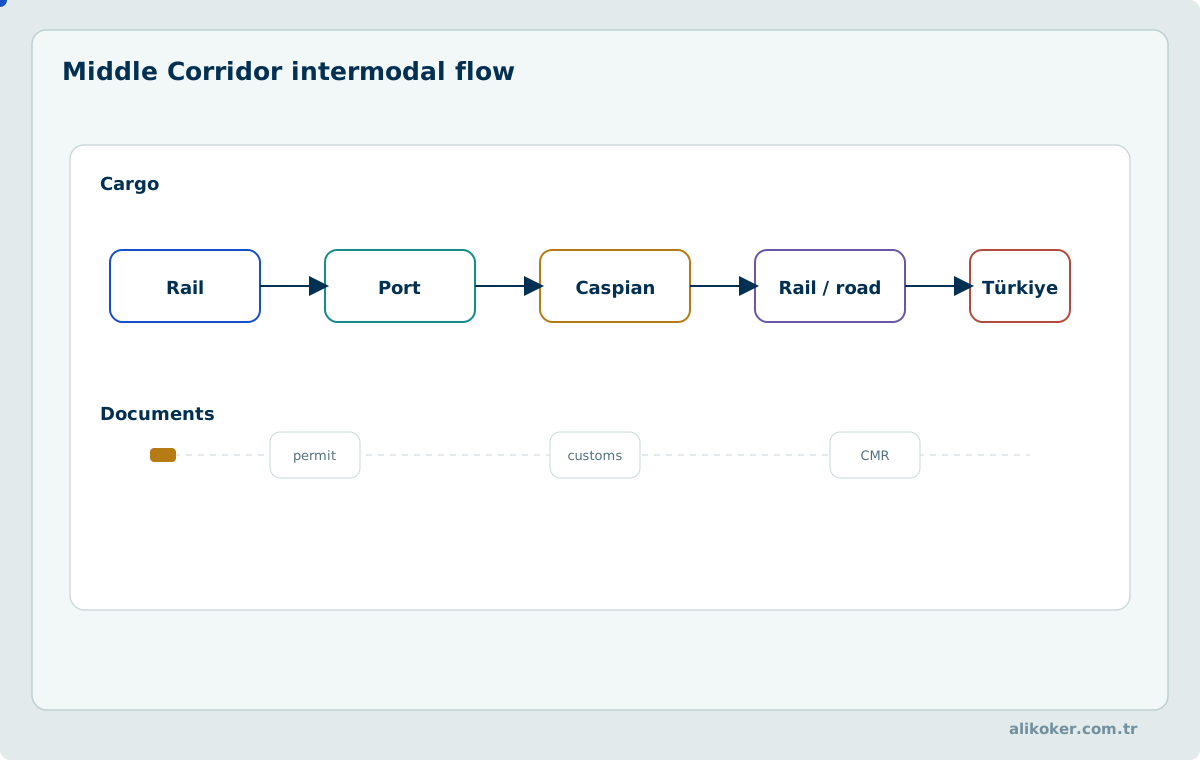
The Trans-Caspian East-West Middle Corridor comprises multimodal transport and logistics connections running from Central Asia through the Caspian Sea and the South Caucasus to Türkiye. Transfer points between railways, roads, ports, customs services, and logistics centers determine the operational integrity of the corridor. Moving freight across several modes requires document consistency, scheduling, route capacity, and coordination between the information systems of different operators. [21, 22]
The OTS transport agenda includes the corridor's infrastructure connections, transport permits, border-crossing facilitation, and electronic documents. An engineering analysis distinguishes physical transport capacity from administrative and digital processing delays. The former is shaped by rail, road, port, and vessel operations; the latter is influenced by permits, notifications, inspections, and document exchange. Considering these dimensions together is necessary to understand end-to-end corridor performance. [21]
4.3. Energy Infrastructure and Green Transformation
The Turkic states encompass oil and natural gas resources, electricity transmission connections, renewable energy potential, and strategic energy transport routes. Energy cooperation is addressed in the OTS sectoral agenda together with industry and transport. From an engineering perspective, cross-border energy connections involve planning generation and transmission capacity, aligning safety and quality standards, managing equipment service life, and maintaining operational continuity. [13, 23]
The inclusion of green industrial transformation in the 2024 Istanbul Declaration places energy efficiency and industrial technologies within a common technological agenda. The Organization's institutional assessments in 2026 also discuss renewable energy, green connectivity, and energy security. These subjects define areas of shared planning and technology development that can inform specific engineering projects. [4, 24]
4.4. Smart Agriculture, Water, and Disaster Infrastructure
Agriculture and water resources are relevant engineering research subjects because Turkic states operate under different climatic and production conditions. Precision agriculture may use geospatial data, sensors, automation, and decision-support methods to evaluate variability at the field level. The inclusion of precision agriculture, unmanned agricultural technologies, and drought-resistant production research in the 2026 Türkiye–Uzbekistan call documents their place in the bilateral research agenda. [20]
In natural disaster and emergency management, communications continuity, geospatial data integrity, early warning, and interoperability between institutions are equally important. The OTS maintains cooperation mechanisms among bodies responsible for disaster and emergency management. The Secretary General's 2026 assessments also address shared response capabilities and civil protection in the context of institutional cooperation. [13, 24]
Unit 5. Computer Engineering and Digital Public Systems
5.1. From Institutional Computing to Cross-Border Systems
Important themes in the history of Turkish public information systems include the development of institutional data processing, networked services, and electronic public transactions at the national level. Within OTS cooperation, the corresponding technical challenge is to enable reliable information exchange between existing systems belonging to different states. Interoperability can be provided by compatible definitions of data models, identities, authorization rules, and transactions while national databases retain their existing deployments. [2, 6, 22]
Integrating institutional systems requires agreement on data types, field definitions, code lists, timestamps, electronic signatures, and transaction states. Data integrity and repeated or duplicated operations must be handled when information passes between institutions. The OTS decision in the 2024 Bishkek Declaration concerning common information and communication technology standards directly addresses this engineering agenda at the intergovernmental level. [6]
5.2. The Digital Economy Partnership Agreement
The Digital Economy Partnership Agreement signed in the framework of the Bishkek Summit on 6 November 2024 represents an institutional step concerning electronic commerce and digital economic relations. OTS economic cooperation documents address electronic records, paperless trade, digital services, and cross-border transactions. Signature of an agreement and its entry into force in all participating countries are distinct stages governed by the relevant national approval procedures. [6, 25]
Engineering for the digital economy involves more than providing a web interface. It requires the authenticity of electronic documents, verification of transacting parties, auditable processing, and preservation of consistent transaction states across national systems. Technical interfaces for international trade must be designed alongside the laws, administrative processes, and operational responsibilities of the participating countries. [21, 22, 25]
5.3. e-Permit, e-TIR, and e-CMR
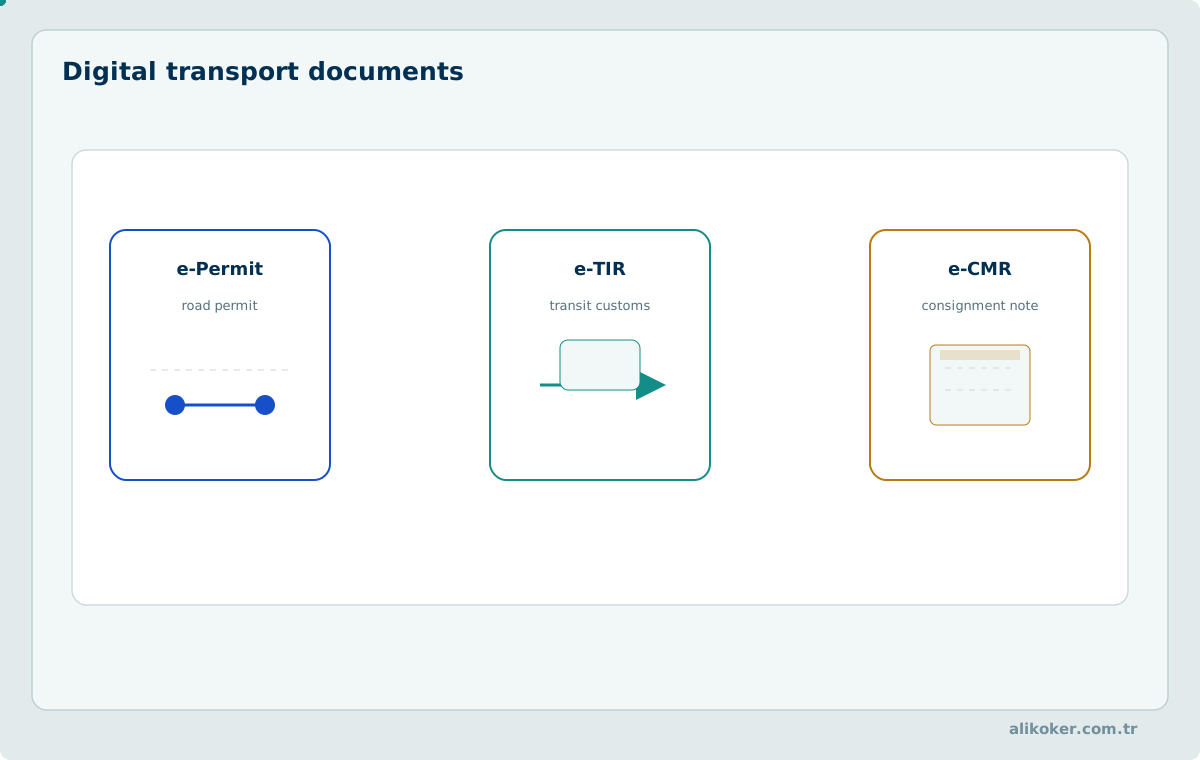
The OTS transport and customs cooperation agenda includes e-Permit, e-TIR, and e-CMR. e-Permit concerns electronic processes for international road transport permits. e-TIR supports customs information exchange associated with transit operations, while e-CMR concerns electronic consignment notes used in international road freight transport. All three initiatives contribute to transport digitalization, yet they address different processes and legally distinct classes of records. [21, 22]
The engineering requirements include exchanging permit and transport data in common formats, identifying transactions, tracing state changes, maintaining record consistency, and enforcing access controls. Sharing relevant transport data before border crossings supports designs intended to reduce administrative delays. The Organization's activity in this field brings together the physical connectivity of the Middle Corridor and the digital transactions needed for its operation. [21, 22]
5.4. Data Centers, Fiber-Optic Networks, and Service Continuity
Digital infrastructure, data centers, fiber-optic connections, and electronic public services feature in Secretary General Kubanychbek Omuraliev's 2026 assessments. Fiber-optic networks and data centers serve distinct functions: the former carry information over communications routes, while the latter support computation and storage. Interoperable public services may use both while remaining subject to national security, access, and data governance requirements. [24]
Availability, latency, data consistency, and recovery from failures are separate engineering properties of distributed information systems. Link diversity, redundancy, and controlled recovery processes are particularly important in critical services. These principles provide a technical basis for assessing network topologies, data-center designs, and service continuity in regional digitalization initiatives. [6, 24]
Unit 6. Cybersecurity and Critical Infrastructure Protection
6.1. Cybersecurity on the OTS Agenda
Cross-border digital services depend on cooperation among multiple institutions and communications networks. Cybersecurity is therefore directly connected with the OTS agenda on digital infrastructure and economic integration. Paragraph 54 of the Bishkek Declaration of 6 November 2024 welcomes the decision of Member States to establish a common protection and information-sharing platform against cyber incidents and attacks. Paragraph 55 of the same document calls for common information and communication technology standards that support interoperability. [6]
The digital development framework of the Turkistan Summit held on 15 May 2026 also addresses cybersecurity alongside innovation and digital transformation. Common protection activities emphasize institutional coordination and information exchange while national critical infrastructure responsibilities remain in place. The documents describe cooperation in terms of institutional coordination and information sharing among the relevant national organizations. [7, 24]
6.2. Cyber Threat Intelligence and MISP
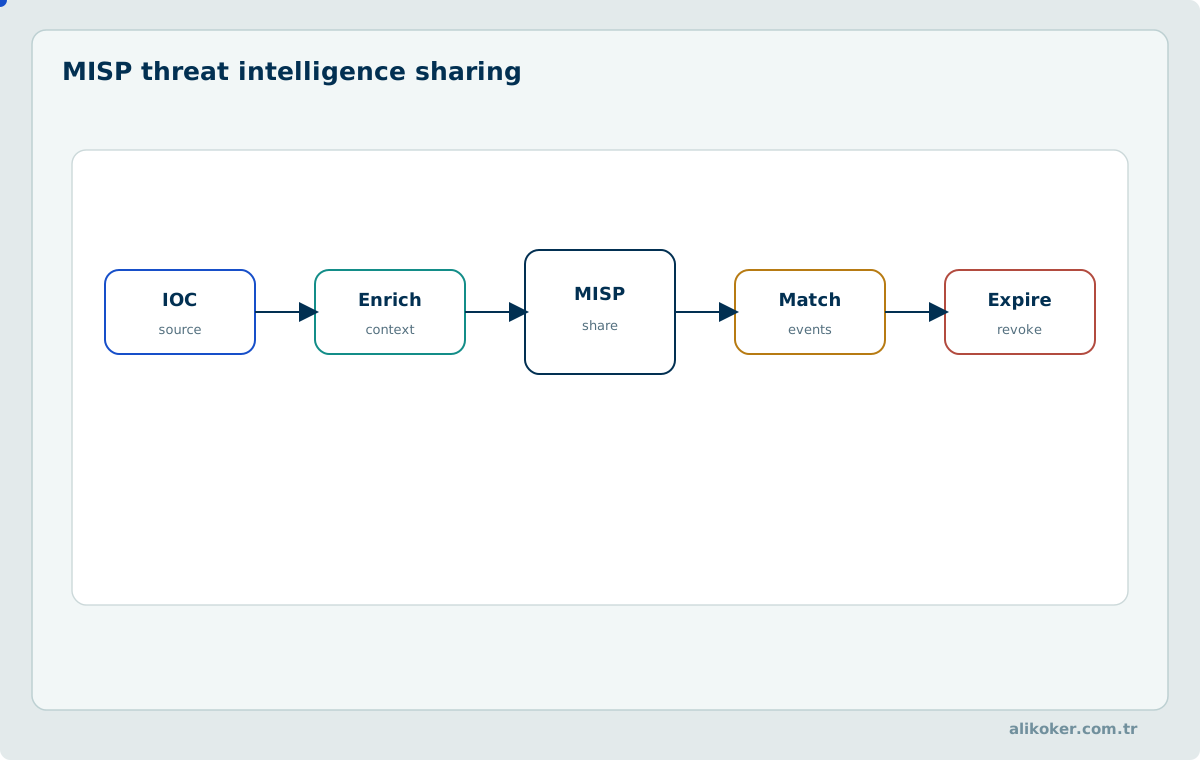
Paragraph 54 of the Bishkek Declaration explicitly names the Malware Information Sharing Platform (MISP) as an example of a common cyber information-sharing approach. MISP is associated with the structured exchange of threat indicators, information about malicious infrastructure, and contextual data concerning incidents. For such an exchange to be operationally useful, the origin of an indicator, time of observation, confidence, sharing permissions, and useful lifetime must be considered together. [6]
False-positive indicators may increase the operational workload of cybersecurity teams, while obsolete indicators can reduce detection quality. Common taxonomies, source verification, and incident correlation are therefore important in cooperation between national response capabilities. The 2024 declaration documents the decision to establish a platform. Operational deployment characteristics, event volumes, and service performance are technical metrics that can be assessed when implementation reports become available. [6]
6.3. National Response Capabilities and Critical Systems
Critical infrastructure protection concerns continuity of services in areas such as energy, transport, telecommunications, finance, and public administration. Cross-border information exchange can help different infrastructure operators assess a related attack indicator. Comparable timestamps, technical classifications, and suitable access levels are needed for records to be useful in this setting. The different responsibilities and jurisdictions of national incident response teams remain fundamental to organizing joint activities. [6, 24]
Network security, identity and access management, integrity of incident records, and supply-chain security are among the engineering disciplines involved. OTS cooperation offers a multilateral environment in which security institutions and specialist bodies can discuss these matters. The technical security requirements of individual critical systems remain connected with each country's legal framework, sectoral regulation, and operational arrangements. [6, 13]
6.4. Secure Interoperability
Shared digital projects incorporate security requirements into the initial system design. Data integrity, verification of institutional identities, restricted access privileges, and auditability must be considered as parts of the system design. Cross-border trade, student mobility, and transport records use similar basic security principles but operate under different authorization, retention, and confidentiality requirements. [6, 8, 21]
The call for common ICT standards in the Bishkek Declaration is relevant in this regard. Reducing dependence on a single proprietary technology, enabling systems from different suppliers to communicate, and managing technical changes are requirements for sustainable infrastructure. The OTS agenda on cybersecurity and interoperability therefore concerns both system architecture and the operational processes needed to maintain it. [6]
Unit 7. Artificial Intelligence, Turkic Languages, and Language Technologies
7.1. The 2024 Bishkek Artificial Intelligence Forum
The OTS agenda on artificial intelligence was explicitly documented through the Turkic States Artificial Intelligence Forum, held in Bishkek on 9–10 October 2024, and the Summit documents adopted on 6 November. Paragraph 56 of the Bishkek Declaration refers to the Forum and its declaration on artificial intelligence. Paragraph 59 records the memorandum of understanding concerning the development of a Turkic large language model, alongside a separate memorandum on space-related activities. [6]
The scientific development of an artificial intelligence system involves collecting data, training models, constructing evaluation datasets, examining error patterns, and comparing performance across languages and user populations. In institutional cooperation, each stage requires arrangements concerning data rights, computing resources, evaluation methods, and long-term maintenance. The OTS memorandum provides an institutional basis for initiating such multinational research activities. [6]
7.2. The 2026 Turkistan Summit: Artificial Intelligence and Digital Development
The OTS Informal Summit held in Turkistan, Kazakhstan, on 15 May 2026 was devoted to the theme of “Artificial Intelligence and Digital Development.” Its agenda included digital transformation, innovation, connectivity, artificial intelligence, and sustainable economic development. The Secretary General's post-summit remarks emphasized continued institutional cooperation concerning digitalization and emerging technologies. [7, 26]
This agenda connects artificial intelligence with public services, research, education, and economic infrastructure as an interdisciplinary field of technology. Developing a model and operating it as an institutional service involve different engineering processes. The first emphasizes data and model validation; the second introduces security, latency, computing cost, traceability, and continuity of service. OTS documents set out the strategic context within which these technical questions can be addressed by participating institutions. [7, 24]
7.3. The Turkic Large Language Model
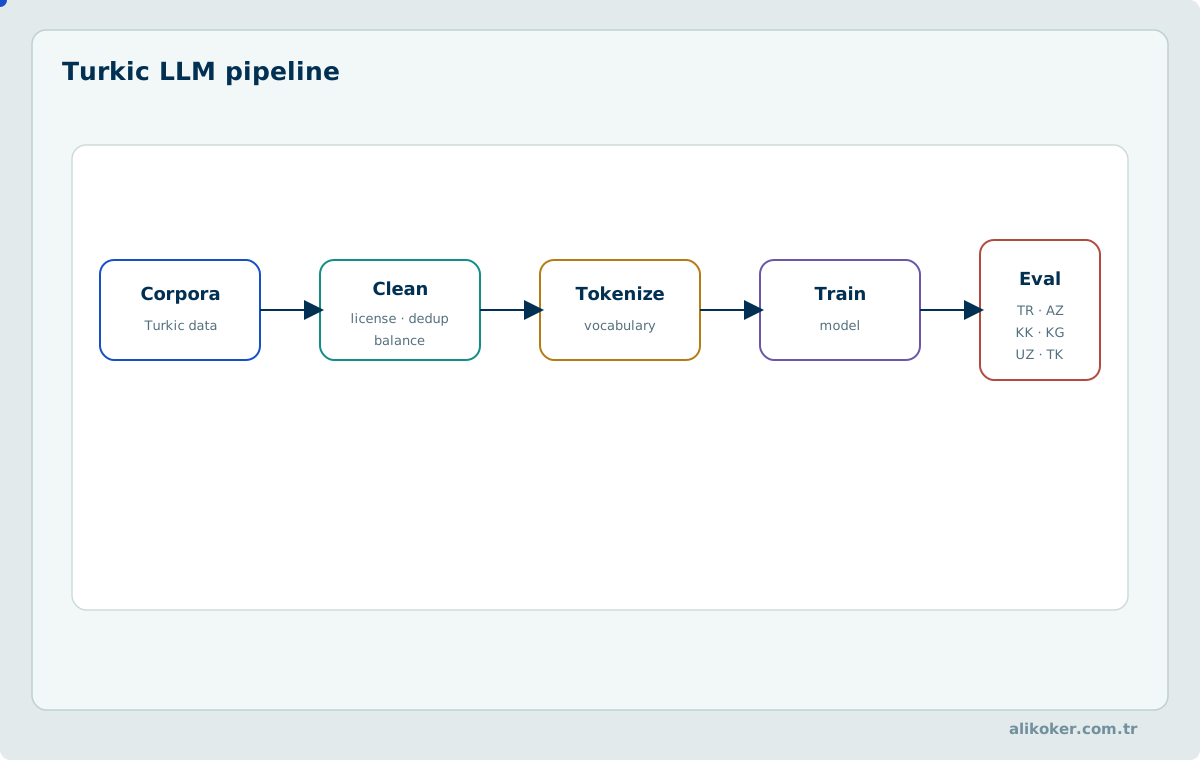
Turkic languages differ in writing systems, vocabulary, morphology, and the availability of digital linguistic resources. A joint language model therefore raises specific research requirements. Dataset preparation must consider licensing conditions, repeated documents, spelling variants, and differences in language use across countries. Uneven distribution of training material by language or subject area can produce significant disparities in model performance, particularly for languages with fewer digital resources. [6, 24]
Evaluating a large language model requires a range of measures extending beyond the fluency of generated text. Translation fidelity, preservation of meaning, terminology consistency, numerical reasoning, unsupported factual generation, harmful outputs, and performance across language varieties require distinct assessments. Shared benchmarks would enable participating research teams to compare methods and results. The Bishkek memorandum of 2024 records the development objective; OTS assessments in 2026 document the continuation of cooperation on digital technologies for Turkic languages. [6, 24]
7.4. Linguistics, a Common Alphabet, and the Turkology Tradition
Research on Turkic languages forms part of an intellectual tradition extending from Mahmud al-Kashgari's Diwan Lughat al-Turk to the First Turkology Congress in Baku in 1926 and contemporary university research. The year 2026 marks the centenary of that Congress. The Secretary General's 2026 assessment addresses work on a Common Turkic Alphabet together with the use of Turkic languages in modern digital technologies. [24, 27]
Compatibility between writing systems has direct implications for character normalization, search, indexing, language identification, and text conversion. Alphabet coordination and large language model training involve distinct technical methods. The former addresses the representation of written language; the latter concerns computational models trained on linguistic data. Historical and linguistic research conducted by the Turkic Academy and universities provides an institutional and scholarly context for both areas. [8, 24, 27]
7.5. Data Governance and the Engineering Life Cycle of Models
Shared artificial intelligence research requires explicit conditions for data exchange, protection of personal and institutional information, copyright permissions, and dataset version management. When text, speech, or terminology resources originating in different countries are assembled for a common model, provenance, licensing status, and language labels must remain consistent. Model training is followed by evaluation, error analysis, and comparisons between successive versions. These processes connect linguistic research with software and computing infrastructure. [6, 7]
The objective of a joint model for Turkic languages brings together linguistics, computer engineering, high-performance computing, and data governance. The involvement of language specialists, research institutions, and technology organizations follows from these interdisciplinary requirements. The official documents establish the memorandum and cooperation objectives. Releases of individual model versions and benchmark results are separate technical research outputs. [6, 24]
Unit 8. Space, Satellite, and Systems Engineering
8.1. Institutional Foundations of Joint Space Activities
Space technology is a field in which multiple engineering disciplines meet within a single technical system. Satellite development requires verifiable interfaces among mechanical structures, power electronics, communications, control, flight software, thermal design, and ground-station components. Cooperation among the space agencies of the OTS Member States was formally addressed in the 2024 Bishkek Declaration through calls for joint projects and a memorandum on space-related activities. [6]
The history of astronomy and measurement in the Turkic world forms a distinct part of the region's scientific heritage. Historical centers such as the observatory associated with Ulugh Beg in Samarkand developed methods of astronomical observation and mathematical calculation. Modern space systems, by contrast, depend on contemporary electronics, communications, materials science, computing, and industrial manufacturing. Historical astronomy and satellite engineering can be related within a broader history of observation and calculation without presenting them as technologically identical practices. [27, 28]
8.2. OTS-SAT and the 12U CubeSat Architecture
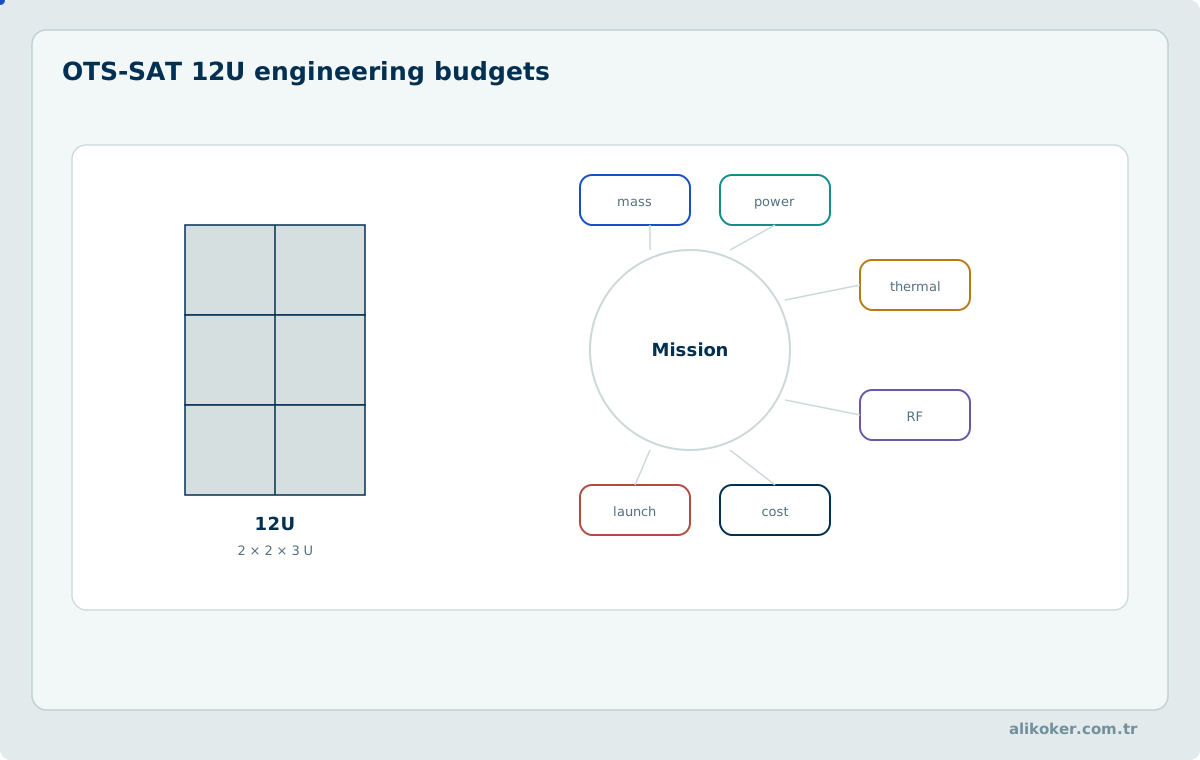
OTS-SAT is a joint 12U-class CubeSat project involving space-related organizations of OTS Member States. In CubeSat terminology, the unit 'U' identifies a standardized modular volume class for the spacecraft structure, while mission and subsystem characteristics are defined through additional technical requirements. This modular architecture requires engineering trade-offs involving payload, mass, electrical power, thermal limits, and launch interfaces. Official OTS records establish the project's scale and its technical coordination meetings. [29]
At the technical meeting held in Astana on 8 September 2026, representatives reviewed the development status, propulsion system, satellite integration, frequency coordination, authorization procedures, and launch costs. These subjects represent interdependent engineering work packages. Mechanical and electrical interfaces of the propulsion system interact with integration activities, while radio-frequency requirements are linked to communications engineering and authorization. The Astana record identifies remaining work and responsibilities among participating institutions. [29]
8.3. Integration, Verification, and Frequency Coordination
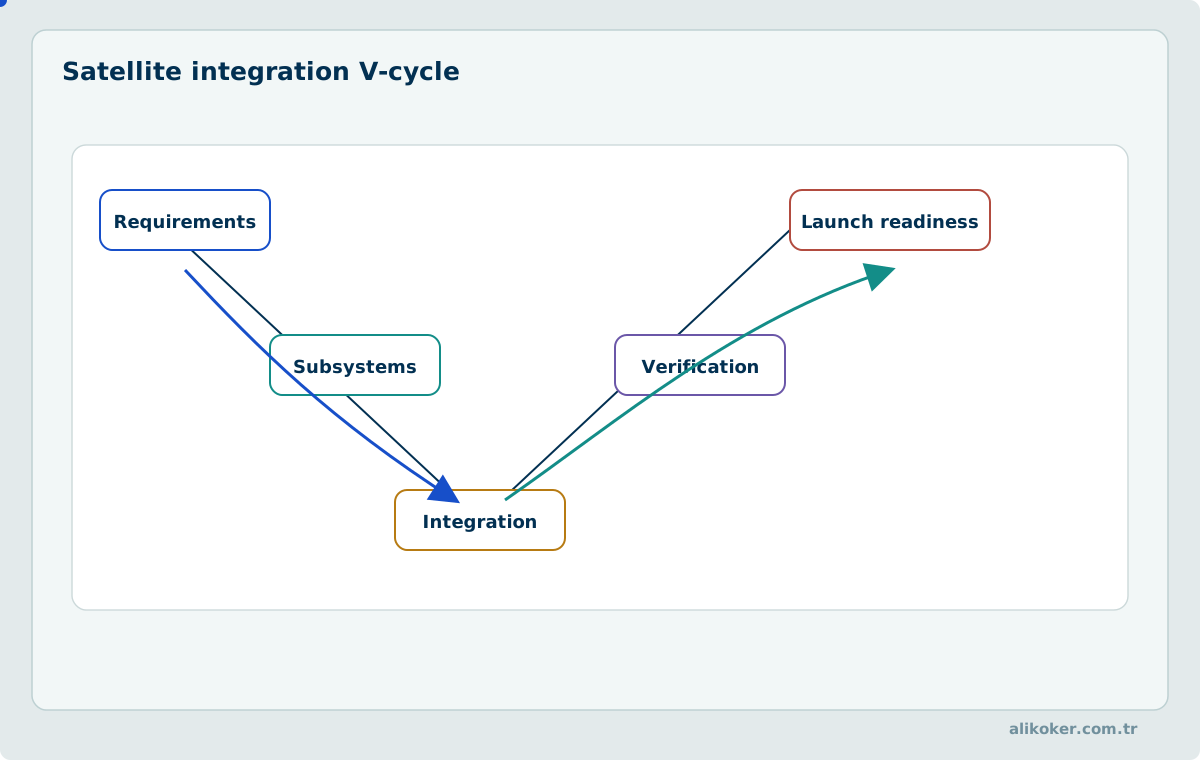
Subsystem verification in spacecraft development is followed by integrated testing against mission requirements. Electrical interfaces, structural connections, software versions, and communication protocols must be verified together. Pre-flight verification may involve vibration testing, thermal cycling, electromagnetic compatibility, and communications scenarios. These constitute general verification domains in spacecraft engineering. [29]
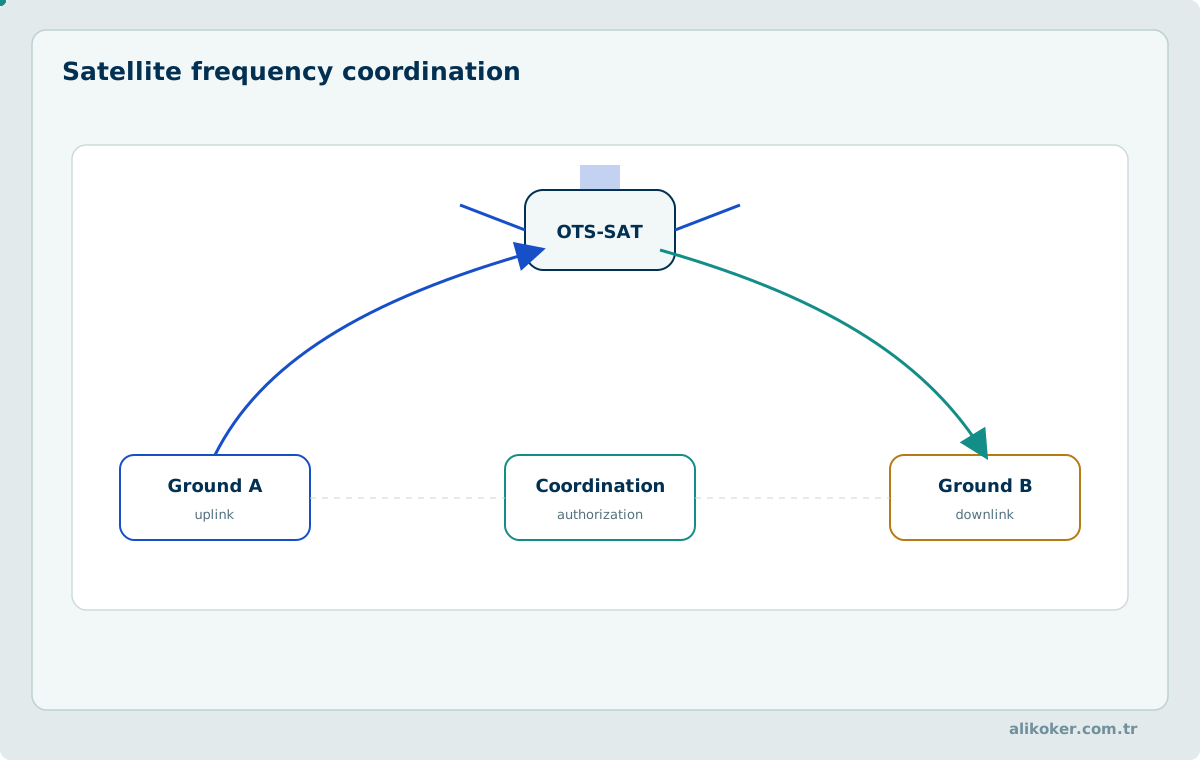
Frequency coordination concerns the compatibility of satellite-ground communications with national and international radio regulations. The separate treatment of frequency and authorization procedures at the Astana meeting demonstrates that the project extends beyond spacecraft hardware. Costs of launch services, the distribution of responsibilities, and the allocation of financial contributions also form contractual and operational dimensions of satellite systems engineering. [29]
8.4. The 2026 Space Industry Framework Contract
On 6 October 2026, relevant space organizations from Azerbaijan, Kazakhstan, Türkiye, and Uzbekistan signed an initial framework contract for the development of cooperation capacity in the space industry within the OTS. The agreement followed work on institutional arrangements discussed at the Astana meeting in September. Alongside technical work packages, defining how expertise, costs, and responsibilities are distributed is essential for the management of multinational satellite projects. [29, 30]
The Astana technical meeting of 8 September 2026 and the space industry framework contract of 6 October recorded the integration, frequency coordination, authorization, and institutional responsibilities of OTS-SAT. Together, these activities define the documented technical work packages of the joint satellite project. [29, 30]
Unit 9. The 2026 Ankara Summit and Its Engineering Agenda
9.1. The Ankara Meetings of 29–30 October 2026
The Ankara program of 29–30 October 2026, hosted by Türkiye, coincides with the 103rd anniversary of the proclamation of the Republic. 29 October 2026, Türkiye's Republic Day, is the scheduled date of the 13th Meeting of the OTS Council of Foreign Ministers. The official calendar lists the 13th Summit of Heads of State, hosted by President Recep Tayyip Erdoğan, on 30 October 2026. The Summit theme was designated as “Turkic Century: Unity in Language, Thought and Deed.” [31, 32]
According to the official announcement, the agenda encompasses political and institutional cooperation, trade and investment, transport, energy, digital transformation, cultural and humanitarian relations, and the Turkic World Vision 2040. Türkiye's assumption of the OTS chairmanship from Azerbaijan and the appointment process for a new Secretary General are also institutional subjects of the meeting. This agenda is directly connected with the strategic framework for engineering cooperation established through earlier sectoral meetings. [31]
9.2. Engineering Background of Secretary General Kubanychbek Omuraliev
Ambassador Kubanychbek Omuraliev, Secretary General of the Organization of Turkic States, studied mechanical engineering at an agricultural university in Bishkek between 1978 and 1984. His official OTS biography records employment as an engineer, chief engineer, and manager from 1984 to 1990, followed by professional work in economics and diplomacy. He was appointed Secretary General at the Samarkand Summit on 11 November 2022. [33]
His assessments preceding the Ankara Summit address industrial and technological cooperation, digital infrastructure, artificial intelligence, cybersecurity, the Turkic large language model, satellite development, technology parks, and academic mobility. The OTS notice concerning his Business Türk magazine article, published on 28 October 2026, and the extended TRT Haber interview of 27 October provide primary and supplementary records of this institutional agenda. [24, 34]
9.3. The 2027–2031 Strategy and Continuity of Technical Cooperation
The Turkic World Vision 2040 defines long-term priorities, while successive strategies address institutional work over shorter periods. The strategic framework for 2027–2031 was among the subjects discussed during the Secretary General's meeting with the Turkish Minister of Foreign Affairs in Ankara on 8 September 2026. The OTS announcement of 24 October also includes the Organization's priorities for its next institutional period. [14, 31]
In engineering cooperation, strategic continuity encompasses project initiation, documented requirements, verification results, assigned responsibilities, and the preservation of operational arrangements across participating institutions. The Istanbul industrial and technology plan, Bishkek decisions on digital technology, Turkistan discussions on artificial intelligence, and OTS-SAT activities identify concrete fields of technical work. Examining them within one institutional framework helps clarify the engineering dimension of multilateral coordination. [4, 6, 7, 29]
9.4. Official Summit Documents and Institutional Agenda
The OTS announcement of 24 October 2026 listed the adoption of the Ankara Declaration and additional decisions among the items on the Summit agenda. The Ankara program of 29–30 October links the engineering and technology initiatives addressed at earlier meetings with the Organization's strategic priorities. [31]
The OTS engineering agenda encompasses the 2024 Istanbul industry and technology plan, the Bishkek decisions on information technologies, the Turkistan meeting of 15 May 2026, higher education and innovation programs, and the satellite technical meetings of 2026. The official Ankara Summit agenda brings these institutional activities together for assessment. [4, 6, 7, 16, 29, 31]
Unit 10. Engineering Research and Country Programs among Turkic States
10.1. Türkiye and Azerbaijan: Joint Research Projects
Scientific cooperation between Türkiye and Azerbaijan includes bilateral programs administered by TÜBİTAK and the Azerbaijan Science Foundation. In an announcement dated 20 May 2026, the two institutions reported decisions to support seven joint projects under their 2025 call. The thematic areas of the call include artificial intelligence, the Internet of Things, big data, information security, nanotechnology, sensors, hydrogen energy, physics, petrochemistry, and biotechnology. [18, 19]
The research fields of the program overlap with the OTS industry and technology agenda of 2024. Decisions to fund seven projects were made through the bilateral mechanism of TÜBİTAK and the Azerbaijan Science Foundation. Together, these institutional levels support engineering research through multilateral OTS mechanisms and programs between national agencies. [4, 18]
10.2. Türkiye and Kazakhstan: Education, Space, and Research Infrastructure
Khoja Akhmet Yassawi International Kazakh-Turkish University is one of the historical institutions of scientific cooperation between Türkiye and Kazakhstan. Its joint higher education model predates the establishment of the OTS. Kazakhstan hosted the informal OTS Summit in Turkistan on 15 May 2026, bringing artificial intelligence and digital development into discussion at the level of heads of state in a city with longstanding academic and cultural significance. [7, 11]
The OTS-SAT meeting of 8 September 2026 was held in Astana within the context of Space Days Kazakhstan and assembled representatives of the Member States' space agencies. Kazakhstan's role in the shared engineering agenda is thus documented through both educational and research ties and the technical coordination of satellite development. Discussions concerning propulsion, integration, frequencies, and financing connect this cooperation with specific requirements of project and systems engineering. [29]
10.3. Türkiye and Kyrgyzstan: Joint University and Digital Technologies
Kyrgyz-Turkish Manas University represents an institutional model of academic cooperation grounded in the 1995 founding agreement and the commencement of teaching in 1997–1998. Developing shared teaching and research capacities at the university level provided experience relevant to the broader multilateral education field subsequently organized through TURKUNIB and the Orhun Exchange Program. The joint university's institutional status remains distinct from those later OTS mechanisms. [8, 12]
Bishkek, the capital of Kyrgyzstan, hosted the Turkic States Artificial Intelligence Forum on 9–10 October 2024 and the OTS Summit on 6 November. The Summit declaration recorded the decision concerning a common cyber information-sharing platform, common ICT standards, and the memorandum on the Turkic large language model. Kyrgyzstan's activities in 2024 accordingly occupy an identifiable place in the Organization's documentary history of digital technologies and artificial intelligence cooperation. [6]
10.4. Türkiye and Uzbekistan: Mechatronics, Digital Systems, and Innovation
The joint research call published on 10 September 2026 by TÜBİTAK and Uzbekistan's Ministry of Higher Education, Science and Innovations covers information and communication technologies, robotics and mechatronics, cybersecurity, precision agriculture, artificial intelligence in healthcare, intelligent decision support, advanced materials, and space observation. The call establishes a mechanism for applications to joint R&D projects; its thematic list must be distinguished from the results of completed or funded projects. [20]
Turkic Science and Innovation Day, held in Tashkent on 27 October 2026, brought research institutions, universities, technology transfer, and intellectual property management into a shared program. Uzbekistan was also among the participating states in the space industry framework contract signed on 6 October 2026. These developments document an engineering cooperation agenda involving academic institutions, technical research, and space technology. [16, 30]
10.5. Observer States and Other Research Partnerships
Hungary, Turkmenistan, and the Turkish Republic of Northern Cyprus are OTS observer states. Observer status supplies a framework for participation in relevant sectoral contacts and cooperation mechanisms. The responsible institutions' records determine the scope of individual research programs, agreements, and specific projects. [13]
Bilateral cooperation between Hungary and Türkiye through TÜBİTAK and Hungary's National Research, Development and Innovation Office (NRDIO) provides opportunities for projects concerning computing, digital twins, intelligent manufacturing, and advanced technologies. Technology education and events involving the Turkish Republic of Northern Cyprus and the regional cooperation activities of Turkmenistan represent other dimensions of scientific and engineering relations. The relevant national institutions administer these bilateral programs, while observer states participate through their respective sectoral mechanisms. [13, 35]
10.6. Status of Joint Initiatives in 2026
The OTS framework for cooperation in industry, science, technology, and innovation is set out in the 2024 Istanbul Declaration and Implementation Plan. These documents identify areas of cooperation among industrial organizations, research institutions, and specialized working groups. The 2024 Bishkek Declaration records a decision concerning shared cyber incident information, alongside a memorandum on the development of a large language model for Turkic languages. The model initiative also appears on the OTS digital technology agenda in 2026. [4, 6, 24]
In space engineering, the OTS-SAT 12U CubeSat project involves the participating countries' space organizations. The technical meeting in Astana on 8 September 2026 addressed development, propulsion, integration, frequency coordination, and authorization. The space industry framework contract signed on 6 October 2026 further defined the institutional scope of cooperation. In higher education, the Turkic Universities Union and the Orhun Exchange Program continue their activities, while proposals on a data bank, quality assurance, and financing arrangements were discussed at meetings in 2026. [8, 17, 29, 30]
The Digital Economy Partnership Agreement is among the multilateral instruments signed in 2024 and is associated with national approval processes. In bilateral research funding, TÜBİTAK and the Azerbaijan Science Foundation announced support decisions for seven joint projects on 20 May 2026. TÜBİTAK and the relevant Uzbek ministry published a new bilateral call covering engineering and technology on 10 September 2026. Those two funding mechanisms are administered by their respective national research institutions. Turkic Science and Innovation Day, held in Tashkent on 27 October 2026, brought the OTS and relevant institutions in Uzbekistan together around research, technology transfer, and academic cooperation. [16, 18, 20, 25]
10.7. Institutional Integration of Engineering Cooperation
OTS engineering activities extend across multiple technical disciplines and institutional programs. Contacts developing from 1992, institutionalization in 2009, adoption of a long-term vision in 2021, and the Istanbul industrial and technology plan of 2024 established a framework for shared research. Universities, research institutions, national technology agencies, and sectoral ministries act at different levels within that framework. The distinction between their responsibilities is essential to the study of multinational engineering systems. [3–5, 8]
In computing and digital systems, common data and document standards have become explicit subjects of cooperation. In cybersecurity, the documents address incident information sharing. In artificial intelligence, they identify work on language data and models for Turkic languages. In space engineering, they cover satellite development and integration. The 2026 Ankara Summit program brings these lines of institutional cooperation into a wider strategic agenda. Engineering in the Turkic world can thus be examined through a documented development extending from recurring diplomatic meetings to concrete technical work packages. [6, 7, 24, 29, 31]
References
- [1] Muhammet Ali Köker. (2026). History of Engineering in Türkiye. alikoker.com.tr.
- [2] Muhammet Ali Köker. (2026). History of Computing, Informatics and Public Information Systems in Türkiye. alikoker.com.tr.
- [3] Türk Devletleri Teşkilatı. (n.d.). Institutional Development of the Organization of Turkic States. Türk Devletleri Teşkilatı.
- [4] Türk Devletleri Teşkilatı. (2026). Cooperation on Industry, Science, Technology and Innovation. Türk Devletleri Teşkilatı.
- [5] Türk Devletleri Teşkilatı. (2021). Turkic World Vision 2040. Türk Devletleri Teşkilatı.
- [6] Türk Devletleri Teşkilatı. (2024). Bishkek Declaration of the Eleventh Summit. Türk Devletleri Teşkilatı.
- [7] Türk Devletleri Teşkilatı. (2026). 2026 Turkistan Informal Summit. Türk Devletleri Teşkilatı.
- [8] Türk Devletleri Teşkilatı. (n.d.). Education Cooperation. Türk Devletleri Teşkilatı.
- [9] Türk Devletleri Teşkilatı. (2026). Ninth Meeting of Ministers of Education. Türk Devletleri Teşkilatı.
- [10] TRT Haber. (2026). Engineering Agenda at the Ankara Summit. TRT.
- [11] Hoca Ahmet Yesevi Uluslararası Türk-Kazak Üniversitesi. (n.d.). University History. Ahmet Yesevi Üniversitesi.
- [12] Kırgızistan-Türkiye Manas Üniversitesi. (n.d.). University History. Kırgızistan-Türkiye Manas Üniversitesi.
- [13] Türk Devletleri Teşkilatı. (n.d.). Areas of Cooperation. Türk Devletleri Teşkilatı.
- [14] Türk Devletleri Teşkilatı. (2026). Secretary General and Turkish Foreign Minister. Türk Devletleri Teşkilatı.
- [15] Türk Devletleri Teşkilatı. (2024). First Ministerial Meeting on ISTI. Türk Devletleri Teşkilatı.
- [16] Türk Devletleri Teşkilatı. (2026). Turkic Science and Innovation Day in Tashkent. Türk Devletleri Teşkilatı.
- [17] Türk Devletleri Teşkilatı. (2026). Meeting with the Kazakh Science and Higher Education Minister. Türk Devletleri Teşkilatı.
- [18] TÜBİTAK. (2026). Azerbaijan Research Call Results. TÜBİTAK.
- [19] TÜBİTAK. (2025). Bilateral Research Areas with Azerbaijan. TÜBİTAK.
- [20] TÜBİTAK. (2026). Bilateral R&D Call with Uzbekistan. TÜBİTAK.
- [21] Türk Devletleri Teşkilatı. (n.d.). Transport Cooperation and Middle Corridor. Türk Devletleri Teşkilatı.
- [22] Türk Devletleri Teşkilatı. (n.d.). Customs Cooperation. Türk Devletleri Teşkilatı.
- [23] Türk Devletleri Teşkilatı. (n.d.). Energy Cooperation. Türk Devletleri Teşkilatı.
- [24] Türk Devletleri Teşkilatı; Kubanıçbek Ömüraliyev. (2026). Secretary General Article in Business Türk. Türk Devletleri Teşkilatı.
- [25] Türk Devletleri Teşkilatı. (n.d.). Economic Cooperation and DEPA. Türk Devletleri Teşkilatı.
- [26] Türk Devletleri Teşkilatı. (2026). Post-Summit Press Conference. Türk Devletleri Teşkilatı.
- [27] Türk Devletleri Teşkilatı. (2026). Centenary of the Baku Turkology Congress. Türk Devletleri Teşkilatı.
- [28] UNESCO. (2018). Evolution of Astronomy along the Silk Roads. UNESCO.
- [29] Türk Devletleri Teşkilatı. (2026). OTS-SAT Technical Meeting. Türk Devletleri Teşkilatı.
- [30] Türk Devletleri Teşkilatı. (2026). Space Industry Framework Contract. Türk Devletleri Teşkilatı.
- [31] Türk Devletleri Teşkilatı. (2026). Ankara Summit Announcement. Türk Devletleri Teşkilatı.
- [32] TRT Haber. (2026). Ankara CFM Programme. TRT.
- [33] Türk Devletleri Teşkilatı. (n.d.). Secretary General Biography. Türk Devletleri Teşkilatı.
- [34] TRT Haber. (2026). Interview with Secretary General. TRT.
- [35] TÜBİTAK. (2025). Hungary NRDIO Bilateral Project Results. TÜBİTAK.